MSC and OOCL emerge as the most ‘Scope 3’ efficient carriers report reveals low-carbon leaders on Asia–Northern Europe trade lane

OceanScore’s second edition of its monthly Scope 3 at Sea report shows that carrier choice can materially reduce Scope 3 emissions exposure, with MSC and OOCL offering shippers the strongest combination of scale, efficiency, and predictability. The report, published today, focuses on the Asia–Northern Europe trade lane for the period January–June 2025.
The report highlights striking differences in how major carriers balance scale, emissions efficiency, and operational consistency.
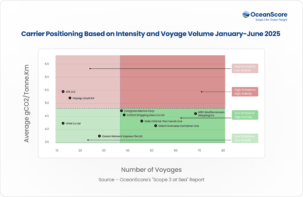
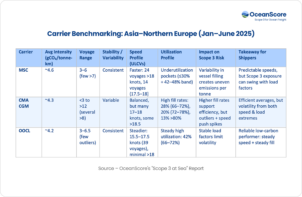
MSC and OOCL emerged as the most efficient carriers on the Asia–Northern Europe trade lane, thanks to their combination of below-average carbon intensity, steadier speed profiles, and consistent vessel utilization. Both carriers operate a significant share of voyages on this corridor (18% for MSC and 14% for OOCL) meaning their operational choices have an outsized impact on shippers’ Scope 3 exposure. Importantly, their voyages show fewer extreme outliers compared to peers, offering shippers greater predictability and lower risk of unexpected carbon spikes.
“On a long-haul corridor like Asia–Northern Europe, the difference between vessels can be huge,” said Thomas Smith, Head of Cargo Solutions at OceanScore. “A well-utilized, fuel-efficient ship can emit far less per container than one that sails faster or emptier, even on the same route. While shippers can’t control every operational decision, consistency is the trend that matters, and with voyage-level data, they can make smarter carrier choices that keep emissions and carbon costs down.”
Key Insights
The analysis goes beyond simple averages to benchmark carriers on three key operational factors driving Scope 3 outcomes:
- Carbon intensity (gCO₂/tonne-km)
- Speed profiles (ULCV sailing speeds)
- Utilization consistency (how steadily ships are filled)
This approach reveals not just which carriers emit less on average, but which offer predictable, lower-risk choices for shippers seeking to reduce carbon exposure and manage costs under tightening regulations.
“The carriers you choose on this corridor can make a big difference to your Scope 3 emissions. On long-haul voyages, there will always be some outliers caused by rerouting, congestion, or weather. What matters most is consistency: carriers that regularly make lower-carbon operational choices, through steadier speeds, stronger utilization, and fewer extremes, help keep Scope 3 exposure lower and more predictable over time.” Added Smith.
With shipping decarbonization regulations tightening, from the EU ETS to FuelEU Maritime, shippers and freight forwarders are under growing pressure to manage and report Scope 3 emissions accurately. OceanScore’s benchmarking provides a practical tool to identify which carriers deliver not just lower averages, but predictable, stable performance that reduces volatility in carbon costs.
OceanScore’s CargoFP solution combines real-time AIS tracking, AI-powered cargo estimation, and modeled emissions to deliver voyage-specific CO₂ calculations. With this intelligence, shippers and forwarders can benchmark carriers, steer volume toward consistent low-carbon services, and cut both emissions and carbon-related costs.



Related News.

ISLAND OIL: Unveiling of the Sculpture “Cyprus’s Journey Through the Ages” in Protaras – A Tribute and Landmark to Cyprus’s Historical Memory and Cultural Heritage
In a modest ceremony marked by a moving atmosphere, the sculpture “Cyprus’s Journey Through the Ages”, created by acclaimed Cypriot sculptor…

World Maritime Day 2026 from Policy to Practice – powering Maritime Excellence
Global regulations will deliver safer, more resilient shipping when they are implemented worldwide. The international maritime community marks…

Diana Shipping announces Time Charter Contract for m/v DSI Polaris with Dai An Ocean Shipping
Diana Shipping , a global shipping company specializing in the ownership and bareboat charter-in of dry bulk vessels, announced that, through a…

Chief Economists Expect Global Economy to Stabilize, but Fiscal Constraints, Rising Living Costs and AI Investment Uncertainty Threaten Growth
The global economy is stabilizing, but the fiscal support that cushioned successive shocks since 2020 is unlikely to play the same role in the year…

V. welcomes its new graduate cohort as programme expands across the group
Twelve graduates from nine nationalities join 11th year of V.’s expanded international management programme. V., the global ship manager and marine…

From Policy to Practice: Why Seafarers Are the Key to Maritime Excellence
The shipping industry is no stranger to regulation. Seafarers and ship operators work within a vast framework of international conventions, national…

Intermodal Report – Week 38 2026
Please find below the Intermodal market report for week 38 2026. Intermodal Report Week 38 2026 Market Insight By Nikos Tagoulis, Head of…

Allied – Weekly Market Review – Week 38
Please find below the Allied Weekly Report for Week 38 | 2026 ALLIED - Weekly Market Report- Week 38

Record year on the Northeast Passage but Arctic shipping remains very limited
In 2025, a record 103 transit voyages were made via the Northeast Passage. However, this is still equivalent to only around a day and a half of…

[xclusiv] S&P Report 21th September 2026
Please find below the [xclusiv] latest Weekly S&P Report [xclusiv] 2026_09_21 Market Commentary: VLCCs: Freight Boom Reprices the Fleet The VLCC…
Subscribe to our newsletter!
if you dont want to swim alone in the ocean of news, sign up for the newsletter, and you will receive daily all the important news of world shipping!
