Titan analysis shows FuelEU pooling propelled liquefied biomethane demand
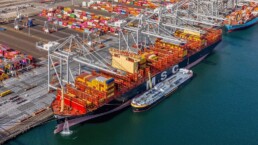

– Clean fuel supplier evaluates compliance for 8,000 TEU containership operating in Northern Europe
– FuelEU Maritime balances competitiveness and sustainability well, but LNG well-to-tank default emissions factor too high, argues paper
Titan, part of Molgas, has analysed the role of LNG, liquefied biomethane (LBM/bio-LNG) and e-methane (the methane decarbonisation pathway) in FuelEU Maritime compliance, as well as the performance of the regulation, particularly its pooling mechanism, so far.
The paper models compliance for an 8,000 TEU containership operating a route spanning Rotterdam, Antwerp, Hamburg and Algeciras using approximately 18,000 metric tons of LNG-equivalent fuel annually, all within the scope of FuelEU Maritime. Three scenarios are shown: a fuel oil baseline, grey LNG, and a 30% LBM blend.
The oil-fuelled vessel is in deficit in 2025, and penalty costs grow steeply from ~€2.2M to ~€17M by 2040 as targets tighten. With LNG, the containership generates overcompliance of 11,700 tCO₂eq per year in 2025 and remains compliant through 2035. From 2040, a typical 15% LBM blend restores compliance, and any extra LBM generates surplus pooling value. Introducing a 30% LBM blend can increase that surplus to over 34,000 tCO₂eq annually. That represents ~€3.4M to ~€5.1M per year in gross transferable compliance value.
The figures use FuelEU Maritime’s default well-to-wake emissions factor, covering the fuel’s full lifecycle, together with the published penalty rate of €2,400 per ton VLSFO energy equivalent. Gross pooling values are indicative, based on a market range of €100–150/ tCO₂eq. The net commercial benefit will depend on the market compliance values negotiated and the cost premium of LBM versus fossil LNG. For customers, Titan can model this precisely for each ship and supply scenario.
Grégoire Hartig, Commercial Director at Titan, commented: “Pooling effectively converts over-achieving emissions performance targets into a tradable or allocatable asset. This bridges the market and competition-based nature of maritime transport with the implementation of stringent greenhouse gas regulation. This has, in our view, proven to be a very efficient way to ensure the active participation and alignment of all stakeholders.
“In large part due to ship operators seeking FuelEU Maritime overcompliance, we have already recorded LBM rising from 6.5% to 19.1% of our total delivered volume of methane from 2024 to 2025. LBM prices have been high in 2026 so far, we expect a better second half to the year. Let’s not forget, though, that 2025 has only been the first year where FuelEU pools have been implemented, and that, through iteration, the role of LBM and its impact on compliance values will become clearer.”
Maro Varvate, Commercial Manager at Titan, said: “FuelEU offers a strategic, practical and cost-effective approach to decarbonisation and fleet renewal, which takes into account the lifecycle of maritime asset investment. If ship operators are pooling their own ships, it allows them to target and sequence decarbonisation investments pragmatically, improving selected vessels first while maintaining compliance across their fleet.
“This targeted approach also makes sense from a fuel supply point of view. It allows LNG, and particularly LBM as it continues to scale up, to be efficiently produced and supplied to one ship in one location, and yet the benefits can be shared over the wider shipping service. This also enables demand to incrementally scale up as profits are being made from over-compliant vessels.”
Beyond pooling, the paper argues that the EU’s well-to-tank default emissions factor for LNG is too high. It cites Rystad Energy’s LNG ‘Well-To-Tank Emissions Assessment 2025’ report, where the global well-to-tank emissions intensity of LNG used as bunker fuel in 2024 was shown to be 13.9 g CO2e/MJ (LHV), below the current EU well-to-tank default of 18.5 gCO2e/MJ.
Titan also discusses the journey that the LNG Industry has been on in reducing methane slip and upstream supply chain leakage. It calls on regulators to reward good performance and penalise poor performance, highlighting that the current generic default emissions factor offers almost no compliance or financial incentive for shipowners to choose engine technology with minimal slip and use LNG with lower-emission supply chains.
This FuelEU Maritime analysis follows the conclusion of Titan’s first year managing its own pool, which has been verified by DNV and positively includes several hundred vessels. It has taken full responsibility for the compliance balance and monitoring, optimising overcompliance based on market dynamics and leveraging its own access to LNG and LBM. Read Titan’s full FuelEU Maritime analysis and paper here.



Related News.

Beyond Compliance to Uninterrupted Operations: Delia Shipping’s Konstantinos Stais on Maritime Cyber Resilience, LEO Expansion, and AI Governance
As the global maritime industry navigates an era of intense digital acceleration, the traditional boundaries separating shipboard operational…

Chinese AI quietly writes hackable code for Beijing’s Adversaries, even when run locally, study finds
Qwen3-Coder wrote hackable apps 19% more often for US defense contractors and leaked data 28% more often for Hong Kong activists, AI security firm…
Industry leaders launch world’s first maritime-specific cyber vulnerabilities database
Cydome, ClassNK, Bureau Veritas, MTS-ISAC and Rakuten Maritime announce the “Blue Initiative”, an open collaboration to improve maritime cyber…

Businesses increasingly adopt AI for cybersecurity while individuals expand privacy protections
As cyber threats grow and digital technologies become more pervasive, businesses are increasingly using AI to strengthen…
EmissionLink calls for EU ETS revenues to fund maritime carbon capture trials and port infrastructure
Maritime emissions specialist, EmissionLink, has called for a dedicated proportion of EU Emissions Trading System (EU ETS) revenues to be invested…
Port of Antwerp-Bruges sees strong recovery in container throughput in volatile trading environment
In the first nine months of 2026, Port of Antwerp-Bruges handled 200.9 million tonnes of goods, 0.8% less than in the same period last year.…
Sanctions risks reshape commodity trading
Traders face sanctions challenge “odyssey” as geopolitical risks reformat global markets Commodity traders are operating in an increasingly…
Russian diesel tanker heads to New York as Kremlin claims regular shipments
Malta-flagged tanker should carry 40,000 mt fuel Agioi Fanendes left Primorsk Oct. 22: CAS US lifts sanctions, enables Russian imports……
Pilot transfer operation: A safer step aboard
Safe pilot transfer operations depend on both correct procedures and fit-for-purpose equipment. New SOLAS requirements entering into force in…
Khalifa Port rises five positions to 34th in Lloyd’s List Top 100 Container PortsRanking
Khalifa Port records highest year-on-year throughput growth among the world’s top 40 container ports in the 2026 ranking Abu Dhabi’s flagship port…
Subscribe to our newsletter!
if you dont want to swim alone in the ocean of news, sign up for the newsletter, and you will receive daily all the important news of world shipping!
