APM Terminals Malaysian JV on course to lead maritime decarbonisation in Asia
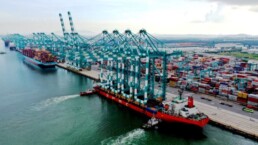

The Malaysian Port of Tanjung Pelepas , a joint venture between APM Terminals and the MMC Group, has been selected to join the Partnerships for Infrastructure initiative. This is a government-to-government decarbonisation scheme between Malaysia and Australia that supports PTPs ambition to become a green bunkering hub for alternative fuels.
The P4I project aims to spearhead Malaysia’s decarbonising effort in the maritime industry and to foster inclusive growth through sustainable infrastructure in Southeast Asia.
Malaysia has the potential to develop into a regional green fuel bunkering hub with the support of both industry and government, according to a study by the Australian Government’s Partnership for Infrastructure (P4I). The study also found that methanol is the green fuel option receiving the most investment from shipping lines.
Green refuelling sites
The study was undertaken in response to a request from Malaysia’s Transport Ministry (MoT) to better understand zero-carbon bunkering and explore the potential for green refuelling sites in Malaysia.
“We hope that the successful implementation of this initiative will become a game changer in transforming the regional maritime industry and further promote opportunities for Malaysia to lead in this area of maritime decarbonisation,” said PTP Chief Executive Officer, Marco Neelsen.
“Given the size and strategic location of PTP, it has the potential to play a key role regionally and globally in supporting maritime and trade decarbonisation,” commented Executive General Manager Commercial at Port of Melbourne, Shaun Mooney.
Lofty ambitions
Shipping accounts for nearly 3 per cent of global emissions, with International Maritime Organization setting a goal to halve annual emissions by 2050 and establish green shipping corridors for vessels using zero-emission fuel.
In support of this, for APM Terminals fully controlled Ports and Container Terminals the company has made an industry leading commitment to reduce its total emissions by 70% by 2030 compared to 2020 and be fully net zero by 2040.
PTP’s own decarbonisation goals are to reduce 45% of its emissions by 2030, having already shaved 30% off its carbon emissions by 2021 compared with its 2011 baseline.
Over the next five years, says Neelsen, PTP will be spending RM3 billion to step up efforts to upgrade its current terminal footprint, including automation, digitalisation and other port functions.
Electrification – reduced emissions – increased efficiency
PTP has electrified and digitalised many of its assets, resulting in emissions reductions, increased efficiency and less waste, according to the company. For instance, it will electrify all its rubber tyred gantry (RTG) cranes — mobile cranes that stack and transport containers — and yard by the end of this year. The port is also testing electric prime movers, which are the trucks that move containers, and electric or hybrid fuel tugs and pilot boats.
PTP’s digital transformation also involves tracking its assets and using digital twins. Functioning as computer-based models, digital twins offer real-time visualisations of the port’s operations, infrastructure and assets to, for example, calculate optimal routes for its trucks and boats to save on fuel.
“Digitalisation, operational efficiency and sustainability are all moving as one transformation activity. It’s something that we can see having a positive impact. Rather than working on your own, we do the transformation together,” says Khairul Amalin Abd Rahman, Senior General Manager at PTP.
Technology push
One of the technologies used at PTP is the vessel traffic management system. The VTMS is connected to the Marine Resource Management System (MRMS) and Vessel Traffic Monitoring and Information System (VTMIS) — both of which are used to step up measures to become a “green” port. It improves the efficiency of vessel traffic movements and the safety of navigation.
The MRMS is able to integrate the entire process, from booking a berth to populating shipping registers, ordering pilots and providing vessel arrivals and departures. In 2022, PTP handled 10,608 vessel calls.
All this costs money. But Neelsen believes it makes business sense. Rising fuel prices and carbon taxes will be costly to those who do not transition. “There will be an extra cost in the future, so we need to start incorporating it,” he says.
“Our customers, which are the shipping lines, forwarders, warehouses and their customers, have different demands than they had 10 years ago. Therefore, this is part of our transformation journey. It has been requested by customers, whose children are asking questions [about how sustainable their products are]. The logistics [industry] has to adapt to it,” concludes Marco Neelsen, CEO of PTP.



Related News.

Beyond Technical Skills: WISTA Cyprus explores the human side of leadership
WISTA Cyprus hosted The Art of Leadership & Emotional Mastery, an interactive workshop held on 15 October at the Alasia Hotel in Limassol,…
The human cost of sending merchant mariners into war zones extends far beyond the immediate danger of missiles and drones. It raises a harder question: who is really protecting the seafarer?
Who protects the seafarer? I have spent much of my professional life at sea. I am a Master Mariner. I have stood on the bridge, made decisions…
Loss of bridge control: Human failure is normal – context is key
When bridge control is lost in a functioning system, it can be easy to blame human error. But accidents rarely happen because of one mistake…

Danish Shipping announces the transport of live animals by sea new rules should improve safety for animals, seafarers and the environment
Revised rules on the transport of live animals by sea are being negotiated in the EU. Danish Shipping wants to ensure good animal welfare,…

Japan’s flawed shipping proposal leaves developing countries adrift
A new analysis by Opportunity Green warns governments of the wide-ranging risks posed by Japan’s proposal at the International Maritime Organization…

Intermodal Report Week 42 2026
Pls find below the Intermodal Report - Week 42 2026 Intermodal Report Week 42 2026

Allied Weekly Market Review Week 42
Pls find below the Allied - Weekly Market Review - Week 42 ALLIED - Weekly Market Report- Week 42
EU Arctic Strategy NGOs welcome EU ambition on on cutting shipping’s Arctic Black Carbon Emissions
Responding to today’s publication of the EU’s Arctic Strategy, which definitively states the EU’s intention to support International Maritime…
The final quarter of 2026 is expected to see softer bauxite flows
Chinese front-loading is expected to have run its course, pointing to softer bauxite flows in 2026 Q4. Global bauxite flows increased by 2.8% y/y…
DP World Foundation and Belewan new container terminal mark groundbreaking of AED 3.7 million school project in Indonesia
Classrooms of Hope initiative expands to Belawan, Medan with a new junior high school designed to provide modern learning facilities and greater…
Subscribe to our newsletter!
if you dont want to swim alone in the ocean of news, sign up for the newsletter, and you will receive daily all the important news of world shipping!
