EU Arctic Strategy NGOs welcome EU ambition on on cutting shipping’s Arctic Black Carbon Emissions

Responding to today’s publication of the EU’s Arctic Strategy, which definitively states the EU’s intention to support International Maritime Organization (IMO) regulations that would regulate the impacts of black carbon emissions from ships on the Arctic, Dr Sian Prior, Lead Advisorto the Clean Arctic Alliance said:
“With a proposal for mandatory regulation for ‘polar fuels’ – currently on the table at the IMO – the EU ambition to cut black carbon from Arctic shipping comes at the perfect moment. The polar fuels proposal led by Denmark – supported by Greenland, and co-sponsored by Germany, France and the Solomon Islands, if accepted, would ensure that ships will be restricted to using cleaner fuels while sailing in Arctic waters. The EU’s call for a broad definition of Wider Arctic Waters – above 60o latitude north, encompassing the Arctic circle is not only welcome, it demonstrates a clear understanding that black carbon emissions from shipping close to Arctic waters travel further north and have a detrimental impact on land-ice and sea-ice in the region by driving further ice melt and climate warming.”
“Other Arctic, and near-Arctic countries must now follow the EU’s lead by backing the proposal, which is due to be considered during the IMO’s Pollution Prevention and Response Committee in January 2027 (PPR14)”, added Prior.
The text of the EU Arctic Strategy reads: “The EU champions renewable and low-carbon fuels for ships calling at EU ports, driven by the FuelEU maritime regulation and the EU Emissions Trading System. At the international level, the EU will contribute actively to negotiations at the International Maritime Organisation to facilitate the transition of Black Carbon measures from voluntary guidelines to binding regulations. The EU will advocate for the definition of wider Arctic waters (above 60°N) to ensure regulations cover the actual footprint of Arctic shipping.”
- European Commission press release: EU sets out a new Strategy for the Arctic
- Download the Joint Communication on Europe’s Northern Neighbourhood: A New Strategy for the Arctic
- EU Arctic Strategy website
“Canada should align with the clear signal sent by the EU decision to prioritise cutting of black carbon emissions from shipping”, said Andrew Dumbrille, Special Advisor to the Clean Arctic Alliance and co-director of Equal Routes. “Canada has already shown leadership by joining the COP30 black carbon pledge, and by bringing its Arctic emission control area into force. Canada’s next step should be to match the EU’s ambition by backing a mandatory polar fuel measure at the IMO that covers the full Arctic.”
“Black carbon from shipping is accelerating the melt of sea ice in the Arctic region, which is warming four times faster than the rest of the planet”, added Dumbrille, “Reducing black carbon emissions protects local community food systems, the integrity of Canada’s Arctic waters, and the ability to steward them. Acting alongside the EU is also a matter of sovereignty, it means Canada is setting the standards for Arctic shipping rather than leaving their definition to others. Arctic states, led by Canada, should work with the EU to close this regulatory gap.”
“With Iceland, along with Norway, already cooperating with the EU on climate policy, Iceland must support and align itself with the EU on cutting black carbon emissions from shipping in the Arctic”, said Arni Finnsson, Board Chair at theIceland Nature Conservation Association. “As Iceland’s Parliament adopted an Arctic policy in 2022; a policy which acknowledged the dangers posed by black carbon. Iceland should support the polar fuels proposal at the International Maritime Organization.”
“By leading the polar fuel proposal at the IMO, Greenland and Denmark have clearly demonstrated global climate leadership”, said Dr Kåre Press-Kristensen, senior advisor on air quality & climate at Green Global Future. This leadership is now reflected in the EU Arctic Strategy which thereby significantly increases the pressure for the IMO to reduce black carbon emissions from Arctic shipping. Hopefully, the EU Arctic Strategy will, as well, generate full support for the polar fuel proposal from other Arctic states like Iceland, Canada and Norway.”
“Bellona welcomes the EU Arctic Strategy’s clear position on reducing harmful black carbon emissions from shipping in the Arctic”, said Sigurd Enge, Senior Advisor, Shipping and Arctic issues at Bellona. “This should be a requirement for ships who arrive from arctic waters and a clear message to the Russian government and their ambition for shipping on the Northern Sea Route. The EU Arctic strategy’s weakened signal to not purchase Norway’s oil & gas from the arctic is on the contrary not helpful in reducing the environmental impact of the vulnerable eco systems.”
“WWF welcomes the clear commitment in the new EU Arctic Strategy to tackle black carbon emissions from ships in the region which has been affected by them the most”, said Karoline Andaur, CEO of WWF-Norway. “We call on Arctic governments, including the government of Norway, to support the adoption of mandatory regulations over black carbon emissions during the forthcoming meeting of the International Maritime Organization in January 2027. This will be consistent with the general commitment of Norway and its European neighbours and allies to reduce the impact from shipping on climate, ecosystems and human health.”
Polar Fuels
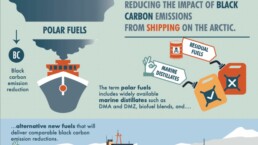
A polar fuel regulation as currently proposed by Denmark, Germany, France and the Solomon Islands would fill an important gap in the IMO’s current regulatory framework, by directly targeting black carbon emissions from ships. This polar fuel measure would require the use of cleaner distillate fuels such as marine gas oil (MGO) and new zero carbon fuels which are beginning to enter the market. It would prevent the use of residual fuel blends including marine diesel oil (MDO) and ultra-low sulphur fuel oils (ULSFOs), or heavy residual fuel oils (HFOs) with scrubbers, which would still be able to be used under an ECA designation.
Black Carbon and the Arctic
Black carbon is a short-lived climate pollutant, produced by the incomplete burning of fossil fuels, with an impact more than sixteen hundred times that of CO2 over a 20 year period. It makes up around 20% of international shipping’s climate impact. Not only does it contribute to warming while in the atmosphere, black carbon accelerates melting if deposited onto snow and ice – hence it has a disproportionate impact when released in and near to the Arctic.
The melting snow and ice exposes darker areas of land and water and these dark patches then absorb further heat from the sun and the reflective capacity of the planet’s polar ice caps is severely reduced. More heat in the polar systems – results in increased melting. This is the loss of the albedo effect.
Declines in sea ice extent and volume are leading to a burgeoning social and environmental crisis in the Arctic, while cascading changes are impacting global climate and ocean circulation. Scientists have high confidence that processesare nearing points beyond which rapid and irreversible changes on the scale of multiple human generations are possible. Scientists say it is now too late to save summer Arctic sea ice, and research has shown that “preparations need to be made for the increased extreme weather across the northern hemisphere that is likely to occur as a result.”
Black carbon also has a negative impact on human health including premature death and harmful effects on the cardiovascular system (heart, blood and blood vessels), and recent research has found black carbon particles in the body tissues of foetuses, following inhalation by pregnant mothers.
The need to reduce emissions of black carbon because of both the climate andhealth impacts has been long recognised. On land, considerable effort has been made to ban dirtier fuels in power stations, to install diesel particulate filters on land-based transport, and to improve the burning of dry wood – all to reduce emissions of black carbon and improve air quality. However, at sea the same efforts have not yet been made.
The report Black Carbon Emissions from Ships in the Arctic 2019 – 2024provides a comprehensive analysis of tank-to-wake black carbon emissions from Arctic shipping using three geographic definitions: a latitudinal band north of 60oN (excluding the Baltic Sea and Gulf of Alaska), the Polar Code Arctic waters, as well as a broader ecological boundary defined by the Arctic Monitoring and Assessment Programme (AMAP). It estimates black carbon emissions for the years 2019, 2022 and 2024. The report examines the seasonal patterns of Arctic shipping routes, profiling vessel characteristics, fuel consumption by EEZ and vessel type as well as energy use. Historical estimates show how Arctic shipping activity and associated emissions have changed over time, while forecasts reveal how growth in emissions could affect the Arctic, and inform decisions on fuel choices, such as that proposed by PPR 13/6, operational practices and regulatory strategies



Related News.

ITF joins ISF Verify to help scale trusted digital seafarer certification worldwide
The International Transport Workers’ Federation has joined the ISF Verify project, to support the roll-out to the ITF’s seafarer network -…

Noatum CSM expands regional client base and managed fleet in first year of operations
Noatum CSM has expanded its managed fleet and secured new regional clients during its first year of operations, strengthening its position in the…

New Climate TRACE report quantifies the emissions impact of COP31 climate targets and identifies pathways with the greatest co-benefits
Clean power is a particular force multiplier of COP31 goals, with facility-level analysis showing that pairing smart 35% electrification with new…
INTERCARGO re-elects John A Xylas as Chair and welcomes two new Vice-Chairs
Members meet in Rome as INTERCARGO membership passes 500 INTERCARGO, the International Association of Dry Cargo Shipowners, has re-elected John A.…
IMO’s Marine Environment Protection Committee MEPC 85 to discuss shipping emissions, pollution and other ocean issues
The Marine Environment Protection Committee (MEPC) of the International Maritime Organization (IMO) will meet for its 85th session at IMO…

The Nautical Institute names winner and runners-up in global pilot transfer safety competition
Elliott Steinberg, a student at Wismar University of Applied Sciences in Germany, has won The Nautical Institute’s global student competition on…
Norway’s ‘green battery’ needs faster wind and grid build-out as power surplus narrows, says GlobalData
Norway’s reservoir hydropower makes it the flexible ‘green battery’ of northern Europe and a structural net electricity exporter. However, rising…
Saudi Red Sea Authority introduces ‘Invest with Guidance’ campaign for Maritime Tourism Investors
The Saudi Red Sea Authority has launched the “Invest with Guidance” campaign, which introduces investor guides. It consolidates licensing…

xclusiv S&P Report 16th November 2026
Pls find below the [xclusiv] S&P Report 16th November 2026 [xclusiv] 2026_11_16
Port of Long Beach recognised for outstanding communications
The Port of Long Beach earned four awards from the Los Angeles chapter of the Public Relations Society of America for outstanding communications…
Subscribe to our newsletter!
if you dont want to swim alone in the ocean of news, sign up for the newsletter, and you will receive daily all the important news of world shipping!
