Riga Central Terminal orders 6 self discharging containers from Latvian maritime manufacturer Graviti
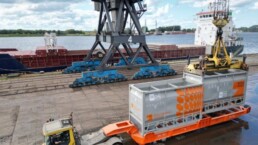

After renting Graviti’s innovative automated dry bulk containers for 2 years and being fully satisfied with the results, the Rigal Central Terminal (in the Freeport of Riga) has decided to purchase six ‘SDC 40’ units from Latvian bulk handling equipment specialist Graviti, even upgrading from ‘SDC30’ types to the bigger ones. The terminal has an option to acquire six more in the future. The containers have already been delivered and are operational. Having noticed the practical implications and cost-efficiency of the system, several other ports in North-Western Europe, Eastern Europe and the Middle-East have expressed their interest too.

In 2022, more than 150 ships were loaded with GRAVITI containers, handling about 1.5 million tonnes of cargo. There have not been any claims, breakdowns or returns, proving the reliability and effectiveness of this containersized shiploading system, according to Graviti. To date, about 60 SDCs have been sold worldwide.

Dinis Hruscovs, Managing Director of Graviti and responsible for developing the SDC, says: “We are very proud of this contract with the Freeport of Riga. It shows that we are now truly past the initial stages in which potential clients were interested, but were not yet ready to invest in such an innovation. It has had to prove itself thoroughly in practice and that has turned the table. The fact that our system reduces CO2 emissions in cargo loading logistics also plays a part: the self-discharging containers can handle more bulk faster than traditional grabs, so less movements are needed. Combine that with lower operational cost and a relatively low pricing due to the simplicity of the design and you can see why we are currently speaking with clients in other regions too.”

Bulk handing at speed
In 2020 Graviti, developed a technology to reduce the costs of loading bulk cargo and speed up the logistics processes at terminals. That resulted in two completely new types of selfdischarging containers, the SDC30, able to handle 600 tonnes of bulk per hour and the SDC 40, with a 900 t/h loading speed, operating with just one crane. After the first types were tested and deployed by, for example, Batumi Port (Georgia) and Riga Universal Port (Latvia), this method became increasingly popular, esp. in eastern European ports.

Each container its own battery pack
The containers operate on electrical power and every container comes with its own battery. The floor can be remotely operated to hydraulically open and close. With a fully charged battery, 500 cycles of loading/offloading are guaranteed, although in practice clients report even higher numbers. Because they are self-unloading, they can secure direct loading of dry cargo from warehouses to the ship’s hold.

The SDCs in Riga will be able to unload its 27 m³ cargoes in 30 seconds, which is 1.5 times more productive than regular methods of loading. This method also saves up to 35% of the cost of loading, making it a cost-effective solution.



Related News.

Beyond Technical Skills: WISTA Cyprus explores the human side of leadership
WISTA Cyprus hosted The Art of Leadership & Emotional Mastery, an interactive workshop held on 15 October at the Alasia Hotel in Limassol,…

The human cost of sending merchant mariners into war zones extends far beyond the immediate danger of missiles and drones. It raises a harder question: who is really protecting the seafarer?
Who protects the seafarer? I have spent much of my professional life at sea. I am a Master Mariner. I have stood on the bridge, made decisions…

Loss of bridge control: Human failure is normal – context is key
When bridge control is lost in a functioning system, it can be easy to blame human error. But accidents rarely happen because of one mistake…

Danish Shipping announces the transport of live animals by sea new rules should improve safety for animals, seafarers and the environment
Revised rules on the transport of live animals by sea are being negotiated in the EU. Danish Shipping wants to ensure good animal welfare,…

Japan’s flawed shipping proposal leaves developing countries adrift
A new analysis by Opportunity Green warns governments of the wide-ranging risks posed by Japan’s proposal at the International Maritime Organization…

Intermodal Report Week 42 2026
Pls find below the Intermodal Report - Week 42 2026 Intermodal Report Week 42 2026

Allied Weekly Market Review Week 42
Pls find below the Allied - Weekly Market Review - Week 42 ALLIED - Weekly Market Report- Week 42

EU Arctic Strategy NGOs welcome EU ambition on on cutting shipping’s Arctic Black Carbon Emissions
Responding to today’s publication of the EU’s Arctic Strategy, which definitively states the EU’s intention to support International Maritime…

The final quarter of 2026 is expected to see softer bauxite flows
Chinese front-loading is expected to have run its course, pointing to softer bauxite flows in 2026 Q4. Global bauxite flows increased by 2.8% y/y…

DP World Foundation and Belewan new container terminal mark groundbreaking of AED 3.7 million school project in Indonesia
Classrooms of Hope initiative expands to Belawan, Medan with a new junior high school designed to provide modern learning facilities and greater…
Subscribe to our newsletter!
if you dont want to swim alone in the ocean of news, sign up for the newsletter, and you will receive daily all the important news of world shipping!
