Era of hydrogen fueled vehicles to begin…world class technology
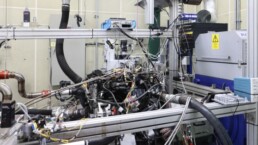

Technology for a 2-liter class hydrogen engine (or a passenger car hydrogen engine) capable of running entirely on hydrogen has been developed for the first time in the country
Amid the fierce competition throughout the globe to develop hydrogen mobility technologies to achieve carbon neutrality, a new technology for a 2-liter class hydrogen-fueled engine (a passenger car hydrogen engine) capable of running entirely on hydrogen has been developed for the first time in the country.
The joint research team led by Principal Researcher Young Choi of the Department of Mobility Power Research of the Korea Institute of Machinery and Materials (President Sang-jin Park, hereinafter referred to as KIMM), an institute under the jurisdiction of the Ministry of Science and ICT, and Researcher Hong-gil Baek of the Zero-Carbon Engine Research Lab of Hyundai-Kia Motor Company (Chairman Eui-sun Chung, hereinafter referred to as HMC) developed the “direct injection hydrogen engine” that runs entirely on hydrogen fuels, and demonstrated its world-class excellence through performance evaluation.
The joint research team of KIMM and HMC injected hydrogen directly into the combustion chamber of the engine of HMC’s existing hybrid vehicle, with a pressure larger by more than 30 times than atmospheric pressure (or with a pressure of more than 30 bar). By using a turbo charger that improves the performance of the engine, the research team was able to maintain high thermal efficiency in all domains from the ignition of the engine to the upper limit of the engine load, allowing the engine to be stably operated throughout the entire engine operating conditions.
In the case of conventional “port injection engines*,” the amount of air that flows into the combustion chamber declines because of the space taken up by the hydrogen fuel that exists in a gaseous state, which leads to lower fuel efficiency and poorer engine performance due to the backfire of the hydrogen fuel and air.
* Port injection hydrogen engine: A port injection hydrogen engine is a type of internal-combustion engine that uses hydrogen as fuel, and combusts hydrogen after mixing it with air by injecting hydrogen using an upper inhaling port instead of injecting it into the cylinder.
On the other hand, the “direct injection hydrogen engine” newly developed by the joint research team has fundamentally resolved the issue of backfire by injecting high-pressure hydrogen fuel directly into the combustion chamber. At the same time, the high compression ratio, fuel stratification, and ultra-lean combustion help to maximize thermal efficiency and improve power performance, while at the same time reducing the amount of harmful emissions.
Compared with gasoline engines, the newly developed hydrogen engine helps to reduce the emissions of carbon dioxide and fine dust by 99 percent and 90 percent, respectively, which meets EU (or European Union)’s requirements for zero-emission vehicles. Additionally, the hydrogen engine emits nitrogen oxides of less than 15 ppm even without an aftertreatment system that purifies exhaust gases, achieving a high thermal efficiency of up to 40 percent.
* Nitrogen oxides: Nitrogen oxides are chemicals that are created through the reaction between nitrogen and oxygen, and are usually generated during the combustion process of vehicle engines and power plants, etc. Nitrogen oxides are considered to be harmful to the environment, and high emissions of nitrogen oxides may lead to health problems related to respiratory diseases.
Principal Researcher Young Choi of the Department of Mobility Power Research of KIMM said, “The newly developed hydrogen engine technology is an instantaneous and economical technology that can help to replace fossil fuels, which are currently being used as the main power source for vehicles, with carbon-free hydrogen fuels.” He added, “Through collaboration with HMC, we will verify the durability of the engine and also expand the application of this technology to not only passenger vehicles but also commercial vehicles and electricity generation power units. Through continuous research and development of technologies for generating power using carbon-free fuels, we will take the lead in the realization of carbon neutrality.”
Meanwhile, this research was carried out with the support of the project for the “development of liquid hydrogen engines for running drones and robots,” one of KIMM’s basic projects, as well as the project for the “evaluation of hydrogen direct injection engines” supported by HMC.



Related News.

Beyond Technical Skills: WISTA Cyprus explores the human side of leadership
WISTA Cyprus hosted The Art of Leadership & Emotional Mastery, an interactive workshop held on 15 October at the Alasia Hotel in Limassol,…

The human cost of sending merchant mariners into war zones extends far beyond the immediate danger of missiles and drones. It raises a harder question: who is really protecting the seafarer?
Who protects the seafarer? I have spent much of my professional life at sea. I am a Master Mariner. I have stood on the bridge, made decisions…

Loss of bridge control: Human failure is normal – context is key
When bridge control is lost in a functioning system, it can be easy to blame human error. But accidents rarely happen because of one mistake…

Danish Shipping announces the transport of live animals by sea new rules should improve safety for animals, seafarers and the environment
Revised rules on the transport of live animals by sea are being negotiated in the EU. Danish Shipping wants to ensure good animal welfare,…

Japan’s flawed shipping proposal leaves developing countries adrift
A new analysis by Opportunity Green warns governments of the wide-ranging risks posed by Japan’s proposal at the International Maritime Organization…

Intermodal Report Week 42 2026
Pls find below the Intermodal Report - Week 42 2026 Intermodal Report Week 42 2026

Allied Weekly Market Review Week 42
Pls find below the Allied - Weekly Market Review - Week 42 ALLIED - Weekly Market Report- Week 42
EU Arctic Strategy NGOs welcome EU ambition on on cutting shipping’s Arctic Black Carbon Emissions
Responding to today’s publication of the EU’s Arctic Strategy, which definitively states the EU’s intention to support International Maritime…
The final quarter of 2026 is expected to see softer bauxite flows
Chinese front-loading is expected to have run its course, pointing to softer bauxite flows in 2026 Q4. Global bauxite flows increased by 2.8% y/y…
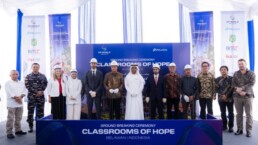
DP World Foundation and Belewan new container terminal mark groundbreaking of AED 3.7 million school project in Indonesia
Classrooms of Hope initiative expands to Belawan, Medan with a new junior high school designed to provide modern learning facilities and greater…
Subscribe to our newsletter!
if you dont want to swim alone in the ocean of news, sign up for the newsletter, and you will receive daily all the important news of world shipping!
