Maersk vessel tanks green methanol for the first time in Rotterdam
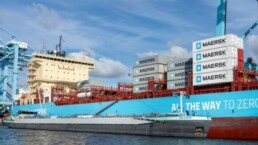

A new Maersk vessel arrived at APMT 2 to bunker green methanol. The vessel was built by Hyundai Mipo in the Korean city of Ulsan. It is on its way to Copenhagen, where its naming ceremony will be held
During its maiden voyage, the vessel sailed on green methanol, which it also bunkered in Egypt. Maersk will be deploying the vessel between Northern Europe and the Baltic Sea. It will run on methanol, but it will also be able to switch to low-sulphur fuel oil.
The new 2,100 teu vessel is a stepping stone towards a much larger order of methanol vessels to be placed by Maersk. In 2021 and 2022, the shipping company ordered eighteen container ships – also from Hyundai – of about 16,000 teus for the Asia-Europe Route. They are set to become operational in 2024 and 2025.
X-Press Feeders
The methanol was supplied by OCI Terminal Europoort, part of Dutch enterprise OCI Global, which originates from DSM. The company stated that with this first supply, a foundation was laid for the construction of an infrastructure for the new fuel type, as well as the creation of ‘a framework for green methanol sailing routes in the future’.
Last month also saw the closing of an agreement with X-Press Feeders that will form the basis for the supply of green methanol in Rotterdam. This will be used for the new dual-fuel vessels as of next year. At the start of this year, OCI closed an agreement with Unibarge for the conversion of an existing bunker vessel into a methanol vessel, in order to facilitate the supply of methanol to sea-going vessels.
Ammonia
Methanol is a simple, toxic form of alcohol (CH4O). Its combustion results in the release of CO2, but if the fuel was produced a on renewable biomass basis, it may carry the ‘bio’ or ‘green’ label. Ahmed El-Hoshy, top executive with OCI Global, holds great expectations for the new fuel type and expects demand to grow to over six million tonnes annually in the coming years.
OCI Global plays an important part in the plans that the port of Rotterdam has for the future in reducing nett CO2 emissions. The company operates the only ammonia import terminal in that port, whose capacity will be upgraded from 400,000 tonnes to 1.2 million tonnes annually.
In the future, it is expected that part of that capacity can be supplied to the shipping industry as fuel. However, that idea is still in its infancy. OCI expects that the larger part of imported ammonia will be used to make hydrogen. The enterprise has already prepared a blueprint to increase the terminal’s capacity to three million tonnes per year, once the use of ammonia as a hydrogen carrier takes flight.
Source: Maersk



Related News.
Beyond Technical Skills: WISTA Cyprus explores the human side of leadership
WISTA Cyprus hosted The Art of Leadership & Emotional Mastery, an interactive workshop held on 15 October at the Alasia Hotel in Limassol,…
The human cost of sending merchant mariners into war zones extends far beyond the immediate danger of missiles and drones. It raises a harder question: who is really protecting the seafarer?
Who protects the seafarer? I have spent much of my professional life at sea. I am a Master Mariner. I have stood on the bridge, made decisions…
Loss of bridge control: Human failure is normal – context is key
When bridge control is lost in a functioning system, it can be easy to blame human error. But accidents rarely happen because of one mistake…
Danish Shipping announces the transport of live animals by sea new rules should improve safety for animals, seafarers and the environment
Revised rules on the transport of live animals by sea are being negotiated in the EU. Danish Shipping wants to ensure good animal welfare,…
Japan’s flawed shipping proposal leaves developing countries adrift
A new analysis by Opportunity Green warns governments of the wide-ranging risks posed by Japan’s proposal at the International Maritime Organization…
Intermodal Report Week 42 2026
Pls find below the Intermodal Report - Week 42 2026 Intermodal Report Week 42 2026
Allied Weekly Market Review Week 42
Pls find below the Allied - Weekly Market Review - Week 42 ALLIED - Weekly Market Report- Week 42
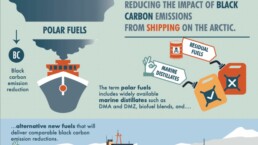
EU Arctic Strategy NGOs welcome EU ambition on on cutting shipping’s Arctic Black Carbon Emissions
Responding to today’s publication of the EU’s Arctic Strategy, which definitively states the EU’s intention to support International Maritime…
The final quarter of 2026 is expected to see softer bauxite flows
Chinese front-loading is expected to have run its course, pointing to softer bauxite flows in 2026 Q4. Global bauxite flows increased by 2.8% y/y…
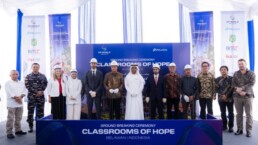
DP World Foundation and Belewan new container terminal mark groundbreaking of AED 3.7 million school project in Indonesia
Classrooms of Hope initiative expands to Belawan, Medan with a new junior high school designed to provide modern learning facilities and greater…
Subscribe to our newsletter!
if you dont want to swim alone in the ocean of news, sign up for the newsletter, and you will receive daily all the important news of world shipping!
