Radar measurements can vastly improve a key technology for the energy and process industries
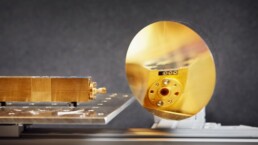

Fluidized beds is a technology used in a variety of industries and plays an important role in the transition to green energy and the production of food and drugs. However, the process that occurs inside a fluidized bed is extremely complex and – due to a lack of effective measurement techniques – has remained largely unknown. Now, researchers from Chalmers University of Technology in Sweden have developed a high-frequency radar technique that can measure exactly what is happening inside a fluidized bed with unrivalled precision. This breakthrough could lead to completely new and more efficient processes in several industries, including energy conversion.
Fluidized bed combustion is one of the leading technologies used in the world’s thermal power plants. This technology converts solid fuels, such as biomass and waste, into district heating and electricity. Fluidization technology is also fundamental to many other processes that are expected to play an important role globally in the transition of energy systems, and in circular resource flows – such as in carbon capture, energy storage and the production of hydrogen and other fossil-free fuels*.
Researchers at Chalmers University of Technology have now developed a radar technique able to provide a detailed characterisation of the flow of solids in fluidized beds, the lack of which has been holding back the development of these processes.
Fluidized beds is already the most effective technology for converting solid biofuels into energy. This technology results in an efficient and consistent rate of combustion because the solid particles assume a liquid-like state which helps to distribute the heat homogeneously in the combustion chamber. In brief, fluidization technology is based on a gas being blown through a bed of small sand-like particles in a reactor, so that these solid particles, the fuel and the gas become thoroughly mixed.
Like a sandstorm and a wildfire in one
In order to achieve even greater efficiencies in this process, you need to be able to understand and control how the solid particles behave in the mixture. But the reactor environment is often hot, dirty and corrosive – like a sandstorm and a wildfire in one – effectively preventing any type of measurement and thus limiting our understanding of what is actually happening inside the reactor.
The Chalmers researchers’ new solution to this problem is an extremely high-frequency radar technique that can measure the flows of solid particles in fluidized beds with unrivalled precision. Inspired by the pulse-Doppler radar used to track weather phenomena such as rain or snow, this is the first time the technique has been demonstrated in the context of a fluidized bed. This breakthrough is now expected to pave the way for new and more efficient processes in a number of industries.
“The use of the high-frequency terahertz radar instrument demonstrated in our study has the potential to revolutionise how fluidized bed technology can be designed and used in many different industrial sectors – from energy conversion to the food industry and drug production. This is one of very few demonstrations of the use of pulse-Doppler radar technique at submillimetre wave frequencies, and it is the first time ever that it has been used for making measurements in a fluidized bed,” says Diana Carolina Guío Pérez, researcher in energy technology at Chalmers.

Unrivalled measurement accuracy
While the measurement techniques used in fluidized beds are normally low-resolution, produce results that are difficult to interpret, or cause disturbances in the flow, the Chalmers researchers’ high-frequency terahertz radar technique can penetrate the reactor from the outside and measure the behaviour of the particles inside it without disturbing the flow. The radar technique can also measure the velocity and concentration of the solid particles simultaneously with great precision and high resolution in time and space. This means that even minimal changes in the flow can be detected in real-time, which is important when monitoring and controlling industrial processes.
In the researchers’ study, the technique was demonstrated in practice, for the first time ever, in a three-metre high circulating fluidized bed boiler. Their findings showed a measurement quality that exceeded the quality achieved by the methods previously used in the field by a big margin.
“We have been able to show that pulse-Doppler radar technique at frequencies up to 340 GHz can measure both the distribution of particles and their velocity inside a process reactor at a much higher resolution than other technologies can. This is information that has long been lacking in the field and will make it possible to improve and scale up process reactors and – in the case of energy conversion – reduce emissions of unwanted residual products,” says Marlene Bonmann, post-doc at the Terahertz and Millimetre Wave Laboratory at Chalmers University of Technology.

“The knowledge that can be acquired with our high-frequency terahertz radar technique has the potential to break new ground in our understanding of solids flows in fluidized bed reactors and other solids handling units. For example, it can lead to improved operation and design of the reactors needed in existing and completely new fluidized bed-based conversion processes, such as carbon capture and storage, energy storage and thermal cycling,” says Diana Carolina Guío Pérez.



Related News.
Beyond Technical Skills: WISTA Cyprus explores the human side of leadership
WISTA Cyprus hosted The Art of Leadership & Emotional Mastery, an interactive workshop held on 15 October at the Alasia Hotel in Limassol,…
The human cost of sending merchant mariners into war zones extends far beyond the immediate danger of missiles and drones. It raises a harder question: who is really protecting the seafarer?
Who protects the seafarer? I have spent much of my professional life at sea. I am a Master Mariner. I have stood on the bridge, made decisions…

Loss of bridge control: Human failure is normal – context is key
When bridge control is lost in a functioning system, it can be easy to blame human error. But accidents rarely happen because of one mistake…

Danish Shipping announces the transport of live animals by sea new rules should improve safety for animals, seafarers and the environment
Revised rules on the transport of live animals by sea are being negotiated in the EU. Danish Shipping wants to ensure good animal welfare,…

Japan’s flawed shipping proposal leaves developing countries adrift
A new analysis by Opportunity Green warns governments of the wide-ranging risks posed by Japan’s proposal at the International Maritime Organization…

Intermodal Report Week 42 2026
Pls find below the Intermodal Report - Week 42 2026 Intermodal Report Week 42 2026

Allied Weekly Market Review Week 42
Pls find below the Allied - Weekly Market Review - Week 42 ALLIED - Weekly Market Report- Week 42
EU Arctic Strategy NGOs welcome EU ambition on on cutting shipping’s Arctic Black Carbon Emissions
Responding to today’s publication of the EU’s Arctic Strategy, which definitively states the EU’s intention to support International Maritime…

The final quarter of 2026 is expected to see softer bauxite flows
Chinese front-loading is expected to have run its course, pointing to softer bauxite flows in 2026 Q4. Global bauxite flows increased by 2.8% y/y…

DP World Foundation and Belewan new container terminal mark groundbreaking of AED 3.7 million school project in Indonesia
Classrooms of Hope initiative expands to Belawan, Medan with a new junior high school designed to provide modern learning facilities and greater…
Subscribe to our newsletter!
if you dont want to swim alone in the ocean of news, sign up for the newsletter, and you will receive daily all the important news of world shipping!
