Environmentally friendly storage cranes optimise terminal operations at Container Terminal Burchardkai
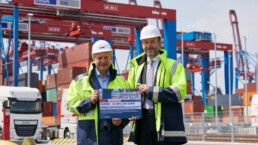

The ongoing electrification of the storage area at Hamburger Hafen und Logistik Aktiengesellschaft Container Terminal Burchardkai continues with the start of operations of four new modern storage blocks. The switch will drive forward the decarbonisation of workflows as well as the reduction of emissions at the Port of Hamburg. The transition to the new technology was subsidised by the environmental authority with special funds from the European Regional Development Fund as part of the REACT-EU initiative, with a total of ten million euros.
HHLA Executive Board member Jens Hansen: “By using new technologies, we want to fully electrify the container handling process at CTB, our largest terminal in Hamburg, while significantly improving our energy efficiency. Using electricity from renewable sources will allow us to continue decarbonising our workflows at the port. We previously demonstrated how this can work at the neighbouring Container Terminal Altenwerder. The switch to environmentally friendly storage crane systems will bring us a big step closer to this goal.”
Dr. Melanie Leonhard, Senator for Economic Affairs: “Burchardkai is Hamburg’s largest and oldest container terminal. This is where the container era began for the Port of Hamburg. The image of large vessels being unloaded at the container gantry cranes characterises our port. Burchardkai represents the global exchange of goods and the internationally connected global economy like no other place in Hamburg. With the commissioning of the modern storage crane systems, the terminal will become even more energy efficient and thus further optimised. New technologies make a decisive contribution towards creating sustainable value for our port based on innovation and quality, as formulated in the mission statement of the Port of Hamburg’s development plan.”
Jens Kerstan, Minister for Environment, Climate, Energy and Agriculture: “Climate protection begins locally. With the start-up of the fourth automated storage crane system, we have achieved a milestone on our path towards decarbonising Container Terminal Burchardkai. This project will save almost five and a half million litres of diesel and 11,000 tonnes of CO2 every year. And there’s more: electrified storage cranes are not only significantly quieter; they allow a considerable amount of soot, particulate matter and nitrogen to be avoided. This directly improves the quality of life of Hamburg’s residents, especially in areas close to the port. The ten million euros from the European Regional Development Fund were optimally invested here. The project gives considerable momentum to the modernisation of container handling, makes a long-term contribution to climate protection and demonstrates impressively that increased capacities can be achieved with lower emissions. In Hamburg, we want to live and do business in a carbon-neutral manner by 2045. It is essential that everyone in politics, the scientific community, business and the general public pull together with all our strength. Projects with charisma, such as this one, are particularly motivating.”
The four new storage blocks, which were gradually put into operation over the first half of 2023, complement the electric container storage at CTB by an additional 8,500 standard containers (TEU). All in all, the automated container yard at CTB thus has a capacity of almost 39,000 TEU spread across a total of 19 storage blocks. The gradual switch of the energy-intensive process of moving goods in and out of storage using diesel-powered straddle carriers in favour of electric storage crane systems will lead to the further reduction of carbon and harmful emissions at the terminal.
The automated storage crane systems that store and prepare containers for onward transport run on green electricity. The switch also creates the conditions for the conversion of horizontal transport to fully automated container transport (Automated Guided Vehicles), which are battery-operated and thus also climate-neutral.
The CTB has been further developed on an ongoing basis during operations since 2006. The storage blocks with state-of-the-art storage crane systems have been fully automated at the terminal since 2010. With the commissioning of the four additional blocks, the terminal’s efficient use of space has increased by more than 30 percent. Due to the fact that the port is so close to the city, it is very important to use the space efficiently and to keep the emissions generated at the Port of Hamburg as low as possible. This includes noise and light emissions. Three additional storage blocks are currently being built at CTB, which will expand storage capacity to a total of 22 blocks starting in 2024. In this way, HHLA continues to drive its “balanced logistics” sustainability strategy consistently forward and is one step closer to its goal of achieving climate-neutral production across the entire Group by 2040.
How storage crane systems work:
The automated container storage at CTB consists of storage blocks that are each 42 metres wide and 375 metres long and arranged side by side, with a capacity between 1,980 and 2,130 TEU depending on their type. CTB stands out because its storage crane system consists of three portal cranes that can drive over each other. This is globally unique and increases productivity: crane operation is optimised and the cranes’ traversability results in a more efficient path through the aisles (roadway diagram). Depending on requirements, one side of the block storage can also be used more intensively. The storage crane system’s high-performance IT system is integrated into the terminal’s overall control system and has been supported by a specially developed AI module for several years. This helps it find optimal storage locations for the stored steel boxes, which can reduce the energy-consuming restacking of containers.



Related News.
Beyond Technical Skills: WISTA Cyprus explores the human side of leadership
WISTA Cyprus hosted The Art of Leadership & Emotional Mastery, an interactive workshop held on 15 October at the Alasia Hotel in Limassol,…
The human cost of sending merchant mariners into war zones extends far beyond the immediate danger of missiles and drones. It raises a harder question: who is really protecting the seafarer?
Who protects the seafarer? I have spent much of my professional life at sea. I am a Master Mariner. I have stood on the bridge, made decisions…
Loss of bridge control: Human failure is normal – context is key
When bridge control is lost in a functioning system, it can be easy to blame human error. But accidents rarely happen because of one mistake…
Danish Shipping announces the transport of live animals by sea new rules should improve safety for animals, seafarers and the environment
Revised rules on the transport of live animals by sea are being negotiated in the EU. Danish Shipping wants to ensure good animal welfare,…
Japan’s flawed shipping proposal leaves developing countries adrift
A new analysis by Opportunity Green warns governments of the wide-ranging risks posed by Japan’s proposal at the International Maritime Organization…

Intermodal Report Week 42 2026
Pls find below the Intermodal Report - Week 42 2026 Intermodal Report Week 42 2026
Allied Weekly Market Review Week 42
Pls find below the Allied - Weekly Market Review - Week 42 ALLIED - Weekly Market Report- Week 42
EU Arctic Strategy NGOs welcome EU ambition on on cutting shipping’s Arctic Black Carbon Emissions
Responding to today’s publication of the EU’s Arctic Strategy, which definitively states the EU’s intention to support International Maritime…

The final quarter of 2026 is expected to see softer bauxite flows
Chinese front-loading is expected to have run its course, pointing to softer bauxite flows in 2026 Q4. Global bauxite flows increased by 2.8% y/y…
DP World Foundation and Belewan new container terminal mark groundbreaking of AED 3.7 million school project in Indonesia
Classrooms of Hope initiative expands to Belawan, Medan with a new junior high school designed to provide modern learning facilities and greater…
Subscribe to our newsletter!
if you dont want to swim alone in the ocean of news, sign up for the newsletter, and you will receive daily all the important news of world shipping!
