‘The heat is on’: Landmark UN, ILO decisions put pressure on governments over crew change
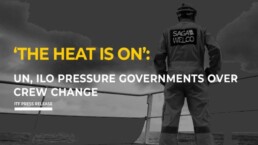

Pressure is mounting on governments to designate seafarers as ‘key workers’ to avoid the prospect of forced labour and human rights abuses in major supply chains this holiday season, say representatives from the International Transport Workers’ Federation (ITF).
The United Nations General Assembly and the International Labour Organization (ILO) in the last week passed landmark resolutions (UN resolution / ILO resolution) calling for urgent action by national governments on the crew change crisis.
“The adoption of Indonesia’s resolution by the UN General Assembly has put seafarers and their ongoing struggle firmly at the centre of the governments’ attention as the consumer holiday season approaches and industry concern over potential forced labour in their supply chains reaches new highs”, said ITF General Secretary Stephen Cotton.
“We now have the full authority of the United Nations General Assembly saying that if countries want to participate in the global economy, then they must recognise this global workforce as ‘key workers’ with practical effect. Key worker status means letting seafarers get off in their ports for medical attention. It means letting them get to an airport to fly home and return to their families when their contract on a ship is completed. It means letting replacement crews through a country’s border to join those waiting ships.”
The ITF, which represents more than a million seafarers through its affiliated seafaring unions, has been working behind the scenes with governments and UN agencies to secure the resolutions.
“The global movement to recognise that seafarers need travel, transit and border exemptions and practical quarantine rules, is gaining momentum. Governments are starting to realise that they need to act now if they want to avoid being blamed for this pressing humanitarian – and potentially economic – crisis. The heat is on,” said Cotton.
The UN’s call was followed this Tuesday by the adoption of a resolution by the International Labour Organization’s Governing Body.
Seafarers’ Group Spokesperson at the ILO, Mark Dickinson, said a comprehensive draft for the resolution was supplied by the social partners. The draft provided more detail on what governments needed to do give the ‘key worker’ status real meaning for seafarers, including allowing shore leave for seafarers to access medical care.
A recent ITF survey found 30% of seafarers had unmet medical conditions while trapped working aboard the world’s shipping fleet, with many unable to access medication or get prescriptions filled.
“We welcome the outcome yesterday and congratulate the member states who voted in favour of adoption of the resolution. We will seek to make governments give real effect to resolution’s intentions. We hope that the call to action will mean states now act as champions for the cause on resolving this epic humanitarian crisis,” said Dickinson.
“It has, at times, been a difficult road to raise this issue amongst the countries that really need to take a leadership role in this. This resolution makes it clear that there is no room in the global economy for those who would seek to undermine seafarers’ long-fought-for rights and their working conditions; whether they be Flag States, Port States, or the home countries of seafarers seeking to get home after their contracts.”
“This ILO resolution throws down the gauntlet to Flag States in particular to do their jobs properly as regulators to enforce seafarers’ human and labour rights. If they fail to uphold the Maritime Labour Convention on their ships, seafaring unions and our allies will be calling them out,” said Dickinson
Chair of the ITF’s Seafarers’ Section, David Heindel, welcomed the ILO decision to up the pressure on governments and companies ahead of the holiday season.
“It is significant that the International Labour Organization has called on the world’s companies to carry out due diligence in their supply chains and ensure crew are changed wherever they are over their initial contracts. The ITF and our affiliates will be informing consumers in the lead up to the holidays which of their favourite brands are potentially benefitting from forced labour in the delivery of their goods,” said Heindel.
“The ITF and our global family of seafarers’ unions will be holding governments and companies to account, including assisting seafarers to enforce their rights to stop working and be repatriated following completion of their contracts, even if that means disrupting key supply chains in the process”.
“With this resolution, the ILO also has echoed our concerns that seafarers’ rights could be undermined by the backsliding we are seeing in the global shipping industry. We need to get back to proper enforcement of seafarers’ rights,” said Heindel.
Heindel said governments should adopt the ILO’s steps to get crew change going now, while seafarers waited for vaccines to be rolled out.
Effective crew change still required more governments to accept seafarers’ documentation and Covid-19 PCR test results so that they could come ashore. The ITF was doing its part by working with industry to improve the reliability of test results of seafarers eager to join ships, he said.



Related News.

Beyond Technical Skills: WISTA Cyprus explores the human side of leadership
WISTA Cyprus hosted The Art of Leadership & Emotional Mastery, an interactive workshop held on 15 October at the Alasia Hotel in Limassol,…
The human cost of sending merchant mariners into war zones extends far beyond the immediate danger of missiles and drones. It raises a harder question: who is really protecting the seafarer?
Who protects the seafarer? I have spent much of my professional life at sea. I am a Master Mariner. I have stood on the bridge, made decisions…
Loss of bridge control: Human failure is normal – context is key
When bridge control is lost in a functioning system, it can be easy to blame human error. But accidents rarely happen because of one mistake…
Danish Shipping announces the transport of live animals by sea new rules should improve safety for animals, seafarers and the environment
Revised rules on the transport of live animals by sea are being negotiated in the EU. Danish Shipping wants to ensure good animal welfare,…
Japan’s flawed shipping proposal leaves developing countries adrift
A new analysis by Opportunity Green warns governments of the wide-ranging risks posed by Japan’s proposal at the International Maritime Organization…

Intermodal Report Week 42 2026
Pls find below the Intermodal Report - Week 42 2026 Intermodal Report Week 42 2026
Allied Weekly Market Review Week 42
Pls find below the Allied - Weekly Market Review - Week 42 ALLIED - Weekly Market Report- Week 42
EU Arctic Strategy NGOs welcome EU ambition on on cutting shipping’s Arctic Black Carbon Emissions
Responding to today’s publication of the EU’s Arctic Strategy, which definitively states the EU’s intention to support International Maritime…
The final quarter of 2026 is expected to see softer bauxite flows
Chinese front-loading is expected to have run its course, pointing to softer bauxite flows in 2026 Q4. Global bauxite flows increased by 2.8% y/y…

DP World Foundation and Belewan new container terminal mark groundbreaking of AED 3.7 million school project in Indonesia
Classrooms of Hope initiative expands to Belawan, Medan with a new junior high school designed to provide modern learning facilities and greater…
Subscribe to our newsletter!
if you dont want to swim alone in the ocean of news, sign up for the newsletter, and you will receive daily all the important news of world shipping!
