Energy-saving “PBCF Reaches Milestone Orders Received for 3,500 Vessels
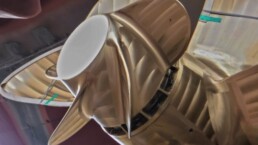

Achieves 3%-5% Reduction in Fuel Consumption,
Helping in-service Vessels Comply with Future Fuel Efficiency Regulation
MOL announced that Propeller Boss Cap Fins (PBCF), marketed by its group company MOL Techno-Trade, Ltd. (MOL Tech; President Hirokazu Hatta; Headquarters: Chuo-ku, Tokyo) has now been ordered for 3,500 vessels.
PBCF is an energy-saving device attached to the propeller of a vessel. It breaks up the hub vortex generated behind the rotating propeller, resulting in energy savings of 3% to 5% compared to an identical vessel not equipped with PBCF. Higher fuel efficiency
in turn cuts emissions of greenhouse gases (GHGs), reducing the shipping industry’s environmental impact.
PBCF was co-developed by MOL, West Japan Fluid Engineering Laboratory Co., Ltd., and Mikado Propeller Co., Ltd. (now Nakashima Propeller Co., Ltd.), and introduced in 1987. PBCF has been installed mainly by Japanese Shipowners, and in 2006, orders reached 1,000. As overseas shipowners and ship operators widely recognized the value of PBCF on the back of skyrocketing bunker prices and growing worldwide awareness of the need for CO2 reduction, the number of orders reached 2,000 vessels in 2011 and topped 3,000 in 2015. MOL Tech calculated that the widening use of PBCF has contributed to a cumulative 42 million-ton reduction in CO22emissions Worldwide.
In 2017, MOL Tech, MOL, and Akishima Laboratories (Mitsui Zosen) Inc. jointly developed a new type of PBCF, featuring a refined fin shape and height to further enhance its energy-saving effect. This upgraded PBCF has already been installed on over 300 vessels. Furthermore, the development team has moved forward with research on a hybrid version with other energy-saving devices such as the Pre Swirl Fin and Energy-saving Rudder with Bulb Fins, and confirmed synergetic effects in a model test (Smart Wake Ship style), having similar wake flow to a full-scale ship. In these ways, PBCF continues to evolve every day.
PBCF won the Award for Logistics Environmental Impact-Reducing Technology Development in the 21st Logistics Environment Award (Note 1), as selected by the Japan Association for Logistics and Transport. It is recognized as an environment-friendly device all over the world, helping to reduce the shipping industry’s environmental impact.
Effective January 2023, the industry expects the introduction of fuel efficiency standards targeting in-service vessels, mandating the same level of efficiency as newbuilding ships. Vessels that do not conform to these standards will not be allowed to provide ocean shipping services. PBCF can be installed on a propeller by the bolt only, which is quite easy to install. In addition, it has no moving parts, so it is maintenance-free once the installation is complete. It is an ideal solution to boost the fuel efficiency of in-service vessels.
The MOL Group continually promotes and expands its “environmental and emission-free businesses” to support environmental conservation at sea and in ports all over the world and will step up its efforts to ensure safe operation and reduce environmental impact through the “ISHIN NEXT – MOL SMART SHIP Project” (Note 2).



Related News.

Beyond Technical Skills: WISTA Cyprus explores the human side of leadership
WISTA Cyprus hosted The Art of Leadership & Emotional Mastery, an interactive workshop held on 15 October at the Alasia Hotel in Limassol,…

The human cost of sending merchant mariners into war zones extends far beyond the immediate danger of missiles and drones. It raises a harder question: who is really protecting the seafarer?
Who protects the seafarer? I have spent much of my professional life at sea. I am a Master Mariner. I have stood on the bridge, made decisions…
Loss of bridge control: Human failure is normal – context is key
When bridge control is lost in a functioning system, it can be easy to blame human error. But accidents rarely happen because of one mistake…

Danish Shipping announces the transport of live animals by sea new rules should improve safety for animals, seafarers and the environment
Revised rules on the transport of live animals by sea are being negotiated in the EU. Danish Shipping wants to ensure good animal welfare,…

Japan’s flawed shipping proposal leaves developing countries adrift
A new analysis by Opportunity Green warns governments of the wide-ranging risks posed by Japan’s proposal at the International Maritime Organization…

Intermodal Report Week 42 2026
Pls find below the Intermodal Report - Week 42 2026 Intermodal Report Week 42 2026

Allied Weekly Market Review Week 42
Pls find below the Allied - Weekly Market Review - Week 42 ALLIED - Weekly Market Report- Week 42
EU Arctic Strategy NGOs welcome EU ambition on on cutting shipping’s Arctic Black Carbon Emissions
Responding to today’s publication of the EU’s Arctic Strategy, which definitively states the EU’s intention to support International Maritime…
The final quarter of 2026 is expected to see softer bauxite flows
Chinese front-loading is expected to have run its course, pointing to softer bauxite flows in 2026 Q4. Global bauxite flows increased by 2.8% y/y…
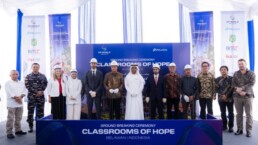
DP World Foundation and Belewan new container terminal mark groundbreaking of AED 3.7 million school project in Indonesia
Classrooms of Hope initiative expands to Belawan, Medan with a new junior high school designed to provide modern learning facilities and greater…
Subscribe to our newsletter!
if you dont want to swim alone in the ocean of news, sign up for the newsletter, and you will receive daily all the important news of world shipping!
