Survitec gives Helicopter passengers and crew more air with new emergency Breathing System
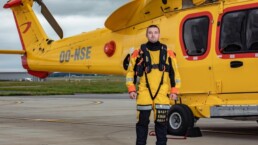

A new compressed air Emergency Breathing System (EBS) for offshore helicopter passengers and crew introduced by global safety and survival solutions provider Survitec has been designed to offer personnel a greater chance of survival in a water impact scenario.
Survitec’s new bespoke Category A EBS has already been integrated into the company’s Halo aviation lifejacket and can be deployed in a single action, using one hand.
It features a mouthpiece with an integrated nose clip, a braided low-pressure hose and a reinforced carbon composite compressed air cylinder. The EBS weighs 949g which is 30% lighter than competing systems.
“The most striking aspect of the new cylinder design, is its high air capacity,” Mark Lutman, Survitec’s Technical Sales Manager for lifesaving appliances (LSA), attests.
“In a water impact scenario, the short window for escape can be a limiting factor when escaping a submerged helicopter. We designed the bespoke EBS to deliver 80% more air than that required by CAP 1034, increasing the chances of survival for those escaping a ditched, capsized or submerged helicopter.”
The Civil Aviation Authority CAP 1034 guidelines (Development of a Technical Standard for Emergency Breathing Systems) to which Lutman refers were developed in 2013 after a spate of fatal helicopter accidents. It states that EBS should provide sufficient air supply for 60 seconds of breathing time at a depth down to 2m.
Over the last 20 years, EBS technology has evolved significantly. Originally, they were classed as rebreathers, these were superseded by hybrid rebreathers and finally, the compressed air systems that we see today. All of which have their advantages and disadvantages.
Nigel Parkes, Head of Lifejacket Design, Survitec, explains. “One of the first EBS was the rebreather system, ostensibly a counter-lung allowing the wearer to breathe back in their own expelled breath. These need to be orally inflated prior to submersion and are not effective when personnel have to escape from depths of more than a few metres.”
The rebreather style system evolved to a hybrid rebreather. This incorporated a cylinder of compressed air containing the equivalent of a lungful of air that is automatically released into the counter-lung on submersion.
“The addition of an air cylinder does provide the user with air to breathe if there is little time to take a deep breath, but again, this type of system is less likely to be effective at depths of more than a few metres. The increased air capacity can also increase overall buoyancy of the lifejacket, impacting the means of escape,” said Parkes, before commenting on the advantages of a compressed air EBS.
“With these new systems, they are more suited for underwater deployment and can be used at depth because pressurised air is supplied on demand.
“Imagine you’re evacuating a submerged helicopter. It’s dark. Water is flooding in. You don’t know whether up is down or down is up and panic is setting in. The last thing you want to worry about is remembering to take a deep breath.”
“Further to this, sudden exposure to cold water can induce the cold water shock response, which can significantly affect the individual’s ability to hold their breath.”
Indeed, a primary reason for developing the new EBS was to take into consideration the additional air capacity required by someone under extreme stress. When people panic, their breathing is rapid and air supplies can be quickly depleted.
Parkes said: “The introduction of a 310 bar cylinder allows us to substantially increase the amount of breathable air available for use by the user in a water impact scenario. By combining composite materials within a pocket shielded and reinforced for impact protection, our design teams have also delivered a much lighter, more resilient CA-EBS.”
This new bespoke EBS is a key integrated feature of Survitec’s Halo lifejacket, launched in September last year.



Related News.

Beyond Technical Skills: WISTA Cyprus explores the human side of leadership
WISTA Cyprus hosted The Art of Leadership & Emotional Mastery, an interactive workshop held on 15 October at the Alasia Hotel in Limassol,…
The human cost of sending merchant mariners into war zones extends far beyond the immediate danger of missiles and drones. It raises a harder question: who is really protecting the seafarer?
Who protects the seafarer? I have spent much of my professional life at sea. I am a Master Mariner. I have stood on the bridge, made decisions…
Loss of bridge control: Human failure is normal – context is key
When bridge control is lost in a functioning system, it can be easy to blame human error. But accidents rarely happen because of one mistake…
Danish Shipping announces the transport of live animals by sea new rules should improve safety for animals, seafarers and the environment
Revised rules on the transport of live animals by sea are being negotiated in the EU. Danish Shipping wants to ensure good animal welfare,…

Japan’s flawed shipping proposal leaves developing countries adrift
A new analysis by Opportunity Green warns governments of the wide-ranging risks posed by Japan’s proposal at the International Maritime Organization…

Intermodal Report Week 42 2026
Pls find below the Intermodal Report - Week 42 2026 Intermodal Report Week 42 2026
Allied Weekly Market Review Week 42
Pls find below the Allied - Weekly Market Review - Week 42 ALLIED - Weekly Market Report- Week 42
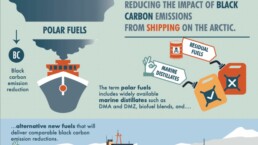
EU Arctic Strategy NGOs welcome EU ambition on on cutting shipping’s Arctic Black Carbon Emissions
Responding to today’s publication of the EU’s Arctic Strategy, which definitively states the EU’s intention to support International Maritime…
The final quarter of 2026 is expected to see softer bauxite flows
Chinese front-loading is expected to have run its course, pointing to softer bauxite flows in 2026 Q4. Global bauxite flows increased by 2.8% y/y…

DP World Foundation and Belewan new container terminal mark groundbreaking of AED 3.7 million school project in Indonesia
Classrooms of Hope initiative expands to Belawan, Medan with a new junior high school designed to provide modern learning facilities and greater…
Subscribe to our newsletter!
if you dont want to swim alone in the ocean of news, sign up for the newsletter, and you will receive daily all the important news of world shipping!
