Prices at stake: If OPEC+ increases output in January, a 200 million-barrel glut will build through May
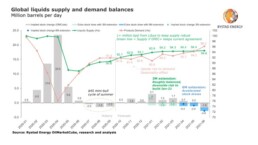

As the world is aching to put an end to a devastating 2020, oil producers are now assessing the lasting effect of the pandemic into 2021 – and in particular, the consequences of oil demand destruction to global balances. The existing OPEC+ group deal saved the market from collapsing earlier this year, but then Covid-19 came back with a second-wave vengeance. If output increases as planned from January, the world will have to face a new 200-million-barrel surplus through May, Rystad Energy calculates.
The OPEC+ group will be debating whether or not to maintain its currently curtailed oil production levels to 2021 or to increase them as planned by nearly 2 million barrels per day (bpd). The existing plan was drafted during the pandemic’s first wave and under a more optimistic forecast for end-year oil demand, which turned out to be too high as the pandemic’s second wave brought new lockdowns globally.
Rystad Energy’s balances show that should OPEC+ fails to amend its existing deal and increases its production, the world in January will face its biggest monthly glut since April 2020 with an average daily surplus of 3.1 million barrels for the month. Smaller surpluses are bound to continue through May, building a total glut that will exceed 200 million barrels for the first five months of 2021, before finally starting to shrink from June.
Modeling a possible decision by OPEC+ to postpone its production increase, Rystad Energy has also calculated the effect on global oil balances of three-month and six-month extension scenarios.
If OPEC+ postpones its planned January production increase by three months, we will still see consecutive monthly surpluses through May, but the total size will be limited to about 115 million barrels. Should, however, OPEC+ take the brave call to extend the current status quo for six months, then surpluses will end after March, leaving behind a smaller, three-month glut of just 90 million barrels, which will be erased by the end of June due to deficits coming from April.
“We believe keeping the current agreement in place – which calls for raising target production by 1.9 million bpd from January 2021 – could send Brent back down to $40 per barrel or lower. A three-month extension would only provide marginal support to prices, but would help to establish $50 as a sturdier floor, while a six-month extension could help to meaningfully deplete the storage overhang and supercharge prices into the mid-$50s,“ says Bjornar Tonhaugen, Head of Oil Markets at Rystad Energy.
In a way, OPEC+ is already locked into extending its current cuts for some period in 2021 and probably knows it will be punished by the market if it doesn’t do so, Tonhaugen adds.
The oil demand recovery trajectory is the primary consideration of OPEC+ as it debates whether to modify its supply regime. We expect the second wave of Covid-19 cases to continue to surge through the end of 2020 and have a residual effect on oil demand in 2021, causing a slow recovery. At present, we expect demand for total liquids will not surpass 93 million bpd before year-end 2020.
Should the OPEC+ cut extension go through, the primary benefactor will of course be the most flexible marginal supply source on the market – shale. The past few months demonstrated that $40 Brent was enough to slow oil production growth prospects in the US shale patch, but at the same time it was clearly not a high enough price environment to allow players to thrive, as evidenced by the increase in consolidation and bankruptcy activity.
“The breakup of the OPEC+ deal in March 2020, when participants failed to agree on an additional 1.5 million bpd of cuts, sparked a full collapse in oil prices with a drop of $10 per barrel from the time the decision was made public until markets opened the following Monday. These were of course special circumstances, but a vote of no confidence from OPEC+ this week would surely be crushing for oil prices, though perhaps to a milder degree this time,“ Tonhaugen concludes.
Note: There is an upside to the above forecasts, especially for the second quarter of 2021, as for the purposes of the above calculations, Rystad Energy has not yet included any material positive effect by vaccines on oil demand in the first half of 2021. The reason is that the roll-out of vaccination campaigns still remains uncertain due to required regulatory approvals. Rystad Energy also expects that the first in line to be vaccinated will be healthcare professionals and the elderly groups of the global population. Our assumption is for a slow and gradual roll-out that will take time before it results in lockdown liftings and behavioral change in the wider population.
For more analysis, insights and reports, clients and non-clients can apply for access to Rystad Energy’s Free Solutions and get a taste of our data and analytics universe.
Source: Rystad Energy



Related News.

Beyond Technical Skills: WISTA Cyprus explores the human side of leadership
WISTA Cyprus hosted The Art of Leadership & Emotional Mastery, an interactive workshop held on 15 October at the Alasia Hotel in Limassol,…

The human cost of sending merchant mariners into war zones extends far beyond the immediate danger of missiles and drones. It raises a harder question: who is really protecting the seafarer?
Who protects the seafarer? I have spent much of my professional life at sea. I am a Master Mariner. I have stood on the bridge, made decisions…

Loss of bridge control: Human failure is normal – context is key
When bridge control is lost in a functioning system, it can be easy to blame human error. But accidents rarely happen because of one mistake…

Danish Shipping announces the transport of live animals by sea new rules should improve safety for animals, seafarers and the environment
Revised rules on the transport of live animals by sea are being negotiated in the EU. Danish Shipping wants to ensure good animal welfare,…

Japan’s flawed shipping proposal leaves developing countries adrift
A new analysis by Opportunity Green warns governments of the wide-ranging risks posed by Japan’s proposal at the International Maritime Organization…

Intermodal Report Week 42 2026
Pls find below the Intermodal Report - Week 42 2026 Intermodal Report Week 42 2026

Allied Weekly Market Review Week 42
Pls find below the Allied - Weekly Market Review - Week 42 ALLIED - Weekly Market Report- Week 42
EU Arctic Strategy NGOs welcome EU ambition on on cutting shipping’s Arctic Black Carbon Emissions
Responding to today’s publication of the EU’s Arctic Strategy, which definitively states the EU’s intention to support International Maritime…

The final quarter of 2026 is expected to see softer bauxite flows
Chinese front-loading is expected to have run its course, pointing to softer bauxite flows in 2026 Q4. Global bauxite flows increased by 2.8% y/y…

DP World Foundation and Belewan new container terminal mark groundbreaking of AED 3.7 million school project in Indonesia
Classrooms of Hope initiative expands to Belawan, Medan with a new junior high school designed to provide modern learning facilities and greater…
Subscribe to our newsletter!
if you dont want to swim alone in the ocean of news, sign up for the newsletter, and you will receive daily all the important news of world shipping!
