Non-compliant Europeans limit second lockdown’s road fuel demand destruction to just 900,000 bpd
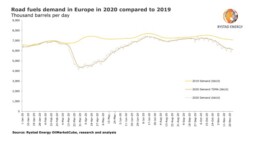

A Rystad Energy analysis of Europe’s real time traffic data has revealed that the road fuel demand destruction during the prevailing second wave of Covid-19-related lockdowns will be limited to just 900,000 barrels per day (bpd) for November 2020, when compared to the same period of 2019. The impact is weaker compared to April, as this lockdown is less extensive and as Europeans show lower compliance to restrictions than before. A third contributing factor is that people are more hesitant to use public transportation due to inherent infection risks, preferring instead to use private vehicles.
During April 2020, the peak month of the first European wave of lockdowns, road fuel demand fell by nearly 40% compared to April 2019, plunging from 7.4 million bpd to just 4.7 million bpd, a shocking 2.7 million bpd difference.
This time – as European governments walk a fine line between combating the virus while also protecting their economies – lockdowns have been imposed in a less severe manner than the shock therapy prescribed in April. That meant road fuel demand in November was expected to avoid the steep plunge that was experienced in April. As it turns out, however, markets are surprisingly seeing an actual resilience in demand this time.
Rystad Energy’s Mobility Stringency Index* shows that the restrictions currently imposed in Europe – had they been adhered to widely – should have resulted in a 20% to 30% drop in activity. Instead, as our real-time measurements show, we observe a drop of only around 12%, forecasting this November’s road fuel demand to fall to 6.3 million bpd from 7.2 million bpd in November 2019.
“Road fuel demand held up much better than expected for two reasons. Firstly, Europeans showed a lower degree of compliance this time compared to the strict enforcement of restrictions seen in April. Secondly, in an attempt to minimize the use of public transport, or to make up for a drop in bus and train services, people have elected to use their personal vehicles more often for commuting, thus lifting demand for road fuels by 2-3 percentage points depending on country,” says Artyom Tchen, Senior Oil Markets Analyst at Rystad Energy.
Despite its limited effect, this demand drop is counter-seasonal and will put a cap on global oil demand recovery in November-December 2020. It could also continue to impede growth in the first few months of 2021. If additional lockdowns are imposed in Europe and globally, there is further downside risk to oil demand, which would likely trigger a supply response.
We expect that the negative demand trend in Europe is sufficiently robust on an empirical level for OPEC+ to consider as a serious factor when the alliance meets on 30 November and 1 December 2020 to discuss whether to extend production cuts in 2021.
Separately, it is noteworthy that even in regions where the most stringent lockdowns were implemented under the first wave, road fuels demand did not completely freeze. In some cases, cars were allowed to circulate under special circumstances – such as emergencies or movement of essential personnel – and in general some road fuels demand was sustained by trucks.
In contrast, truck activity on the road was 7-8% above pre-virus levels in the largest European countries during October and most of November, while light-duty vehicle activity stayed below pre-virus levels. This resiliency of truck traffic can in part be attributed to the “Amazon effect” – reflecting an increased volume of goods delivery as more people order take-away and shop groceries from home.
It remains to be seen just how long the current lockdown will ultimately last, as this will depend on the epidemiological situation in each country, but most European governments are hoping to lift strict measures before Christmas in a bid to inject a degree of festive stimulus into their beleaguered economies.
Although restrictions could ease if a potential vaccination campaign in Europe rolls out relatively soon, the current lockdowns could be extended well into 1Q21 if cases continue to rise, providing a further downside risk to European demand levels this December and January – a risk that should not be brushed off by the market in the months to come.
*Rystad Energy has developed a Mobility Stringency Index, where 100 is the complete impossibility to use any type of transport and 0 is no mobility restrictions whatsoever. The index shows that the measures currently implemented in Europe are only about half as strict as those introduced during the first wave of the coronavirus.
Source: Rystad Energy



Related News.

Beyond Technical Skills: WISTA Cyprus explores the human side of leadership
WISTA Cyprus hosted The Art of Leadership & Emotional Mastery, an interactive workshop held on 15 October at the Alasia Hotel in Limassol,…

The human cost of sending merchant mariners into war zones extends far beyond the immediate danger of missiles and drones. It raises a harder question: who is really protecting the seafarer?
Who protects the seafarer? I have spent much of my professional life at sea. I am a Master Mariner. I have stood on the bridge, made decisions…

Loss of bridge control: Human failure is normal – context is key
When bridge control is lost in a functioning system, it can be easy to blame human error. But accidents rarely happen because of one mistake…

Danish Shipping announces the transport of live animals by sea new rules should improve safety for animals, seafarers and the environment
Revised rules on the transport of live animals by sea are being negotiated in the EU. Danish Shipping wants to ensure good animal welfare,…

Japan’s flawed shipping proposal leaves developing countries adrift
A new analysis by Opportunity Green warns governments of the wide-ranging risks posed by Japan’s proposal at the International Maritime Organization…

Intermodal Report Week 42 2026
Pls find below the Intermodal Report - Week 42 2026 Intermodal Report Week 42 2026

Allied Weekly Market Review Week 42
Pls find below the Allied - Weekly Market Review - Week 42 ALLIED - Weekly Market Report- Week 42
EU Arctic Strategy NGOs welcome EU ambition on on cutting shipping’s Arctic Black Carbon Emissions
Responding to today’s publication of the EU’s Arctic Strategy, which definitively states the EU’s intention to support International Maritime…

The final quarter of 2026 is expected to see softer bauxite flows
Chinese front-loading is expected to have run its course, pointing to softer bauxite flows in 2026 Q4. Global bauxite flows increased by 2.8% y/y…

DP World Foundation and Belewan new container terminal mark groundbreaking of AED 3.7 million school project in Indonesia
Classrooms of Hope initiative expands to Belawan, Medan with a new junior high school designed to provide modern learning facilities and greater…
Subscribe to our newsletter!
if you dont want to swim alone in the ocean of news, sign up for the newsletter, and you will receive daily all the important news of world shipping!
