Fuel from waste: In future Volkswagen Group Logistics will power car freighters with used oil from restaurants
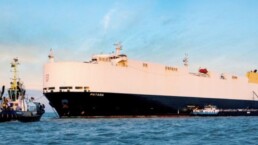

- First ship with MAN engine already running on climate-friendly fuel
- Approach reduces CO2 emissions of car freighters by more than 85 percent
- Part of a package of measures for sustainable logistics within the Volkswagen Group

The Volkswagen Group continues to force the pace of climate protection: in future, Volkswagen Group Logistics will be using certified fuel from vegetable residues for certain new car shipments via marine routes. The fuel is produced from materials such as used oil from restaurants and the food industry. The first car freighter was re-fuelled for the first time with this oil in mid-November 2020 and a second ship is due to follow at the beginning of 2021. “We are the first automaker to make widespread use of this fuel. This way, we reuse waste oil in an environmentally compatible way. With 85 percent lower CO2 emissions than with conventional fossil fuels, the contribution to climate protection is enormous,” says Thomas Zernechel, Head of Volkswagen Group Logistics.
For European shipments, Volkswagen Group Logistics continuously charters two vessels which carry up to 3,500 vehicles on a route from Emden via Dublin (Ireland), Santander (Spain) and Setubal (Portugal) back to Emden about 50 times per year. In the course of their journeys, they carry about 250,000 new vehicles of the AUDI, SEAT, ŠKODA, Volkswagen Passenger Cars and Volkswagen Commercial Vehicles brands every year.
The two ships, which are both 180 meters long, are each powered by an MAN marine diesel with more than 19,000 PS (14,220 kW). In future, the two ships are to be refueled at sea off the coast of Vlissingen (Netherlands) with alternative fuel supplied by the Dutch company GoodFuels. This way, the CO2 emissions of the two conventional vessels along their route will be reduced by more than 85 percent – from over 60,000 to about 9,000 tonnes per year. In addition, sulfur oxide emissions will be almost completely avoided.
This change is part of a strategy to make Group Logistics even greener: another element is the use of liquefied natural gas (LNG) to power car freighters. These vessels travel between Europe, North America and Latin America. Furthermore, all rail shipments in Germany with DB Cargo are being changed over to eco-power. “This way, Volkswagen Group Logistics is helping the Group achieve net carbon neutrality by 2050,” says Zernechel.



Related News.
Beyond Technical Skills: WISTA Cyprus explores the human side of leadership
WISTA Cyprus hosted The Art of Leadership & Emotional Mastery, an interactive workshop held on 15 October at the Alasia Hotel in Limassol,…
The human cost of sending merchant mariners into war zones extends far beyond the immediate danger of missiles and drones. It raises a harder question: who is really protecting the seafarer?
Who protects the seafarer? I have spent much of my professional life at sea. I am a Master Mariner. I have stood on the bridge, made decisions…
Loss of bridge control: Human failure is normal – context is key
When bridge control is lost in a functioning system, it can be easy to blame human error. But accidents rarely happen because of one mistake…
Danish Shipping announces the transport of live animals by sea new rules should improve safety for animals, seafarers and the environment
Revised rules on the transport of live animals by sea are being negotiated in the EU. Danish Shipping wants to ensure good animal welfare,…

Japan’s flawed shipping proposal leaves developing countries adrift
A new analysis by Opportunity Green warns governments of the wide-ranging risks posed by Japan’s proposal at the International Maritime Organization…

Intermodal Report Week 42 2026
Pls find below the Intermodal Report - Week 42 2026 Intermodal Report Week 42 2026

Allied Weekly Market Review Week 42
Pls find below the Allied - Weekly Market Review - Week 42 ALLIED - Weekly Market Report- Week 42
EU Arctic Strategy NGOs welcome EU ambition on on cutting shipping’s Arctic Black Carbon Emissions
Responding to today’s publication of the EU’s Arctic Strategy, which definitively states the EU’s intention to support International Maritime…
The final quarter of 2026 is expected to see softer bauxite flows
Chinese front-loading is expected to have run its course, pointing to softer bauxite flows in 2026 Q4. Global bauxite flows increased by 2.8% y/y…
DP World Foundation and Belewan new container terminal mark groundbreaking of AED 3.7 million school project in Indonesia
Classrooms of Hope initiative expands to Belawan, Medan with a new junior high school designed to provide modern learning facilities and greater…
Subscribe to our newsletter!
if you dont want to swim alone in the ocean of news, sign up for the newsletter, and you will receive daily all the important news of world shipping!
