Shipping industry urges Governments to take forward USD 5 billion proposal to accelerate the decarbonisation of maritime transport

Copenhagen/London/Washington, November 13, 2020 – As governments come together at the UN International Maritime Organization (IMO) to consider important next steps to decarbonise maritime transport, the global shipping industry urgently calls on them to take forward its proposal for an industry-financed, USD 5 billion research and development programme, to catalyse the transformation of the industry from dependence on fossil fuels to operating with zero-carbon energy sources.
“Meeting the ambitions of the IMO Greenhouse Gas reduction strategy requires immediate actions, which the IMO member states made very clear a few weeks ago. Now, we look forward to seeing the member states put weight behind their calls for action and advance our proposal, which can actually help the industry develop the technology needed to reach our decarbonisation targets,” says Deputy Secretary General Lars Robert Pedersen, BIMCO.
Although total emissions from shipping are about 7% lower than in 2008, there is a limit to what can be achieved so long as ships remain dependent on fossil fuels and global demand for maritime services continues to grow. The carbon reductions required by the IMO target of reducing total emissions from international shipping by at least 50% by 2050 compared to 2008, will only come from identifying and developing new zero-carbon technologies so that commercially viable zero-carbon ships can begin to operate in the 2030s.
There are several potential solutions, such as hydrogen or ammonia produced from renewable energy sources, but these do not yet exist in a scale or form that can be applied to large ocean-going ships. A host of complex technical questions remain to be answered, including safety, storage, distribution, energy density considerations and lifecycle impacts. In short, we do not yet know what the fuels of the future will be.
The shipping industry has therefore proposed a USD 5 billion R&D programme, to be overseen by IMO and financed through a mandatory R&D contribution of USD 2 per tonne of marine fuel consumed. The R&D programme would be managed through a non-governmental research and development organisation – an International Maritime Research and Development Board or IMRB. The co-sponsors emphasize that for the proposal to work, the R&D contributions need to be mandatory via an IMO regulation, to ensure that all shipping companies globally contribute, in a fair and equitable manner, and that the necessary funds will be generated to achieve the programme’s objectives.
A number of governments are understood to be positive to the proposal, subject to addressing issues such as governance.
The Industry is eager to work with governments to ensure that this initiative is implemented as soon as possible and calls on the IMO Marine Environment Protection Committee to support the development of the IMRB concept at its critical meeting starting November 16th. The IMO 2050 climate targets can only be achieved with the immediate acceleration of zero-carbon fuels and technologies, and the IMRB is a crucial vehicle for driving the progress needed to decarbonize the shipping industry.
Highlights of the International Maritime Research and Development Board (IMRB) proposal:
- The IMRB would be quasi-independent, subject to IMO oversight, with the sole duty to accelerate the research and development of low-carbon and zero-carbon fuels, energy sources, propulsion systems and other new GHG reduction technologies, operating under a Charter approved by IMO.
- An International Maritime Research Fund (IMRF) would provide industry financing for the IMRB research and development programmes, collecting about US$ 5 billion over a ten year period via mandatory contributions of USD 2 per tonne of fuel consumed by each ship.
- Other relevant stakeholders such as energy suppliers, technology companies, research and development institutions and foundations would be welcome to participate and contribute to the International Maritime Research and Development Board and its work.
- The IMRB is designed to work itself out of a job in 10-15 years by delivering research and development projects that will then allow commercial entities to provide the technologies and services that will move proven technologies into the global fleet by the 2030s, so that the IMO target for 2050 can be achieved.
- The shipping industry organisations behind the proposal emphasise that the USD 2 levy is not to be seen as a market-based CO2 reduction measure as it would only exist for a defined technical purpose – the acceleration of R&D for zero-carbon propulsion systems.
Source: BIMCO



Related News.

Beyond Technical Skills: WISTA Cyprus explores the human side of leadership
WISTA Cyprus hosted The Art of Leadership & Emotional Mastery, an interactive workshop held on 15 October at the Alasia Hotel in Limassol,…
The human cost of sending merchant mariners into war zones extends far beyond the immediate danger of missiles and drones. It raises a harder question: who is really protecting the seafarer?
Who protects the seafarer? I have spent much of my professional life at sea. I am a Master Mariner. I have stood on the bridge, made decisions…
Loss of bridge control: Human failure is normal – context is key
When bridge control is lost in a functioning system, it can be easy to blame human error. But accidents rarely happen because of one mistake…
Danish Shipping announces the transport of live animals by sea new rules should improve safety for animals, seafarers and the environment
Revised rules on the transport of live animals by sea are being negotiated in the EU. Danish Shipping wants to ensure good animal welfare,…
Japan’s flawed shipping proposal leaves developing countries adrift
A new analysis by Opportunity Green warns governments of the wide-ranging risks posed by Japan’s proposal at the International Maritime Organization…

Intermodal Report Week 42 2026
Pls find below the Intermodal Report - Week 42 2026 Intermodal Report Week 42 2026
Allied Weekly Market Review Week 42
Pls find below the Allied - Weekly Market Review - Week 42 ALLIED - Weekly Market Report- Week 42
EU Arctic Strategy NGOs welcome EU ambition on on cutting shipping’s Arctic Black Carbon Emissions
Responding to today’s publication of the EU’s Arctic Strategy, which definitively states the EU’s intention to support International Maritime…
The final quarter of 2026 is expected to see softer bauxite flows
Chinese front-loading is expected to have run its course, pointing to softer bauxite flows in 2026 Q4. Global bauxite flows increased by 2.8% y/y…
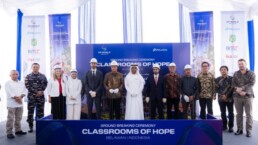
DP World Foundation and Belewan new container terminal mark groundbreaking of AED 3.7 million school project in Indonesia
Classrooms of Hope initiative expands to Belawan, Medan with a new junior high school designed to provide modern learning facilities and greater…
Subscribe to our newsletter!
if you dont want to swim alone in the ocean of news, sign up for the newsletter, and you will receive daily all the important news of world shipping!
