Asia-US container rates rise, tanker rates ex-USG steady; Panama Canal lowers draft limits
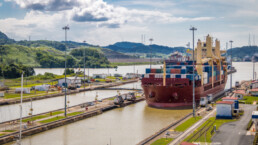

Rates for shipping containers from east Asia and China to the US were mostly higher, liquid chemical tanker rates ex-US Gulf were largely stable, and the Panama Canal issued further drafts restrictions, highlighting shipping news this week.
PANAMA CANAL
The Panama Canal Authority (PCA) is lowering draft limits at its neopanamax locks beginning 26 August as the strengthening El Nino is contributing to lower levels at Gatun Lake, the freshwater body of water that feeds the locks.
Draft limits will be lowered to 48ft (14.63m) on 26 August and then to 47.5ft on 3 September.
These are the fourth and fifth reductions in draft limits this year.
The PCA will continue to closely monitor water levels in Gatun Lake, the freshwater reservoir that feeds the canal locks, and hydrological projections and will announce additional adjustments as necessary.
El Nino – which is a recurring climate pattern characterized by warmer-than-normal water in the eastern and central tropical Pacific – tends to result in increased vertical wind shear, which is unfavorable for Atlantic hurricane formation and intensification, and is important for predictions during hurricane season.
El Ninos can lead to reduced rainfall around Panama, which in the past has contributed to lower water levels in Gatun Lake.
The latest advisory from the US National Oceanic and Atmospheric Administration (NOAA) said the El Nino is present with equatorial sea surface temperatures (SSTs) above average across the central and eastern Pacific Ocean.
“El Nino will strengthen through the end of the year, with a 97% chance it will persist through early spring 2027,” NOAA said.
CONTAINER RATES
Asia-US container rates saw upward pressure this week on a combination of the early peak season demand lasting longer than anticipated, carriers managing capacity by scheduling blank sailings, and partial success of 1 August rate hikes.
Rates to the US West Coast are between $5,800-$7,200/FEU (40-foot equivalent unit) while rates to the East Coast are between $7,900-$10,250/FEU.
Supply chain advisors Drewry said carriers successfully implemented GRIs (general rate increases) as volumes held firm into August. Meanwhile, port congestion across central and south China continued to constrain capacity, providing further support to freight rates.
With eight blank sailing scheduled for next week, Drewry expects less volatility in rates in the coming weeks.
Peter Sand, chief analyst at ocean and freight rates and analytics firm Xeneta, said carriers keep trying to strike the right balance between the soft patch of demand and their eagerness to deploy capacity.
“This is done by blanking sailings on services where weekly departures were scheduled only to be cancelled at the last minute,” Sand said. “Tactics like these are spooking shippers, who thought they could rely on the announcements only to find their cargo not moving.”
Shipping market intelligence firm Linerlytica said cargo demand remains strong out of Asia, and persistent port congestion in China has created space and equipment shortages that have kept freight rates at elevated levels.
Not all analysts think rates will remain elevated.
Robert Khachatryan, founder and CEO of Freight Right Global Logistics, said some of the GRIs have not been widely accepted in the market.
“Forwarders are already using contract allocations, blended rate structures, and special pricing to offer practical rates,” Khachatryan said. “Based on current booking activity, the August increase is expected to be largely erased within days, returning West Coast rates to approximately where they stood before the increase.”
Rates on the Shanghai Containerized Freight Index (SCFI), which tracks rates for containers leaving Shanghai, rose by 2.19% for the second week in a row following three consecutive down weeks.
Rates on the NYSHEX Freight Index (NYFI) rose by 1% to the West Coast and fell by 3.9% to the East Coast.
Container ships and costs for shipping containers are relevant to the chemical industry because while most chemicals are liquids and are shipped in tankers, container ships transport polymers, such as polyethylene (PE) and polypropylene (PP), which are shipped in pellets. Titanium dioxide (TiO2) is also shipped in containers.
They also transport liquid chemicals in isotanks.
LIQUID TANKER RATES
US chemical tanker freight rates ex-US Gulf (USG) assessed by ICIS were mostly unchanged week on week.
Trade routes from the USG remain slow as several trade lanes are discussed slightly and enquiries continue to be slow and largely dominated by contract of affreightment (COA) volumes.
Spot cargo moving into Asia remains muted following the escalation of tensions in the Middle East as well as precautionary measures implemented for Panama Canal transits.
As a result, rates are stable from the previous week. The usual cargoes of methanol, monoethylene glycol (MEG), and ethanol were seen quoted in the market for end-August to early-September lifting.
Meanwhile rates from the USG to Rotterdam are experiencing the same trend, as this market also remains stable.
Most of the regular carriers have noted that there is little prompt space. However, they did comment that there is plenty of space remaining for H2 August.
Should this trend continue, rates could be pressured even lower. Large parcels of methanol and caustic soda as well as parcels of styrene were seen quoted in the market.
COA volumes remain fairly steady heading into the first half of August.
From the USG to Brazil, this market has remained relatively unchanged and is experiencing some downward pressure.
While the market continues to be inactive it is further influenced by freight availability and a swing in trade lane dynamics.
Demand remains soft, particularly for larger parcels further pressuring some downward movement.
For the USG to India trade lane, the market remains extremely soft with plenty of space available as outsiders entered the market.
As a result, this has placed downward pressure on rates, which fell this week, and could fall further on the route if this persists.
Several enquiries were seen for MEG, methanol, ethanol, and vinyl acetate monomer (VAM).
Source: ICIS by Adam Yanelli, Additional reporting by Kevin Callahan



Related News.
Italy and Cyprus chart a shared course for the blue economy: Italy-Cyprus Maritime Business Forum in Limassol on 9 October
Institutions and businesses from both countries will meet at the DP World Terminal for three sessions on sustainable ports, shipping and maritime…
Satellite monitoring reveals recurring vessel activity across three of Cyprus’s marine protected areas
More than two thousand detections at Lady’s Mile, Latsi-Akamas and Cavo Greco within the months of June-August highlight distinct activity patterns…

Shipbuilding Labor talks hit fresh snags after tentative deal rejected
This year’s wage and collective bargaining negotiations in the shipbuilding industry are drifting back into uncertainty just as they appeared to be…

SEA.AI brings Machine Vision to multiple USV platforms at NATO’s REPMUS 2026
Maritime AI specialist demonstrated a shared perception layer across crewed and uncrewed vessels during the Portuguese Navy-led exercise, held in…

Clean tanker markets size up impact of potential US diesel export curbs
HIGHLIGHTS Trump floats diesel export ban amid soaring prices MR tanker demand could fall by 1.35 million b/d Russian diesel exports…
RINA and PTT sign strategic agreements to advance innovation and decarbonization across the energy and maritime sectors
RINA, the inspection, certification and engineering consulting multinational, announces the signing of two Memoranda of Understanding with PTT…

IMEC and The Hood launch Sisterhood Box to support the next generation of female seafarers
The International Maritime Employers’ Council and The Hood Platform have joined forces to launch the Sisterhood Box, a new initiative providing…

The Port Authority and Valencia City Council launch the countdown to the River Mouth Park
The Port Authority of Valencia (APV) and Valencia City Council have reached an agreement on the River Mouth Park setting out the commitments of both…

Newbuild order for two very large ammonia acriers in combination with long term time charters
SFL Corporation announced that it has agreed to build two 93,000 cbm Very Large Ammonia Carriers. The vessels will be able to carry a wide range of…

xclusiv S&P Report 05th October 2026
Pls find below the [xclusiv] S&P Report 05th October 2026 [xclusiv] 2026_10_05
Subscribe to our newsletter!
if you dont want to swim alone in the ocean of news, sign up for the newsletter, and you will receive daily all the important news of world shipping!
