Why Nordic Ministers must commit to backing Arctic Black Carbon Reduction
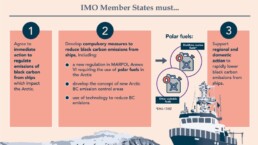

NGOs call on ministers meeting in Stockholm to back IMO regulation on polar fuels
Ahead of next week’s session of the Nordic Council, the Clean Arctic Alliance today called on Nordic governments to adopt a resolution on polar fuels during the meeting, and together commit to support an International Maritime Organization (IMO) regulation that would require cleaner maritime fuels, which would result in lower emissions of black carbon by ships when operating in the Arctic.
The deadline for concrete proposals for such a regulation to be submitted to the thirteenth session of the IMO’s technical committee that addresses pollution prevention and response (PPR13, February 2026) is December 5th.
“Ahead of a crucial meeting of the IMO next February, the Clean Arctic Alliance is calling for the Member States of the International Maritime Organization to develop and adopt a mandatory regulation which would require that only polar fuels can be used by shipping in the Arctic”, said Dr Sian Prior, Lead Advisorto the Clean Arctic Alliance. “A resolution on polar fuels adopted by Nordic governments next week would send a strong message to IMO Member States that action is urgently needed to protect the Arctic from the impacts of shipping emissions.”
“Black carbon is a climate superpollutant produced when fossil fuels are burned”, said Prior. “Black carbon has a disproportionate impact because it both heats the atmosphere – and when released from ship exhausts and when near to the Arctic it settles onto snow and ice, speeding up the melting and exposing darker land and sea beneath, which continue to absorb more heat. It is the loss of the planet’s reflectivity – or albedo – which is contributing to the fast pace of warming seen in the Arctic.”
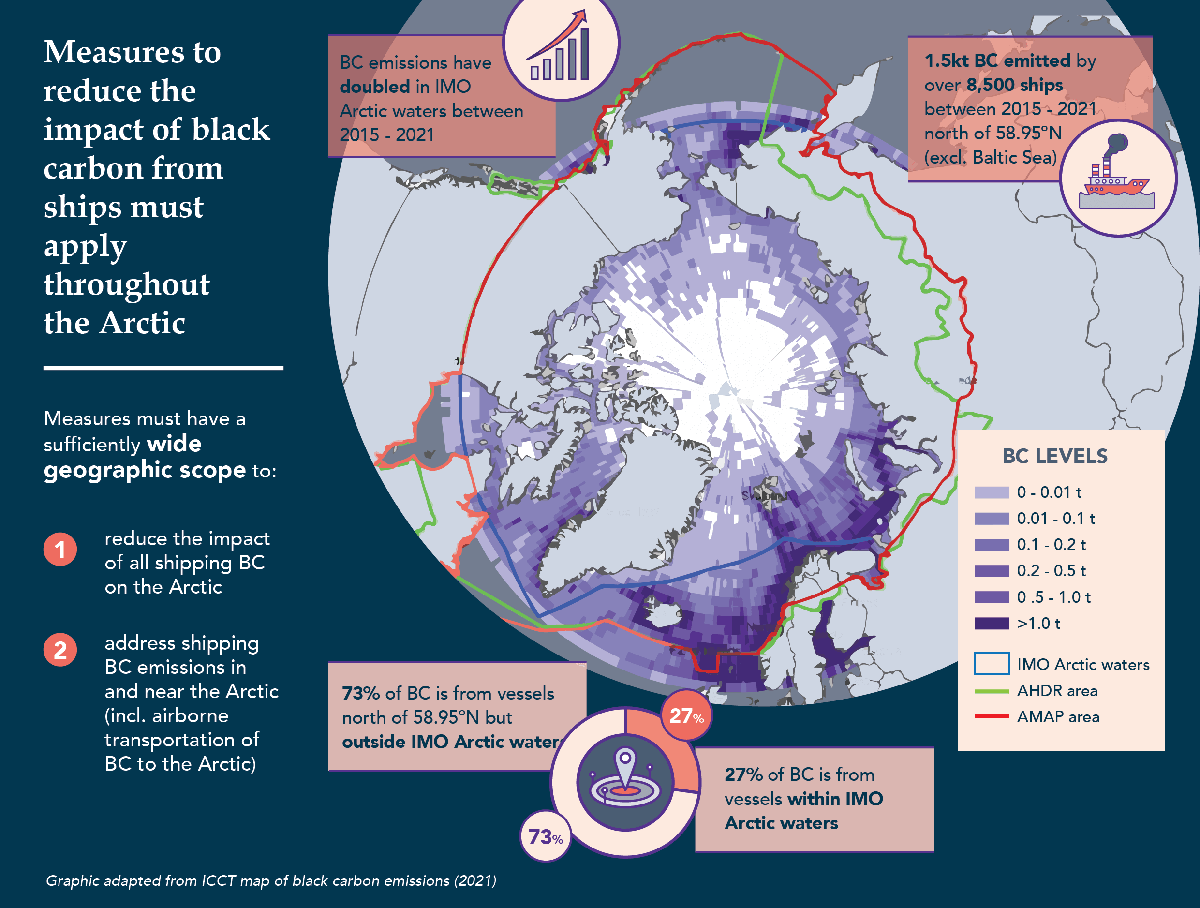
“Black carbon emissions from ships burning oil-based fuels have more than doubled in the last decade, yet a simple and easy solution is to require shipping to use widely available distillate fuels with lower black carbon emissions when operating in and near to the Arctic”, said Prior.
About Black Carbon, Polar Fuels, and the Arctic
Black carbon is a short-lived climate pollutant, produced by the incomplete burning of fossil fuels, with an impact more than three thousand times that of CO2 over a 20 year period. It makes up around one-fifth of international shipping’s climate impact. Not only does it contribute to warming while in the atmosphere, black carbon accelerates melting if deposited onto snow and ice – hence it has a disproportionate impact when released in and near to the Arctic.
The melting snow and ice exposes darker areas of land and water and these dark patches then absorb further heat from the sun and the reflective capacity of the planet’s polar ice caps is severely reduced. More heat in the polar systems – results in increased melting. This is the loss of the albedo effect.
Declines in sea ice extent and volume are leading to a burgeoning social and environmental crisis in the Arctic, while cascading changes are impacting global climate and ocean circulation. Scientists have high confidence that processesare nearing points beyond which rapid and irreversible changes on the scale of multiple human generations are possible. Scientists say it is now too late to save summer Arctic sea ice, and research has shown that “preparations need to be made for the increased extreme weather across the northern hemisphere that is likely to occur as a result.”
Black carbon also has a negative impact on human health including premature death and harmful effects on the cardiovascular system (heart, blood and blood vessels), and recent research has found black carbon particles in the body tissues of foetuses, following inhalation by pregnant mothers.
The need to reduce emissions of black carbon because of both the climate and health impacts has been long recognised. On land, considerable effort has been made to ban dirtier fuels in power stations, to install diesel particulate filters on land-based transport, and to improve the burning of dry wood – all to reduce emissions of black carbon and improve air quality. However, at sea the same efforts have not yet been made.
In a paper submitted to a meeting of the IMO’s Marine Environment Protection Committee (MEPC 82/5/2*: Regulating Black Carbon emissions from international shipping impacting the Arctic) NGOs called on IMO Member States to consider the development of a new regulation for inclusion in MARPOL Annex VI (the main international treaty addressing air pollution prevention requirements from ships) which would identify suitable polar fuels, for example distillate fuels, such DMA or DMZ, to deliver an immediate fuel-based reduction in black carbon emissions from international shipping impacting the Arctic. The paper develops the concept of “polar fuels” discussed at technical subcommittee meeting (PPR 11) and sets out the fuel characteristics that would distinguish polar fuels from residual fuels and thus lead to fuel-based reductions in ship Black Carbon emissions if mandated for use in and near the Arctic. Polar fuels were discussed further at a meeting of the PPR technical subcommittee in January 2025, following which the Clean Arctic Alliance welcomed the broad support from IMO member states, and parts of the fuel and shipping industry, for the further development of the polar fuels concept.



Related News.

OL Shipping Group in Tokyo: Capt. Eberhard Koch calls for realistic solutions to Maritime Decarbonisation
An intensive and engaging couple of days in Tokyo brought together leading figures from the international maritime community, providing a valuable…
Regatta for Peace one of the largest ever in Cyprus
Cyprus will host the first European stop on a global sailing journey leading up to the 2027 America’s Cup in Naples. More than 120 sailors…
The propulsion technology powering the marine energy transition
The marine industry is under increasing pressure to future-proof fleets, balancing the need to reduce emissions and improve efficiency. Propulsion…
Signal Ocean acquires Lgmar
Signal Ocean announced the acquisition of Lgmar, the Athens-based company behind Telix, a maritime email and communication platform in daily use…

Canada clean power push challenged by interprovincial grid limits, says GlobalData
Canada is entering a pivotal phase of power-sector expansion as federal tax credits, the phase-out of coal-fired generation, and accelerating…

Maritime safety depends on human factors and leadership, not procedures alone
Interim survey findings point to a gap between seafarers’ perceptions of risk and injury data Seafarers may misjudge when and where they are most at…

New BIMCO contracts tackle ship recycling and energy-saving retrofits
BIMCO adopted two new contractual solutions designed to help you manage important operational and regulatory challenges: the revised…
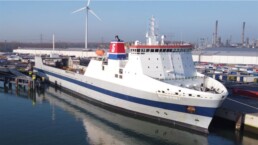
Stena Line to acquire vessel and make changes to its network
Stena Line has reached an agreement to acquire the RoRo vessel Somerset from CLdN. Subject to closure and transfer, the vessel would begin operating…
DORIC WEEKLY INSIGHT 16 OCTOBER 2026
Please find below the DORIC Market Insight for the week ending 16th October 2026. Weekly Report 16.10.2026

Important information for port clients and freight carriers effective November 1, a new traffic overpass and port checkpoint will open for traffic to the Port of Riga on Kundziņsala
Starting November 1 of this year, a new traffic overpass connecting Tvaika Street to Kundziņsala will open to facilitate traffic to and from the Port…
Subscribe to our newsletter!
if you dont want to swim alone in the ocean of news, sign up for the newsletter, and you will receive daily all the important news of world shipping!
