
The marine industry is under increasing pressure to future-proof fleets, balancing the need to reduce emissions and improve efficiency. Propulsion technology is becoming a strategic differentiator rather than simply a component of vessel design.
ABB is at the forefront of this transition, developing propulsion and electrification technologies that enable vessel operators to reduce fuel consumption, lower emissions and prepare for increasingly stringent environmental requirements.
The shift is being driven by tightening regulation. The International Maritime Organization’s decarbonization ambitions, alongside measures such as FuelEU Maritime and the Carbon Intensity Indicator (CII) are creating new expectations around fuel consumption and emissions performance.
In response, electrification is playing an increasingly important role across a broad range of vessel types. Ferries, harbour tugs, offshore support vessels and hybrid-powered ships are all adopting new propulsion systems designed to reduce energy consumption while maintaining both performance and reliability.
Meeting evolving requirements in marine operations
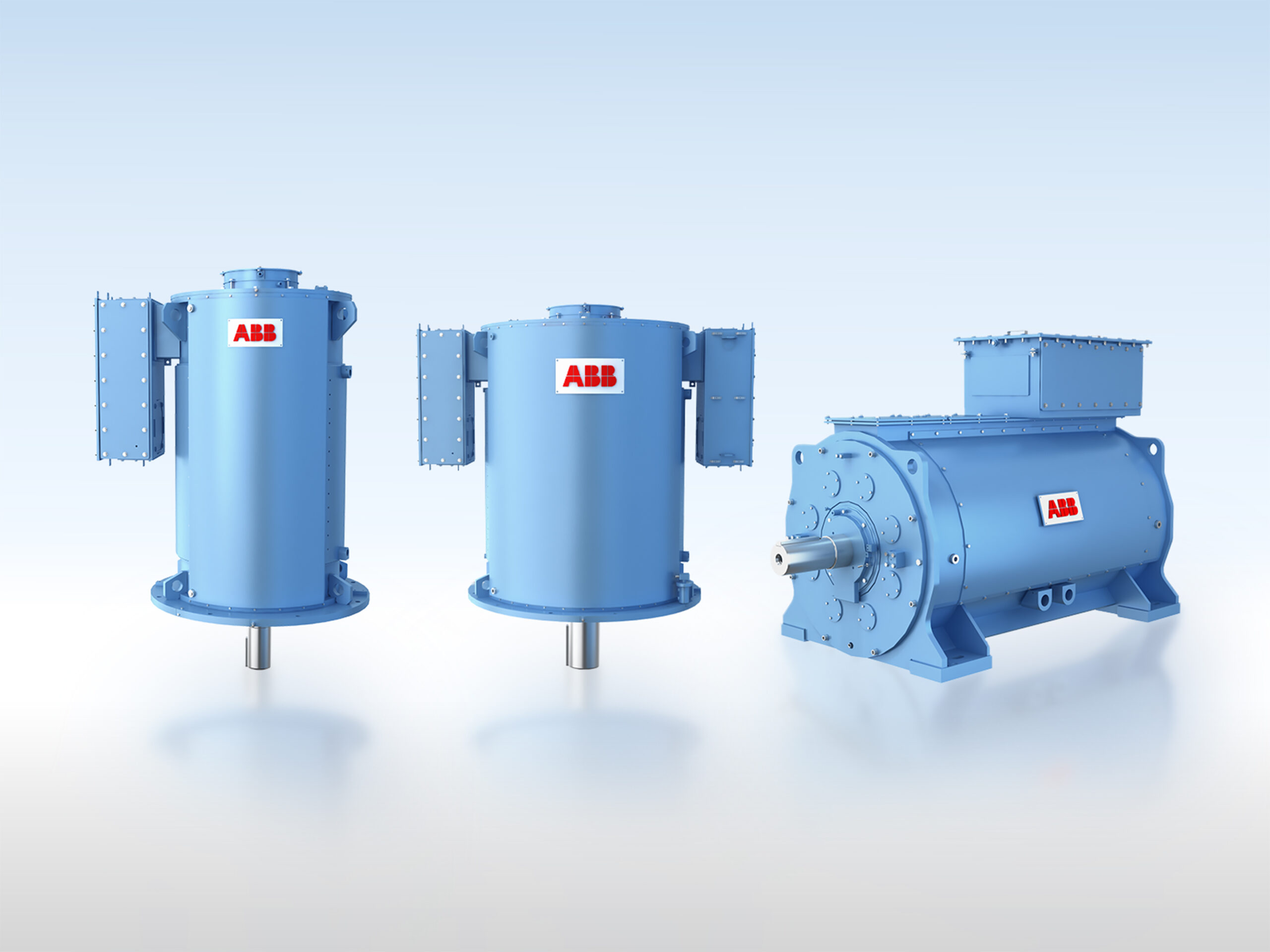
A variety of proven motor technologies are available to vessel operators for propulsion, thruster and auxiliary applications. Induction motors are widely adopted throughout the maritime industry due to their reliability, simplicity and cost-effectiveness, while synchronous motors offer enhanced overload performance, making them well suited to demanding operational environments.
Marine vessels rarely operate at constant speeds or loads. So, manoeuvring in ports, dynamic positioning and unpredictable sea conditions mean propulsion systems spend much of their time operating outside of rated conditions. Under these conditions, motor efficiency can vary across the operating range, influencing energy consumption and battery endurance.
In addition, many traditional propulsion systems require gearboxes to deliver the low-speed, high-torque performance required for marine operations. While effective, these arrangements occupy valuable onboard space and introduce maintenance requirements throughout the vessel’s lifecycle.
These challenges are helping to drive interest in Permanent Magnet (PM) motor technology in both geared and direct-drive configuration.
PM motors minimize rotor losses and maintain high efficiency across a much broader operating range. The result is a propulsion solution that can deliver both operational and environmental benefits while helping vessel owners prepare for an increasingly electrified future.
Improving efficiency through permanent magnet technology
The advantages of PM motor technology become particularly significant in marine environments where operating conditions continually change.
Whether a vessel is manoeuvring in confined waters, maintaining position offshore or operating under varying weather conditions, propulsion demands fluctuate constantly. When paired with variable speed drives, PM motors can continuously optimize speed and torque to match operational requirements, improving overall system performance and reducing wasted energy.
PM motor systems can achieve efficiencies of up to 98%, while reducing energy losses by as much as 50% when compared with equivalent induction motor solutions.
For a 1,500 kW motor operating 8,000 hours per year, a permanent magnet motor can generate energy savings of approximately $38,000 annually compared with an equivalent induction motor, assuming electricity costs of $0.10/kWh. This enables a return on investment in under 18 months and avoids around 80,000 kg of CO₂ emissions each year. Over a 25-year service life, the cumulative savings can be significant.
A key advantage is the ability to operate in direct-drive configurations. By eliminating gearboxes, belts and pulleys, vessel operators can reduce mechanical losses, improve drivetrain efficiency and simplify maintenance requirements. These benefits can significantly shorten return-on-investment timelines while contributing to lower fuel consumption, reduced generator loading and extended battery operating range.
Over the life of a vessel, these improvements can translate into meaningful emissions reductions and lower operating costs.
Built for demanding marine environments
Alongside efficiency, reliability remains one of the most important considerations for vessel operators.
Space restrictions, harsh operating conditions and continuous duty cycles place significant demands on propulsion equipment. Compact and robust solutions are becoming increasingly important for both newbuild projects and retrofit programmes.
In this regard, the high torque density of permanent magnet technology allows more power to be delivered from a smaller footprint, providing greater flexibility for vessel designers while helping reduce overall vessel weight.
Direct-drive configurations also reduce the number of components within the propulsion system, simplifying installation and maintenance.
Advanced cooling solutions, including water-jacket cooling technology, further reduce space requirements while lowering auxiliary system complexity. Meanwhile, motors designed for demanding industrial environments, including IP55 and IP56 protection classes, provide the durability required to withstand humidity, vibration, salt exposure and continuous operation at sea.
PM motor technology supports future-ready propulsion architectures capable of integrating with diesel-electric systems, battery storage, shore power connections and emerging renewable energy technologies as they become more widely adopted.
By generating electricity from the main propulsion shaft, the technology also helps reduce fuel consumption, lower emissions and support compliance with the International Maritime Organization’s Energy Efficiency Design Index (EEDI) and Carbon Intensity Index (CII) requirements.
Juha-Pekka Kivioja, Senior Global Product Manager at ABB Motion High Power
“As shipping advances towards a lower-carbon future, vessel operators need technologies that improve efficiency without compromising operational performance. Permanent magnet motors offer a practical pathway to achieving both goals, enabling higher efficiency, more compact propulsion systems and greater flexibility for hybrid and fully electric vessel architectures.”
To learn more about ABB’s marine propulsion and electrification solutions, visit: https://www.abb.com/global/en/areas/motion/motors-generators/mv-hv-motors/synchronous-motors/permanent-magnet-motors



Related News.

OL Shipping Group in Tokyo: Capt. Eberhard Koch calls for realistic solutions to Maritime Decarbonisation
An intensive and engaging couple of days in Tokyo brought together leading figures from the international maritime community, providing a valuable…
Regatta for Peace one of the largest ever in Cyprus
Cyprus will host the first European stop on a global sailing journey leading up to the 2027 America’s Cup in Naples. More than 120 sailors…
Signal Ocean acquires Lgmar
Signal Ocean announced the acquisition of Lgmar, the Athens-based company behind Telix, a maritime email and communication platform in daily use…

Canada clean power push challenged by interprovincial grid limits, says GlobalData
Canada is entering a pivotal phase of power-sector expansion as federal tax credits, the phase-out of coal-fired generation, and accelerating…

Maritime safety depends on human factors and leadership, not procedures alone
Interim survey findings point to a gap between seafarers’ perceptions of risk and injury data Seafarers may misjudge when and where they are most at…

New BIMCO contracts tackle ship recycling and energy-saving retrofits
BIMCO adopted two new contractual solutions designed to help you manage important operational and regulatory challenges: the revised…
Stena Line to acquire vessel and make changes to its network
Stena Line has reached an agreement to acquire the RoRo vessel Somerset from CLdN. Subject to closure and transfer, the vessel would begin operating…

DORIC WEEKLY INSIGHT 16 OCTOBER 2026
Please find below the DORIC Market Insight for the week ending 16th October 2026. Weekly Report 16.10.2026

Important information for port clients and freight carriers effective November 1, a new traffic overpass and port checkpoint will open for traffic to the Port of Riga on Kundziņsala
Starting November 1 of this year, a new traffic overpass connecting Tvaika Street to Kundziņsala will open to facilitate traffic to and from the Port…

Trafigura appoints Chipokota Mwanawasa as Executive Director, Zambia
Trafigura has appointed Chipokota Mwanawasa as Executive Director, Zambia. Chipokota is a Zambian national and brings more than 10 years of…
Subscribe to our newsletter!
if you dont want to swim alone in the ocean of news, sign up for the newsletter, and you will receive daily all the important news of world shipping!
