Containers lead on efficiency: 67% of the fleet achieves a CII Rating of A–C


Using VesselsValue (a Veson Nautical solution) data, we take a look at who controls the largest vessel portfolios and how the global fleet measures up against increasingly stringent environmental benchmarks. As the industry faces mounting pressure to decarbonise and regulatory frameworks tighten worldwide, understanding both market concentration and sustainability performance has never been more critical for stakeholders.
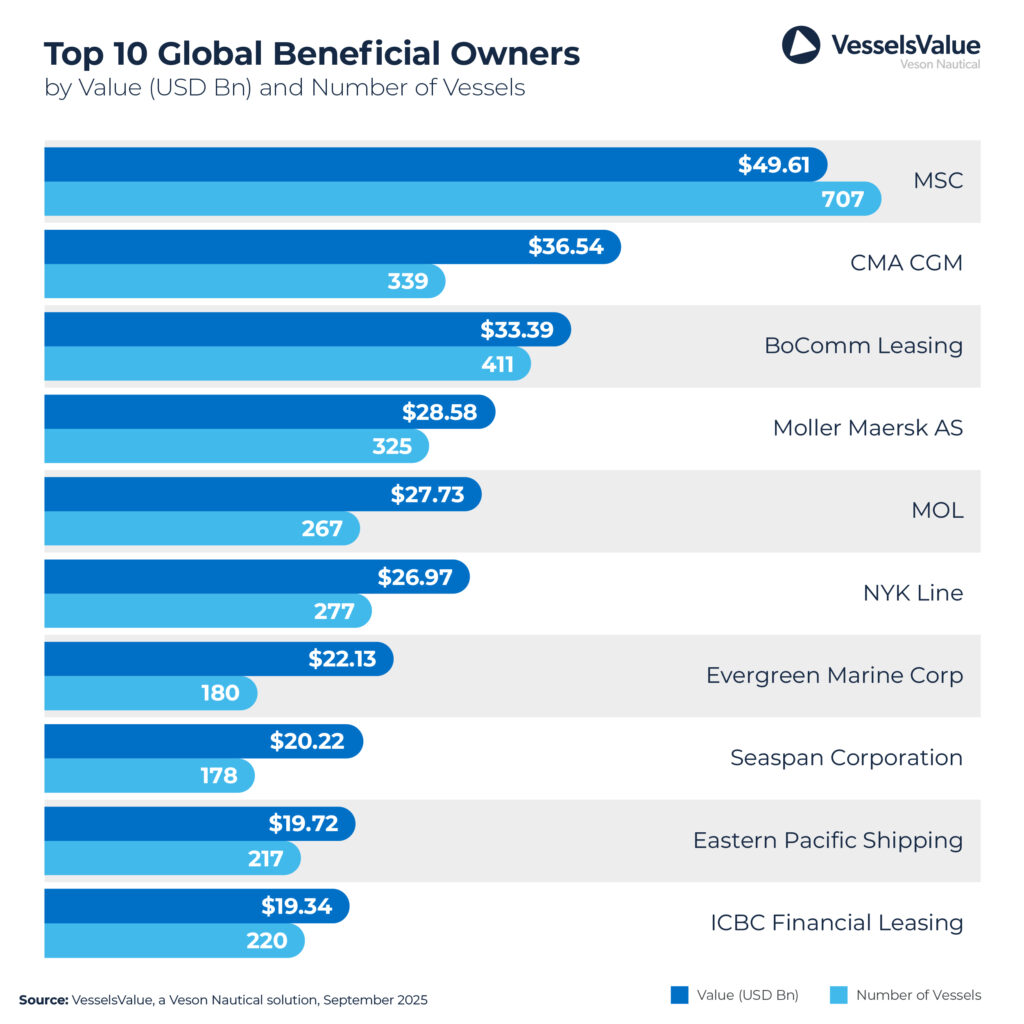
In terms of the top 10 global beneficial owners by value, Swiss based MSC currently owns the most expensive fleet with a value of USD 49.6 bil. This is also the largest in terms of vessel numbers with a total of 707 vessels, of which 584 are live and 125 on order. The vast majority of this fleet is of course in the Container sector with Panamaxes and Post Panamaxes accounting for around half of this segment. Within the orderbook, MSC has invested heavily in ULCVs, accounting for around c.59% of the orderbook and the remainder of orders are in the New Panamax category.
Values for the Container vessel type have increased across most sub sectors and age ranges this year, particularly for older ships. For example, 15YO Sub Panamax Container vessels of 2,500 TEU have increased by c.19.96% from the start of the year from USD 26.4 mil to USD 31.67 mil. Given that there are a number of Container owners in the top 10, this would have a significant positive impact on fleet values.
In second place is French owner, CMA CGM whose fleet is valued at USD 35.5 bil and a total of 339 vessels. This fleet is almost entirely dedicated to the Container sector with 243 live vessels ranging from Feedermaxes to ULCVs, 95 vessels on order,c.53% in the ULCV sector, c.34% in New Panamax sector, and the remaining c.13% in the Post Panamax sector.
BoComm leasing is the third largest owner through leasing arrangements in dollar terms, with a fleet value of USD 33.3 bil. However, this fleet ranks second in terms of size with a portfolio of 411 vessels spanning all major sectors, including Bulkers, Tankers, Containers, Gas, RoRo, and Vehicle Carriers.
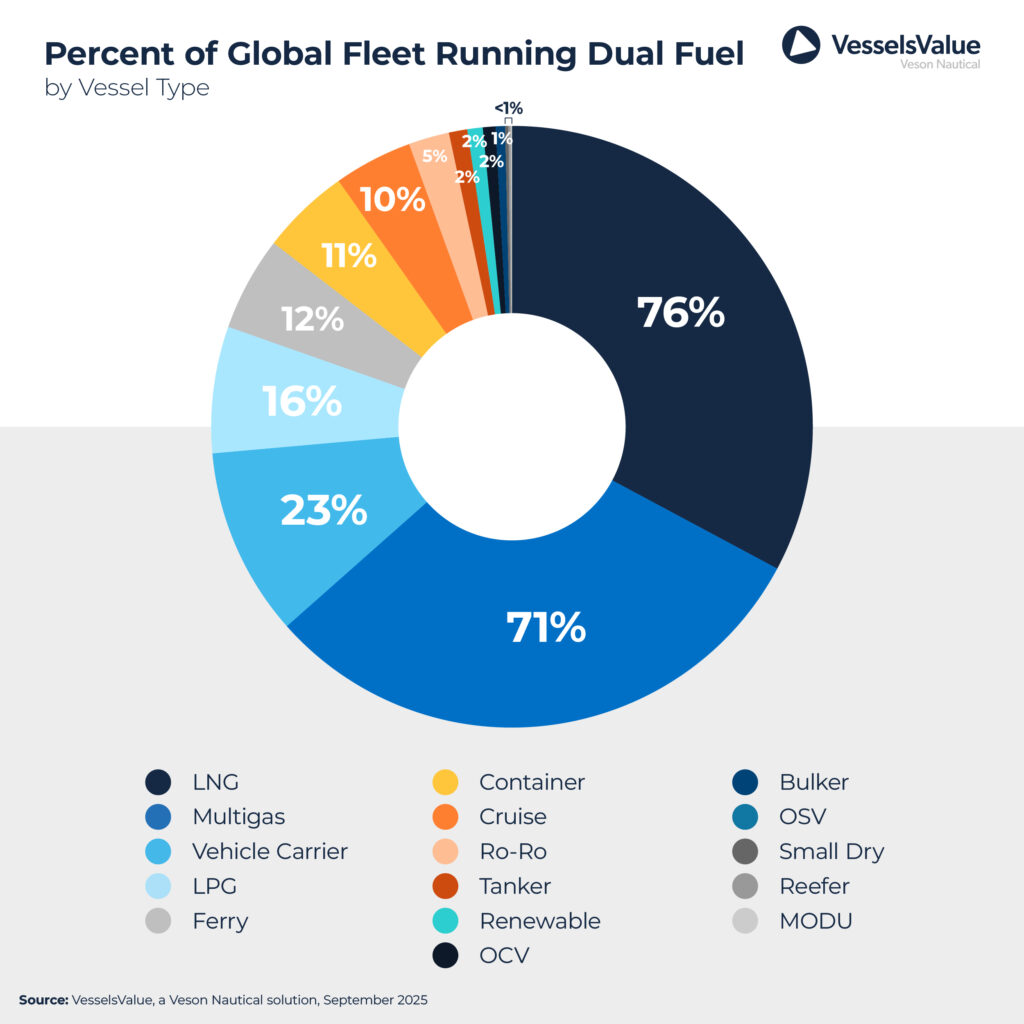
The Gas sectors have the highest percentage of the fleet both live and on order with LNG vessels leading the way at c.76%. Modern and newly built LNG vessels will inherently be dual fuel, but older vessels typically were not built with such a design. However, some vessels may have been built as dual-fuel ready, providing shipowners with the option to retrofit full dual-fuel systems when market conditions or regulations make the investment attractive.
Multigas rank second with c.71% followed by Vehicle Carriers with a share of 23%. Within the global orderbook, the majority of Vehicle Carriers are dual-fuel specific. This trend is driven by the primary cargo transported aboard these vessels: factory new OEM (Original Equipment Manufacturer) light vehicles, including EVs (Electric Vehicles). OEMs prioritize transporting their new light and heavy vehicles on clean vessels that provide lower emission ratings. This preference has led to increased demand for environmentally superior shipping solutions. As a result, shipowners operating in the Vehicle Carrier sector are ordering dual-fuel ships at significantly higher rates than those in other maritime sectors.
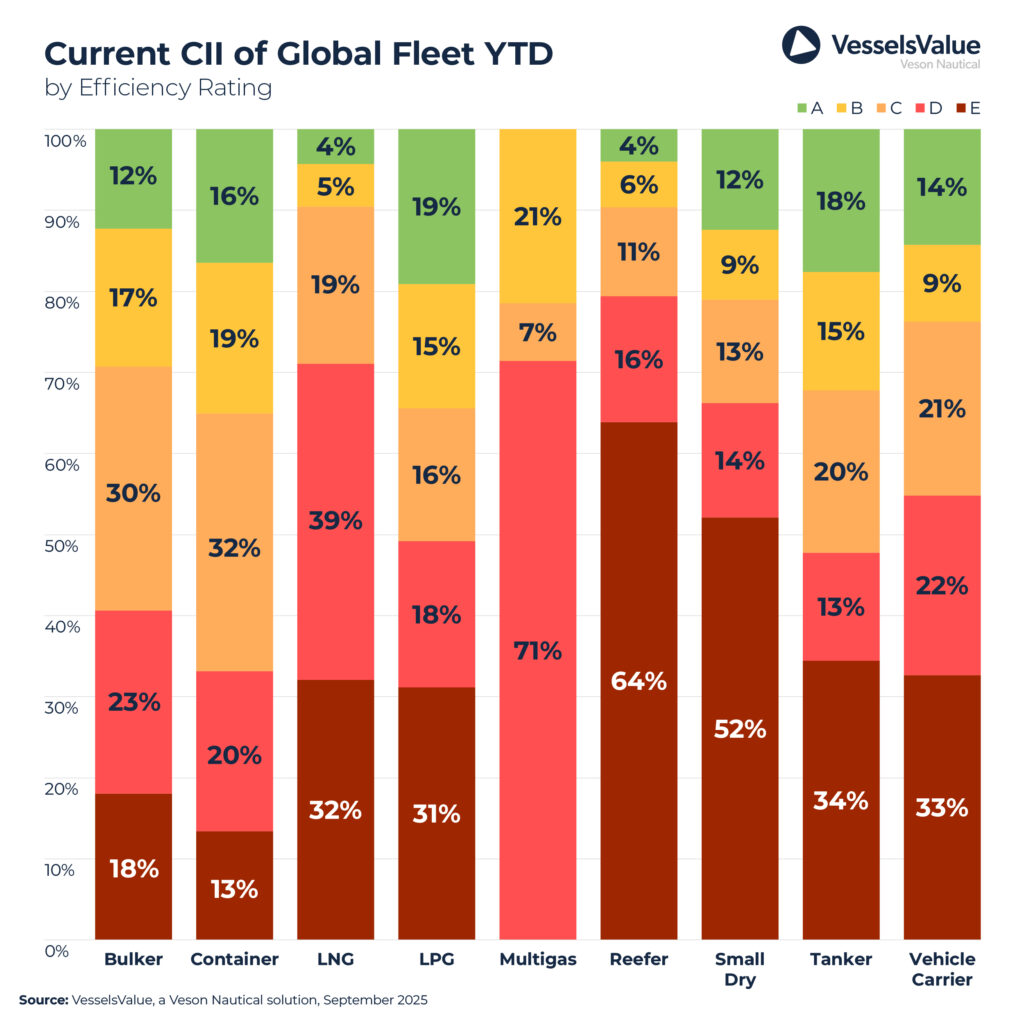
Decarbonisation is of increasingly high importance to the global fleet and a growing percentage of the overall fleet ranks highly in the mandatory energy efficiency ratings from the International Maritime Organization (IMO). The Multigas sector is the fleet with the largest percentage of vessels in band A at c.21% and the Container sector has the most vessels within bands A-C with c.67% of the fleet achieving a rating within this range.
The data reveals a sector in transition. While market concentration remains high among a few dominant players, the rapid adoption of dual-fuel technology and improving energy efficiency ratings demonstrate the industry’s commitment to meeting global decarbonisation goals. The challenge ahead lies in balancing operational efficiency with environmental responsibility as regulatory frameworks continue to evolve and stakeholder expectations intensify.
Source: Veson Nautical



Related News.

Cyprus Marine Club Welcomes a Full House for Aphentrica’s War Risks Presentation
The Cyprus Marine Club marked its return after the summer break with a full house at Gazebo Mare on Tuesday, 22 September, bringing together members,…

IMO seeks feedback on Maritime Single Window implementation
The International Maritime Organization (IMO) has launched a global survey to assess the implementation and use of Maritime Single Windows (MSWs),…

World Maritime Day industry panel to examine the gap between maritime policy and the reality of life at sea
OneCare Group will bring together crewing, safety, insurance and wellbeing specialists for a World Maritime Day webinar examining how shipping can…

IUMI President – Marine insurers are war insurers
Marine insurers are at the heart of managing war risks to global shipping and must continue to develop the tools needed to support and facilitate…
Seafarer welfare is improving amongst leading companies, but five years of evidence shows this progress is far from the norm
Five years on, the Seafarers’ Rights Code of Conduct is driving more than 1,000 companies to participate in RightShip’s Crew Welfare…
The UK ETS arrives for shipping what it means for charterers
Introduction The UK Emissions Trading Scheme (UK ETS) was extended to domestic maritime activity on 1 July 2026, following the EU ETS, FuelEU…
ABP Southampton invests locally with Marine Cranes to boost capability
Associated British Ports , the UK’s largest port operator, has invested a new marine deck crane aboard Spartina, one of the Port of Southampton’s…
BIMCO Shipping Number of the Week
Caribbean Basin crude oil and heavy product exports jump 45% “Seaborne exports of crude oil and heavy products from the Caribbean Basin have…

xclusiv S&P Report 21th September 2026
Pls find below the [xclusiv] S&P Report 21th September 2026 [xclusiv] 2026_09_21
Marine insurance supply remains stable as geopolitical and technical changes reshape the market, says IUMI President
The global marine insurance market remains in a stable position, with premium growth strongly supported by a weak USD in hull and cargo. Meanwhile…
Subscribe to our newsletter!
if you dont want to swim alone in the ocean of news, sign up for the newsletter, and you will receive daily all the important news of world shipping!
