The future of trade infrastructure in Europe is connectivity
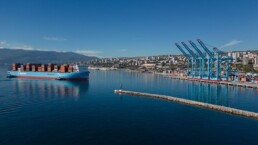

On 10 September last year, Rijeka Gateway, operated by APM Terminals and ENNA, entered service with the arrival of its first commercial vessel. The terminal was officially inaugurated on 28 October, marking the public launch of a project years in the making.
One year on, its significance extends beyond a single port. Rijeka Gateway offers a glimpse into a broader shift taking place across European supply chains, where connectivity is becoming just as important as capacity.
As vessels grow larger, trade flows evolve and customers place greater value on reliability and resilience, businesses are rethinking how goods move through Europe. Increasingly, competitive advantage depends not on individual assets, but on how effectively ports, transport networks and logistics facilities work together.
From capacity to connectivity
In today’s supply chains, connectivity is becoming as important as capacity.
While larger vessels and modern terminals remain critical, businesses increasingly need logistics networks that are reliable, predictable and connected from origin to destination. The greatest opportunities to improve performance often lie in how effectively different parts of the supply chain work together.
As a result, the conversation is shifting beyond capacity alone. The most competitive trade corridors are increasingly those that integrate ocean transportation, terminals, inland transport and warehousing into a seamless flow, rather than operating as standalone assets.
Why this matters for Europe
Europe’s supply chains are becoming more interconnected and more complex. Businesses serve multiple markets, manage diverse sourcing locations and respond to changing customer demand across borders.
In this environment, efficient connections between maritime gateways and inland markets can help reduce complexity and create greater flexibility.
Locations such as Rijeka are well positioned in this evolving landscape. Situated on the Adriatic coast, Rijeka Gateway combines deep-water access with digital operations and modern infrastructure designed to support larger vessels and growing trade volumes. It is also the first container terminal in the Adriatic region to operate remote-controlled electric container-handling equipment, highlighting how technology is becoming increasingly embedded in trade infrastructure.
But modern infrastructure cannot be judged solely by what happens at the terminal gate. Its real value lies in how efficiently cargo can continue its journey onwards.

The growing importance of inland logistics
As supply chains become more sophisticated, warehousing and distribution are playing a more strategic role. Distribution centres are evolving from storage locations into strategic hubs that help businesses manage inventory, respond to changing demand and position goods closer to customers. As a result, inland connectivity is becoming just as important as maritime connectivity.
Near Rijeka, the Maersk facility in Kukuljanovo provides warehousing, distribution and value-added logistics services that support customers across Central and Eastern Europe. Together, the terminal operated by APM Terminals and Maersk’s inland logistics capabilities, illustrate how connected trade corridors can help businesses move goods more efficiently between global trade lanes and regional markets.
What customers increasingly value
These shifts are being driven by customer needs. Across industries, businesses are looking beyond individual logistics services and focusing on how entire supply chains perform. Reliability, predictability and visibility are becoming as important as speed.
Customers increasingly value logistics ecosystems that connect transportation, terminals, warehousing and distribution into a seamless flow. The goal is not simply to move cargo from A to B, but to reduce complexity and improve consistency across the entire journey.
This reflects a broader trend across European supply chains: success depends less on individual assets and more on how effectively they work together.
Looking ahead
One year after opening, Rijeka Gateway offers a useful illustration of where the industry is heading.
The future of trade will not be defined solely by larger vessels or larger terminals. It will be shaped by the strength of the connections between ports, transport networks, warehousing and digital capabilities.
For Europe, building these connected trade corridors will be critical to supporting growth, competitiveness and resilient supply chains in the years ahead.
Source: Maersk



Related News.

ITF joins ISF Verify to help scale trusted digital seafarer certification worldwide
The International Transport Workers’ Federation has joined the ISF Verify project, to support the roll-out to the ITF’s seafarer network -…

Noatum CSM expands regional client base and managed fleet in first year of operations
Noatum CSM has expanded its managed fleet and secured new regional clients during its first year of operations, strengthening its position in the…

New Climate TRACE report quantifies the emissions impact of COP31 climate targets and identifies pathways with the greatest co-benefits
Clean power is a particular force multiplier of COP31 goals, with facility-level analysis showing that pairing smart 35% electrification with new…

INTERCARGO re-elects John A Xylas as Chair and welcomes two new Vice-Chairs
Members meet in Rome as INTERCARGO membership passes 500 INTERCARGO, the International Association of Dry Cargo Shipowners, has re-elected John A.…
IMO’s Marine Environment Protection Committee MEPC 85 to discuss shipping emissions, pollution and other ocean issues
The Marine Environment Protection Committee (MEPC) of the International Maritime Organization (IMO) will meet for its 85th session at IMO…

The Nautical Institute names winner and runners-up in global pilot transfer safety competition
Elliott Steinberg, a student at Wismar University of Applied Sciences in Germany, has won The Nautical Institute’s global student competition on…

Norway’s ‘green battery’ needs faster wind and grid build-out as power surplus narrows, says GlobalData
Norway’s reservoir hydropower makes it the flexible ‘green battery’ of northern Europe and a structural net electricity exporter. However, rising…

Saudi Red Sea Authority introduces ‘Invest with Guidance’ campaign for Maritime Tourism Investors
The Saudi Red Sea Authority has launched the “Invest with Guidance” campaign, which introduces investor guides. It consolidates licensing…

xclusiv S&P Report 16th November 2026
Pls find below the [xclusiv] S&P Report 16th November 2026 [xclusiv] 2026_11_16

Port of Long Beach recognised for outstanding communications
The Port of Long Beach earned four awards from the Los Angeles chapter of the Public Relations Society of America for outstanding communications…
Subscribe to our newsletter!
if you dont want to swim alone in the ocean of news, sign up for the newsletter, and you will receive daily all the important news of world shipping!
