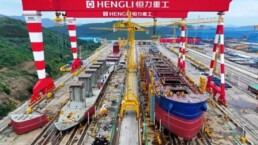

Prices for high-value vessels, including liquefied natural gas carriers and ultra-large container ships, have begun to decline despite rising demand. Intensifying competition from Chinese shipbuilders entering the premium vessel market, coupled with their aggressive supply strategies, is putting downward pressure on newbuilding prices.
According to UK-based shipping market intelligence provider Clarksons Research, the benchmark newbuilding price for an LNG carrier stood at $245 million as of Oct. 23, down $3 million from $248 million in October last year. Prices for ultra-large container ships also declined over the same period, from $266.5 million to approximately $242 million. The downturn is particularly notable given that LNG carrier orders have increased more than 4.5-fold year-on-year.
China’s rapid expansion in both shipbuilding capacity and technological capabilities is seen as a major factor behind the price decline. Yangzijiang Shipbuilding, previously focused on medium-sized vessels, has been securing more orders for ultra-large container ships. Hengli Heavy Industries, meanwhile, is targeting the LNG carrier market through a build-first, sell-later strategy, constructing vessels before securing buyers. Jiangnan Shipyard has also intensified price competition by securing LNG carrier orders at $225 million per vessel, undercutting prevailing benchmark prices and challenging South Korean shipbuilders’ market share.
South Korean shipbuilders are unlikely to experience an immediate earnings impact, as this year’s results largely reflect vessels ordered at peak prices approximately two years ago. HD Korea Shipbuilding & Offshore Engineering’s third-quarter operating profit is projected to rise 50.5% year-on-year to 1.5854 trillion won, while Hanwha Ocean and Samsung Heavy Industries are expected to record profit growth of 86.5% and 8.9%, respectively. However, a prolonged decline in newbuilding prices could erode profitability once their existing backlog of higher-priced orders is delivered.
An oversupply of vessels and mismatches between ship deliveries and LNG project schedules are also limiting price recovery. Large numbers of vessels ordered since 2022 are entering service, while major LNG production projects, including Qatar’s North Field East, have experienced delays. With shipping capacity expanding ahead of available cargo volumes, shipowners have less incentive to pay premium prices for new vessels.
Industry experts say South Korean shipbuilders need to accelerate technological development and business diversification to maintain their competitive edge over Chinese rivals. The period around 2029, when the quality and performance of vessels built by newer Chinese entrants become clearer, could prove a critical test of competitiveness. In response, Korean shipbuilders are expanding beyond conventional commercial vessels into higher-value businesses, including small modular reactor (SMR)-powered ships, offshore power generation facilities and floating liquefied natural gas production (FLNG) units.
Source:Business Korea



Related News.

European Shipowners call on MEPs to back Commission proposal to include two Indian yards in the EU ship recycling list
The Environment Committee of the European Parliament votes on 4 November on a motion for resolution objecting to the Commission’s proposal to add two…
Oversea signs commercial agreement with UECC following Successful Pilot
Following a successful pilot onboard Auto Advance, UECC has chosen to enter into a commercial agreement with Oversea. The pilot demonstrates how…
First NABEP Crude Cargo Under U.S. Agreement Arrives in Texas
Shipment of 1 million barrels arrived as NABEP production passes 223,000 barrels of oil equivalent per day. Two tankers carrying 1 million barrels of…
Vehicle Carrier Safety Forum publishes new Fire Drill Guidelines for vehicle carrying vessels
The Vehicle Carrier Safety Forum has published new Fire Drill Guidelines for Vehicle Carrying Vessels, providing vessel operators with a practical…

Is an Atlantic Basin crude glut on the cards?
Atlantic crude discounts fail to offset high freight to Asia, raising the risk of a regional glut as VLCC availability tightens. Freight…
The future of trade infrastructure in Europe is connectivity
One year after its inauguration, Rijeka Gateway offers a glimpse into the future of European trade. On 10 September last year,…

Allied – Weekly Market Review – Week 43
Please find below the Allied Weekly Report for Week 43 | 2026 ALLIED - Weekly Market Report- Week 43

Intermodal Report – Week 43 2026
Please find below the Intermodal market report for week 43 2026. Intermodal Report Week 43 2026
Wind Challenger-Equipped LNG Dual-Fueled Coal Carrier ‘MAIZURU KAZENOMAI’ Delivered
-While Supporting a Stable Energy Supply, Reducing Environmental Impact - Mitsui O.S.K. Lines announced the delivery and entry into service of an…
Noatum Logistics accelerates GCC growth by doubling its Trucking Fleet to over 850 Units
The expansion strengthens cross-border connectivity while boosting customer control, flexibility and business continuity across regional supply…
Subscribe to our newsletter!
if you dont want to swim alone in the ocean of news, sign up for the newsletter, and you will receive daily all the important news of world shipping!
