From assumptions to accuracy rethinking fuel efficiency in maritime shipping


The maritime sector’s longstanding reliance on Specific Fuel Oil Consumption and manufacturer power curves to measure fuel efficiency is increasingly coming under fire for masking real performance as well as real inefficiencies at sea, according to Rob Mortimer, CEO of Fuelre4m.
These legacy metrics, rooted in idealised factory conditions and theoretical assumptions, fail to capture the complexities of actual vessel operation. This results in an industry managing appearances rather than actual fuel-to-thrust efficiency, risking misguided investment, compliance, and sustainability decisions.
SFOC figures are calculated based on engine output assumptions rather than direct measurement, using static power curves provided by engine OEMs that do not account for fuel quality variations or operational wear and tear. This creates a closed loop where neither engine nor fuel inefficiencies are visible, preventing operators and stakeholders from accurately benchmarking performance.
In practice, engine load is inferred from RPM without adjusting for real-world variables, leading to misleading emissions and fuel consumption reports and a false sense of compliance with increasingly stringent ESG and regulatory targets.
Fuel is the largest operational cost for shipowners. Flawed efficiency metrics risk skewing decisions on fuel procurement, vessel upgrades, and alternative fuel investments. Moreover, regulators’ growing emphasis on carbon intensity and emissions trading hinges on incomplete data, exposing companies to compliance risk and accusations of greenwashing.
Shipping must adopt direct measurement tools — including torque sensors and shaft power meters — to quantify real mechanical output. Fuel quality must be validated with precise calorific values, enabling accurate tracking of fuel-to-thrust conversion efficiency across different fuel types.
Updating reporting frameworks to reflect these realities will enable the industry to expose underperforming fuels, hold suppliers accountable, and align cost and emissions targets with actual performance — not outdated assumptions.
Mr Mortimer comments: “Fuel efficiency reporting in shipping has long been shackled by legacy metrics that paint a misleading picture. The industry needs to move beyond theoretical models and assumptions to embrace real-world measurement. Without understanding exactly how much of the fuel burned actually turns into propulsion, operators are flying blind on efficiency and emissions. It’s time for transparency and precision if we are serious about sustainability and operational excellence.”
Mr Mortimer is urging the industry to demand greater transparency and accurate measurement, as this is essential for shipping to credibly tackle its economic and environmental challenges in the decade ahead.



Related News.

Navigating the Multi-Orbit Era: In Conversation with Intellian’s Jon Harrison at SMM 2026
At SMM 2026 in Hamburg, the rapid evolution of maritime satellite communications took centre stage. Across the exhibition halls, discussions among…

Cyprus ports need joint energy and investment strategy, shipping agents chief says
Cyprus needs a coordinated strategy for shipping, energy and environmental protection to support port investment and modernisation, Cyprus shipping…

MASO Public Affairs introduces MASO Regulatory Intelligence
A new subscription service helping businesses understand what is changing and what it means for them MASO Public Affairs introduces MASO Regulatory…
Anglo-Eastern helps turn CMBTECH’s ammonia ambition into an operational reality
From early feasibility study and risk-based design to newbuilding supervision, crew readiness and technical management, Anglo-Eastern drew on its…

Escalation of attacks threatens to derail recovery in Middle East oil exports
World oil demand is forecast to fall by 2.5 mb/d y-o-y in 4Q26 and 2.6 mb/d on average in 2026. As the Iran war manifests itself through restricted…
New study finds shipping pays twice its share to EU ETS earmarked revenues should triple to help build market for sustainable fuels and technologies
Shipping is responsible for around 10% of EU ETS emissions but pays almost 20% of the ETS bill. Unlike other sectors, it has never received free…

MSARC strengthens maritime mass rescue readiness through training and national live exercise off Dakar, Senegal
Joint MSARC–FHAS programme combines three days of SAR training with a national multi-agency live exercise The Maritime Search and Rescue Council ,…

Sogese report deliveries are still being delayed as container freight rates fluctuate
FOR IMPORTERS Spot rates into the Mediterranean are back at January levels, Far East to Europe reliability sits at pandemic lows, and nearly…

Glencore begins trading on Australian Securities Exchange
Glencore has begun trading on the Australian Securities Exchange under the ASX code GLC. Gary Nagle, Glencore’s CEO, said it was an exciting day for…
BIMCO Shipping Number of the Week
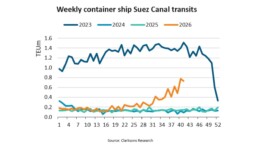
Suez Canal container ship transits exceed 50% of pre-disruption levels "During the first two weeks of October, weekly container ship capacity…
Subscribe to our newsletter!
if you dont want to swim alone in the ocean of news, sign up for the newsletter, and you will receive daily all the important news of world shipping!
