Tax Update Shipping & Offshore – January 2025

1. Netherlands
1.1 Tonnage Tax Regime: No EU/EEA Flag Requirement in 2025
In 2025, the national exemption applies. This means that any ship newly taken into management, (co)ownership or bareboat charter-in in 2025 is not subject to the EU/EEA flag requirement. Therefore, there is a free choice of flag for 2025 without jeopardizing the application of the tonnage tax regime. However, the free choice of flag does not apply to dredgers and tugs. In the case of setting up a new structure, we point out that there must always be at least one EU/EEA flagged ship managed under the tonnage regime within the fleet (this can also be via for example co-ownership).
1.2 Updated Decree on Tonnage Tax Regime
This decree is an update of the decree from February 19, 2021, and various positions have been added. See here.
1.3 Dutch tax authorities knowledge group position on determining a shipping enterprise
Knowledge group position on determining the shipping enterprise for the application of Article 8 (the shipping article) in the case of a foreign general partner in a transparent partnership that operates a vessel in the Netherlands via its general partner is established in the Netherlands. This position is very welcome when it comes to scenarios of for example individuals or companies investing in a Dutch shipping partnership which apply the Dutch tonnage tax regime and are not confronted with dividend withholding tax.
2. France
Proposal Introducing Temporary CIT Surcharge for Large Companies
The Bill also introduces an exceptional CIT surcharge for shipping companies subject to the tonnage tax regime and with annual worldwide turnover exceeding EUR 1 billion.
3. Singapore
Introduction of shipping taxation based on net tonnage
Singapore’s Budget 2024 introduced a new basis of taxation for shipping entities based on net tonnage to better align Singapore’s tax regime with common international practices. Legislation was passed by Parliament and awaits presidential assent.
4. Greece
European Commission accepts Greece’s measures to bring its tonnage tax scheme in compliance with State aid rules
The European Commission (EC) on November 24, 2024, recorded Greece’s acceptance of measures proposed by the EC to align Greece’s tonnage tax scheme and related measures with EU State aid rules. These measures were initially introduced by Greece to support its shipping sector.
The EC release explains the cooperation between the EC and Greece as follows:
• The EC in December 2015 proposed changes to Greece’s tonnage tax scheme, expressing concerns about its scope and beneficiaries. The scheme, in place since 1975, is considered “existing aid” and subject to a specific cooperation procedure.
• The EC on November 6, 2024, amended its proposal, focusing on tax benefits related to dividends, capital gains, and vessel operations, while dropping proposals related to inheritance tax exemptions.
• Greece on November 14, 2024, accepted the proposed measures.
• The EC on November 24, 2024, formally recorded the acceptance, concluding the cooperation procedure.
This alignment does not preclude State support for the shipping sector, as the Maritime Guidelines permit certain fiscal measures for maritime transport companies, such as tonnage tax, which offers tax predictability and potentially lower taxes.
5. United Kingdom
5.1 Fifth meeting of the Specialised Committee on Energy under the EU-UK Trade and Cooperation Agreement
The Specialised Committee on Energy (SCE) made available the minutes of its fifth meeting, which took place on 7 November 2024. Among others The United Kingdom and European Union highlighted renewable energy priorities, including offshore wind, hydrogen and Offshore Hybrid Assets (OHAs). They also agreed to explore interoperability for biofuels and advance technical discussions on Carbon Capture Utilisation and Storage (CCUS) and hydrogen standards.
5.2 HMRC Issues Customs Guidance on Movement of Goods Between Great Britain, UK Continental Shelf
His Majesty’s Revenue and Customs (HMRC), has published guidance regarding a simpler way to declare goods moving between Great Britain and the UK Continental Shelf. The UK Continental Shelf declaration by conduct will simplify the declarations for non-controlled goods that are in free circulation or eligible for returned goods relief.
This procedure applies to eligible low-risk goods and is given effect by physically loading or unloading goods from a vessel or aircraft and submitting information to HMRC using the:
• UK Continental Shelf imports and exports form (available online here),
• the National Maritime Single Window service (FAL), or the
• General Aviation Report (GAR).
6. Serbia
Parliament Introduces New Tax Rules for Seafarers
The parliament has enacted the Law on Amendments to the Individual Income Tax Law as published in Official Gazette No 94/2024 dated 28 November 2024. The amendments apply as of 1 January 2025. The most significant developments for the Maritime industry are as follows:
• taxing the income generated by an individual from performing work on ships and other vessels with the flag of a foreign country (seafarer) if performed for less than 174 days in a calendar year.
• the tax rate amounts to 10%. Seafarers will pay tax on their income through self-assessment taxation. They must submit the tax return annually by 31 March of the current year for the income generated in the previous year.
7. Bahamas
Senate Agrees Pillar Two Tax Law
The Senate has passed the Domestic Minimum Top-Up Tax Bill 2024 (DMTT Bill), which seeks to impose a domestic minimum top-up tax (DMTT) that meets the requirements for a qualified DMTT under the OECD Inclusive Framework. During the debate, Bahamas Attorney General Ryan Pinder disclosed the territory is currently developing a tonnage tax regime that would be implemented alongside an exclusion for shipping-related income from corporate tax.
8. Canada
Introduces Regulations to Limit Greenhouse Gas Emissions
The government has announced draft regulations to cap greenhouse gas (GHG) emissions from oil and gas production. The regulations would set a cap on GHG pollution within the oil and gas sector, equivalent to 35% below 2019 levels. The government invites public input on the draft regulations from 9 November 2024 to 8 January 2025. Ongoing consultations with partners and stakeholders will also inform the final regulations, expected to be published in 2025.
The draft regulations, informed by extensive consultations with industry, indigenous groups, provinces, territories, and other stakeholders, target pollution, not production. They apply to upstream oil and gas facilities, including offshore and liquefied natural gas (LNG) production, which account for most sector emissions.
Source: Meijburg&Co



Related News.

OL Shipping Group in Tokyo: Capt. Eberhard Koch calls for realistic solutions to Maritime Decarbonisation
An intensive and engaging couple of days in Tokyo brought together leading figures from the international maritime community, providing a valuable…

Regatta for Peace one of the largest ever in Cyprus
Cyprus will host the first European stop on a global sailing journey leading up to the 2027 America’s Cup in Naples. More than 120 sailors…

The propulsion technology powering the marine energy transition
The marine industry is under increasing pressure to future-proof fleets, balancing the need to reduce emissions and improve efficiency. Propulsion…
Signal Ocean acquires Lgmar
Signal Ocean announced the acquisition of Lgmar, the Athens-based company behind Telix, a maritime email and communication platform in daily use…

Canada clean power push challenged by interprovincial grid limits, says GlobalData
Canada is entering a pivotal phase of power-sector expansion as federal tax credits, the phase-out of coal-fired generation, and accelerating…

Maritime safety depends on human factors and leadership, not procedures alone
Interim survey findings point to a gap between seafarers’ perceptions of risk and injury data Seafarers may misjudge when and where they are most at…

New BIMCO contracts tackle ship recycling and energy-saving retrofits
BIMCO adopted two new contractual solutions designed to help you manage important operational and regulatory challenges: the revised…
Stena Line to acquire vessel and make changes to its network
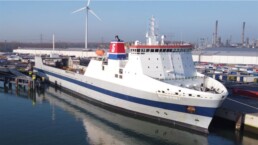
Stena Line has reached an agreement to acquire the RoRo vessel Somerset from CLdN. Subject to closure and transfer, the vessel would begin operating…
DORIC WEEKLY INSIGHT 16 OCTOBER 2026
Please find below the DORIC Market Insight for the week ending 16th October 2026. Weekly Report 16.10.2026

Important information for port clients and freight carriers effective November 1, a new traffic overpass and port checkpoint will open for traffic to the Port of Riga on Kundziņsala
Starting November 1 of this year, a new traffic overpass connecting Tvaika Street to Kundziņsala will open to facilitate traffic to and from the Port…
Subscribe to our newsletter!
if you dont want to swim alone in the ocean of news, sign up for the newsletter, and you will receive daily all the important news of world shipping!
