Millions in costs due to discharge of scrubber water into the Baltic Sea
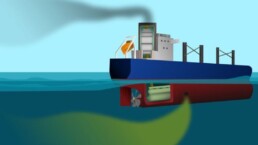

Discharge from ships with so-called scrubbers cause great damage to the Baltic Sea. A new study from Chalmers University of Technology, Sweden, shows that these emissions caused pollution corresponding to socio-economic costs of more than EUR 680 million between 2014 and 2022. At the same time, the researchers note that the shipping companies’ investments in the much-discussed technology, where exhaust gases are “washed” and discharged into the sea, have already been recouped for most of the ships. This means that the industry is now making billions of euros by running its ships on cheap heavy fuel oil instead of cleaner fuel.
“We see a clear conflict of interest, where private economic interests come at the expense of the marine environment in one of the world’s most sensitive seas,” says Chalmers doctoral student Anna Lunde Hermansson, who is one of the authors of the new study, published in Nature Sustainability.
The study has been prompted by the ongoing discussion on a potential ban of scrubber water discharge – where large volumes of polluted water is produced and discharged from the ships’ exhaust gas cleaning systems. The issue is on the agenda at multiple levels within the International Maritime Organization (IMO) and is also being discussed at EU level as well as on national levels such as the Swedish Parliament, although a Swedish decision on a ban is yet to be made.
Anna Lunde Hermansson and Chalmers colleagues Erik Ytreberg and Ida-Maja Hassellöv have been researching the environmental impact of shipping for many years and are contributing with their expertise in both international and national contexts. In a previous study, for example, they have shown that more than 200 million cubic metres of environmentally hazardous scrubber water is discharged into the Baltic Sea annually and that scrubber discharge water accounts for up to 9 percent of the total emissions of certain carcinogenic polycyclic aromatic hydrocarbons (PAHs) into the Baltic Sea.
Excluding oil spill costs
In the new study, the Chalmers researchers calculated both the external costs of scrubber water discharge, and the financial balance sheets of over 3,800 vessels that invested in the scrubber technology. As for the costs associated with the degradation of marine ecosystems, the study shows that between the years 2014 and 2022, scrubber water discharges have polluted at a cost of over EUR 680 million in the Baltic Sea area. The calculations are based on models for willingness to pay to avoid marine environmental degradation, but according to the researchers, the estimates should be regarded as an underestimate. For example, direct costs associated with heavy fuel oil spills from ships using scrubbers are not included. The multi-million euro sum that it costs to clean up oil after ships have grounded and leak oil, for example Marco Polo on the Swedish coast of Blekinge last autumn, are not included in the calculations.
“If the scrubbers had not existed, no ships today would have been allowed to run on this dirty residual fuel. That is why the scrubber issue is highly relevant to push the shipping industry towards less negative environmental impact,” says Lunde Hermansson.
Restrictions in several countries
In terms of the shipowner perspective, the researchers calculated the costs of installing and maintaining the scrubber systems, as well as the monetary gain from running the scrubber-equipped vessels on the cheaper and dirtier heavy fuel oil instead of the more expensive low-sulphur fuel alternatives. According to the calculations, the majority of the shipping companies that invested in scrubbers have already reached break even, and the total surplus by the end of 2022 for all of the 3,800 vessels, was EUR 4.7 billion. The researchers also note that more than 95 percent of the most common scrubber system (so-called open loop) are repaid within five years.
“From the industry’s point of view, it is often stressed that shipping companies have acted in good faith by investing in technology that would solve the problem of sulphur content in air emissions and that they should not be penalised. Our calculations show that most investments have already been recouped and that this is no longer a valid argument,” says Lunde Hermansson.
Recently, Denmark has decided to ban the discharge of scrubber water into so-called territorial waters, within 12 nautical miles of the coast. A number of countries around the world, such as Germany, France, Portugal, Turkey and China, have also adopted national bans or restrictions.
In Sweden, there is currently no general ban, although some ports, such as the Port of Gothenburg, have banned the discharge of scrubber water in their area.
“We now hope that the issue will also be given priority in the Swedish Parliament. This is a low-hanging fruit where we can reduce our negative impact on the vital marine environment,” says Lunde Hermansson.



Related News.

Predicting the Future or Preparing for It? Cyprus Marine Club Explores the Power of Adaptability with Natasa Pilides
In a world where uncertainty has become the new normal, is predicting the future really the best strategy, or is the ability to adapt the greater…

Greece and Egypt in talks to extend EEZ Eastwards towards Cyprus following Libya’s move on Turkish Maritime Pact
Athens and Cairo have agreed to advance bilateral consultations aimed at extending the geographical scope of their 2020 Exclusive Economic Zone (EEZ)…
Seafarers face widening competency gap as digital shipping accelerates, recent research finds
Eighty two per cent of maritime professionals surveyed say current training does not adequately prepare crews for the realities of modern,…

Wärtsilä and WinGD sign new Service Framework Agreement to ensure long-term continuity and support for the global fleet
Technology groups Wärtsilä and WinGD have entered into a new long-term Service Framework Agreement, reaffirming their shared commitment to supporting…
Seatrium and Karpowership sign contract for a series of whale class Powership Conversion and Integration Projects
Seatrium and its strategic partner, floating power leader Karpowership, have strengthened their longstanding collaboration with the award of a…
ClassNK releases Handbook Supporting Consideration of Onboard Carbon Capture “Onboard Carbon Capture Systems Implementation Framework”
Bringing together technical, infrastructure, regulatory and emissions assessment considerations across the OCCS value chain - ClassNK has released a…
HHLA lowers earnings forecast for the 2026 financial year
Based on the business development to date and updated estimates for the fourth quarter of 2026, the Executive Board of Hamburger Hafen und…
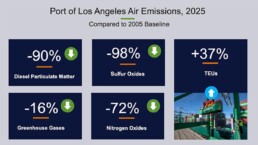
Port of Los Angeles reports lowest emissions per Container on Record
The Port of Los Angeles continued to make clean air gains in 2025, recording its lowest emissions per container on record, according to the Port's…
Drewry World Container Index – 22 Oct
WCI increased for the second consecutive week, the highest in 15 weeks. See detailed commentary below. Drewry World Container Index…
Mammoet, Port of Argentia and Argentia Capital Partner to Advance Floating Dry Dock and Marine Repair Facility
Partnership builds on Mammoet’s established presence at Port of Argentia and shared confidence in the growing market for ship repair and marine…
Subscribe to our newsletter!
if you dont want to swim alone in the ocean of news, sign up for the newsletter, and you will receive daily all the important news of world shipping!
