Ahti Climate new research reveals huge FuelEU Maritime benefits available from pooling


- Ahti has calculated that one e-methanol fuelled vessel can enable the FuelEU Maritime compliance of 70 HFO-fuelled ships.
- By adding 1-1.5% e-methanol and pooling you can make your operational fuel costs cheaper under FuelEU Maritime than burning straight HFO
- Ahti Pool is the world’s first public FuelEU Maritime compliance pool.
- Ahti is already trusted by companies including Gasum and Ren-Gas.

New research from emissions compliance experts Ahti Climate reveals the scale of FuelEU Maritime optimisation available through pooling and the use of appropriate low-carbon fuels.
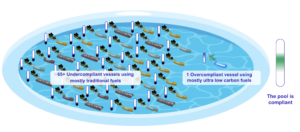
Using tools it has developed to manage Ahti Pool, the world’s first FuelEU Maritime compliance pool, Ahti has calculated that the use of one e-methanol vessel on voyages within the European Union’s waters could make 70 vessels using HFO compliant. By comparison, under the FuelEU Maritime regulations, an LNG vessel with a low-speed engine could only be used to make five HFO-fuelled ships compliant.
Moreover, by adding 1-1.5% e-methanol and pooling you can make your operational fuel costs cheaper under FuelEU Maritime than burning straight HFO and paying penalties.
Ahti has further calculated that FuelEU Maritime will grow the alternative fuel market value in European shipping to greater than the fossil fuel market value by 2040.
Ahti is trusted by companies including Gasum and Ren-Gas to provide calculations about their position under the FuelEU Maritime regulation, and Ahti’s senior leadership team contains more than 100 years of combined maritime experience. The Ahti Calculator contains data for all relevant alternative fuels for shipping verified against the regulation parameters and calculation methodology.
Background
FuelEU Maritime will come into force in 250 days on 1 January 2025, and the regulations are part of the European Union’s ‘Fit For 55’ package. It aims to enable the EU to reduce its net greenhouse gas emissions by at least 55% by 2030 compared to 1990 levels, and to achieve climate neutrality by 2050.
FuelEU Maritime will come into force in 250 days on 1 January 2025, and will require all ships entering EU waters to comply with new carbon intensity limits on vessel emissions.
One of the primary aims of FuelEU Maritime is to increase the demand for, and consistent use of renewable and low-carbon fuels. The rewards for doing so can be considerable – if they are effectively chosen and implemented systematically.
Market Impacts
There has been criticism in some quarters about the financial viability of ships powered by low-carbon fuels because they are going to be at least 3-6 times more expensive than traditional bunkers. However, this ignores the additional benefits which can be achieved under FuelEU Maritime through pooling compliance within a fleet that’s using an optimised mix of low-carbon and traditional bunkers on different vessels.
The sustainability value obtained from using low-carbon fuels is not limited to the year in which it occurs. Any compliance surplus can be ‘banked’ for following FuelEU Maritime reporting periods.
By pooling you also avoid the need to run frequent calculations to assess carbon intensities for each fuel’s unique feedstock, and you’ll escape the time-consuming scenario planning necessary for each possible variation of a vessel’s energy sourcing strategy and execution.
For shipowners who are concerned about ordering the wrong future-fuelled newbuilds, pooling and the use of appropriate low-carbon fuels on their vessels provides them with substantially increased time to analyse the results of first movers, and to make better informed investments.

Risto-Juhani Kariranta, CEO of Ahti, said, “We are a on a mission to make shipping’s green transition affordable, and one of the best ways to do that for ships that are visiting and operating within European Union waters is via pooling and choosing the optimal low-carbon fuels.
Ahti Pool combines expert geographical knowledge, the latest optimization algorithms, and unique energy data sets to find the lowest cost of compliance for your vessels and avoid implementing a “paying the penalties” strategy.
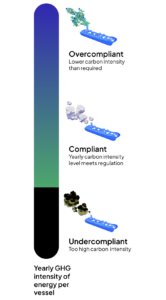
For example, thanks to our Ahti Pool calculator we have determined that through the ultra-low carbon intensity possible with e-fuels and the renewable fuels of nonbiological origin (RFNBO) multiplier, in 2025 only 1.3% of a ship’s total energy would need to come from e-methanol to be compliant, and for biodiesel it would be 3.1%. The rest of your bunkers could be HFO, and you’d suffer no penalty under FuelEU Maritime.
Companies that fail to optimise their vessel operations in response to FuelEU Maritime will find their overheads quickly become a competitive handcuff.”



Related News.

Cyprus Maritime Innovation takes Centre Stage at SMM Hamburg 2026
Underscoring its expanding role as a premier international hub for cutting-edge maritime technology and sustainable shipping, the Republic of Cyprus…

Trump seeks to refill US oil reserve with Venezuela deal but faces long delay
U.S. President Donald Trump said on the 30th (local time) that he would refill the U.S. Strategic Petroleum Reserve, which has been depleted with…

US Navy Official visits South Korean Shipyards in private
With U.S. President Donald Trump pushing a plan to allow overseas construction of U.S. warships, attention is focusing on whether the building of…

SES and De Boer Marine expand collaboration with FlexMaritime deployment across Global Markets
SES, a leading space solutions company, and De Boer Marine, a leading provider of top-quality marine equipment and maritime connectivity services,…

New ESG guidance to help maritime industry turn sustainability into commercial advantage
New framework helps shipowners and ports align ESG strategy with access to capital, charterer expectations and long-term asset value. Maritime…

Britannia P&I Club analysis finds four in five crew deaths linked to illness rather than accidents
New report highlights cardiovascular disease as leading cause of fatalities and raises concerns over mental health risks among younger seafarers.…

The Swedish Club launches new Loss Prevention podcast, Knot Another Lesson
The Swedish Club has launched Knot Another Lesson, a new podcast exploring the practical lessons, emerging risks and operational challenges shaping…

Lloyd’s Register appoints Jens Grunenberg as Senior Representative for Germany
Lloyd’s Register has appointed Jens Grunenberg as its Senior Representative for Germany, effective 1 September. Based in Hamburg, Grunenberg will…
Indian Register of Shipping sets sights on Hamburg for European Expansion
Indian Register of Shipping, a leading international classification society and full member of the International Association of Classification…
MOL completes Merger of 6 Ship Management Companies
Unifying Management of Over 200 Vessels and Strengthening Safety Mitsui O.S.K. Lines, announced that it has completed the integration of the MOL…
Subscribe to our newsletter!
if you dont want to swim alone in the ocean of news, sign up for the newsletter, and you will receive daily all the important news of world shipping!
