
Signal Ocean has conducted an in-depth analysis of clean tanker exports traversing the Red Sea bound for Europe. Building upon our previous insights, this analysis underscores the strategic importance of the Red Sea route in facilitating the transportation of essential clean oil products to European markets, with particular emphasis on the leading contributors and their respective shares in this dynamic maritime landscape.
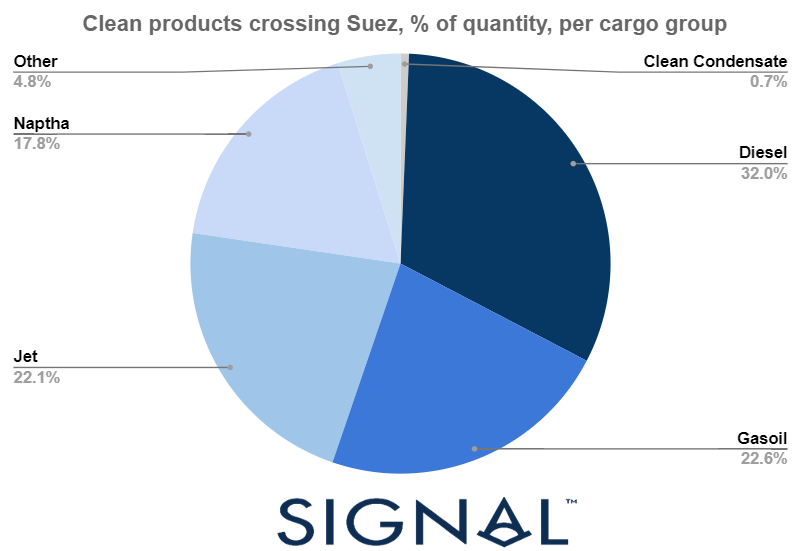
The visual representation below illustrates the key categories in this context and highlights the significant volumes associated with jet fuel, gasoil and naphtha. Figure 1 vividly illustrates the dominance of diesel, gasoil and jet fuel, which together account for over 70% of clean product shipments transiting the Suez Canal. The share of naphtha in this complex energy landscape is an impressive 18%.
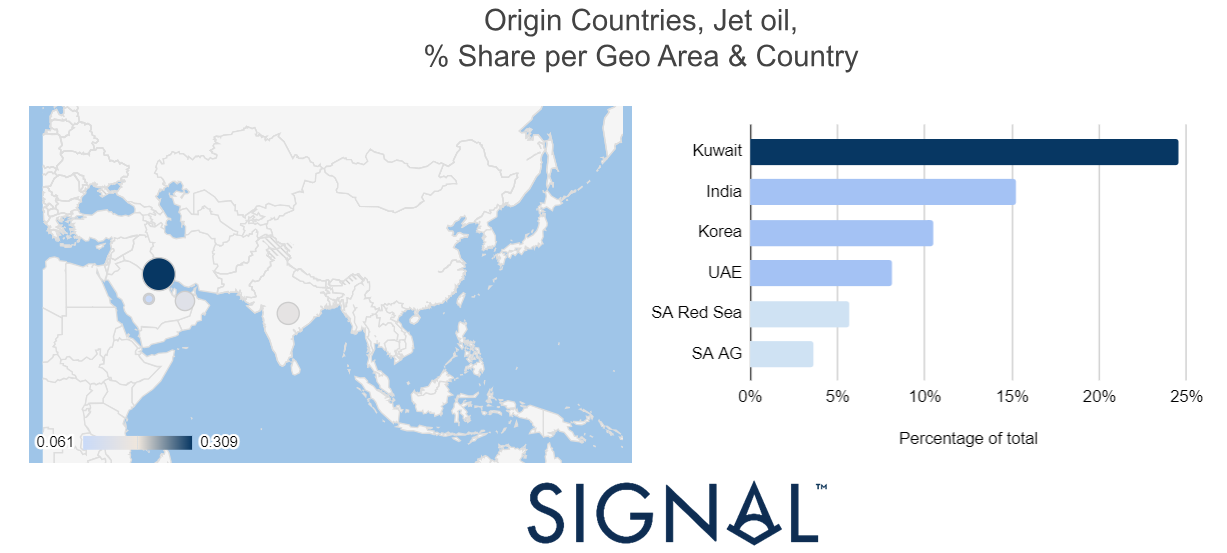
Turning our attention to the oil flow dynamics from the beginning of 2022 till today, a noteworthy pattern emerges. A significant portion—around 70%—of jet oil tanker shipments destined for Europe is attributed to key players such as Kuwait, India, and the UAE. (Figure 2) Looking per area the Arabian Gulf absorbs the 50% of shipments with Kuwait taking the first ranking with a 25% share and India with a 15%.
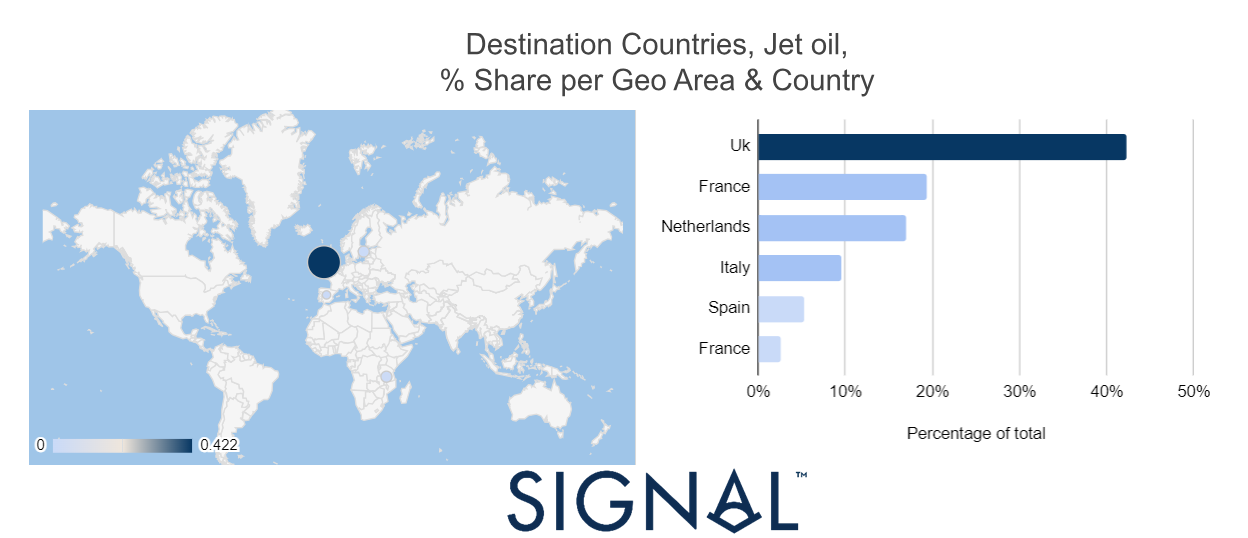
This dominance of the United Kingdom in receiving 40% of jet oil shipments from Arabian Gulf (AG) origin countries underscores its significance as a primary destination for such maritime trade. The substantial share suggests a robust trade relationship between the AG region and the United Kingdom, emphasizing the strategic importance of this trade route. In the second position, France’s 19% share further contributes to the diverse distribution of jet oil shipments. This highlights the European market’s role in receiving significant portions of AG-originating jet oil cargo, with France emerging as a notable player in this trade network. (Figure 3)
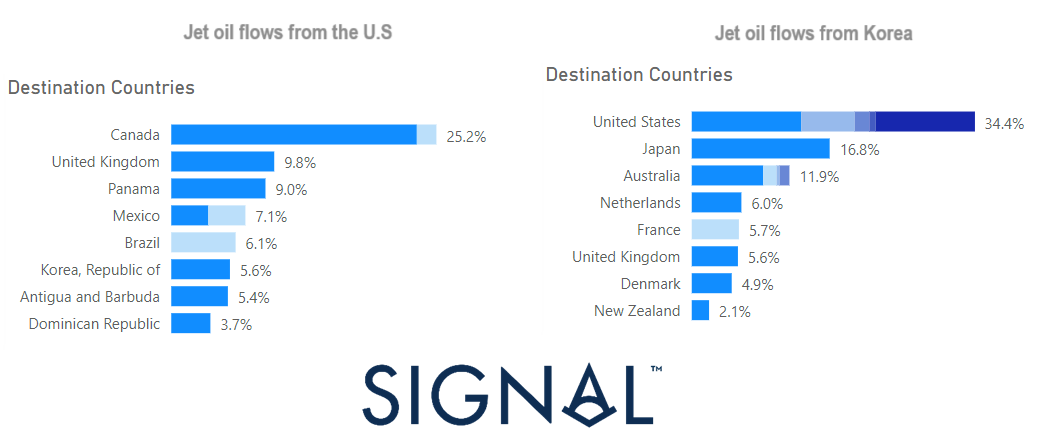
As for alternative origin countries for jet oil shipments to the United Kingdom, two notable contenders that, thus far, haven’t demonstrated significant shipment volumes are Korea and the United States. Leveraging Signal Ocean data, our analysis reveals that, in the preceding year, the United States secured a 10% share of clean oil shipments to the United Kingdom, as depicted on the left side. Similarly, shipments from Korea also accounted for a 10% share, as illustrated on the right side. This data sheds light on emerging players in the jet oil trade, hinting at potential diversification of sources for the United Kingdom’s oil imports. (Figure 4)
A careful analysis of the monthly volume of jet oil shipments originating from the Arab Gulf states—specifically Saudi Arabia, Kuwait, and the United Arab Emirates—to the United Kingdom unveils noteworthy trends. As of the present moment, the cumulative volume of shipments from the Arabian Gulf to the UK stands at a comparable level to that recorded at the conclusion of December last year (refer to Figure 5). However, the definitive assessment awaits the conclusive results at the end of the month. This determination is crucial in confirming the percentage of interrupted or uninterrupted clean flow shipments heading towards the Mediterranean/UK continent. The forthcoming data will provide a comprehensive understanding of the continuity and potential disruptions in the oil shipment trajectory, shedding light on the overall stability of the supply chain to the designated destinations.

As we delve deeper into the ongoing discussion surrounding potential rerouting scenarios for ships, the recent surge in attacks on vessels in the Red Sea introduces a temporal dimension that complicates the conclusive assessment of outcomes for various types of merchant vessels. Leveraging the capabilities of the Signal Ocean Platform becomes instrumental in this scenario. The platform enables us to actively monitor voyages, allowing for a detailed examination of loading and unloading locations based on vessel size and cargo trade parameters.
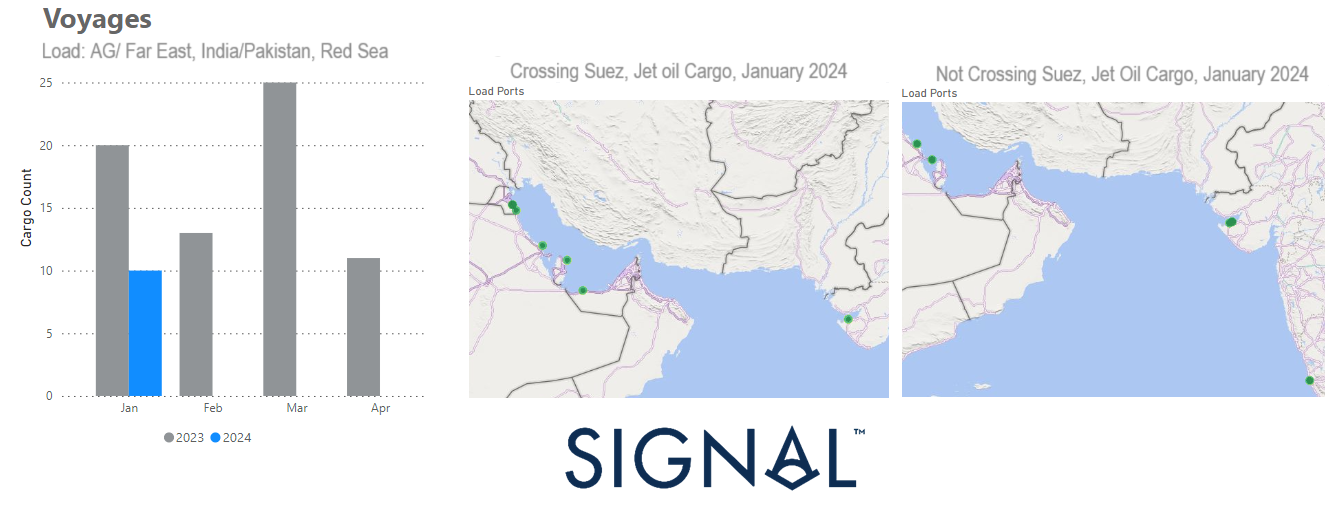
We conducted an analysis using jet oil voyages as an illustrative case, focusing on routes from the Arabian Gulf, Far East, India/Pakistan, and the Red Sea to the Mediterranean continent. Specifically, we examined the vessel count for those opting not to traverse the Suez Canal at the beginning of the year. This count was then compared to the number of vessels choosing to follow the regular route, mirroring the quantity of vessels tracked in January 2023 that crossed the Suez Canal.
In the left-side chart depicted below, you can discern the monthly volume of vessels transporting jet oil cargo as they traverse the Suez Canal. This data is juxtaposed against vessels that crossed the Suez Canal during a corresponding period in the previous year, providing a comprehensive view of the changes in shipping patterns. On the right side of the image, the accompanying map visually represents instances where vessels have opted not to cross the Suez Canal since the beginning of the year.
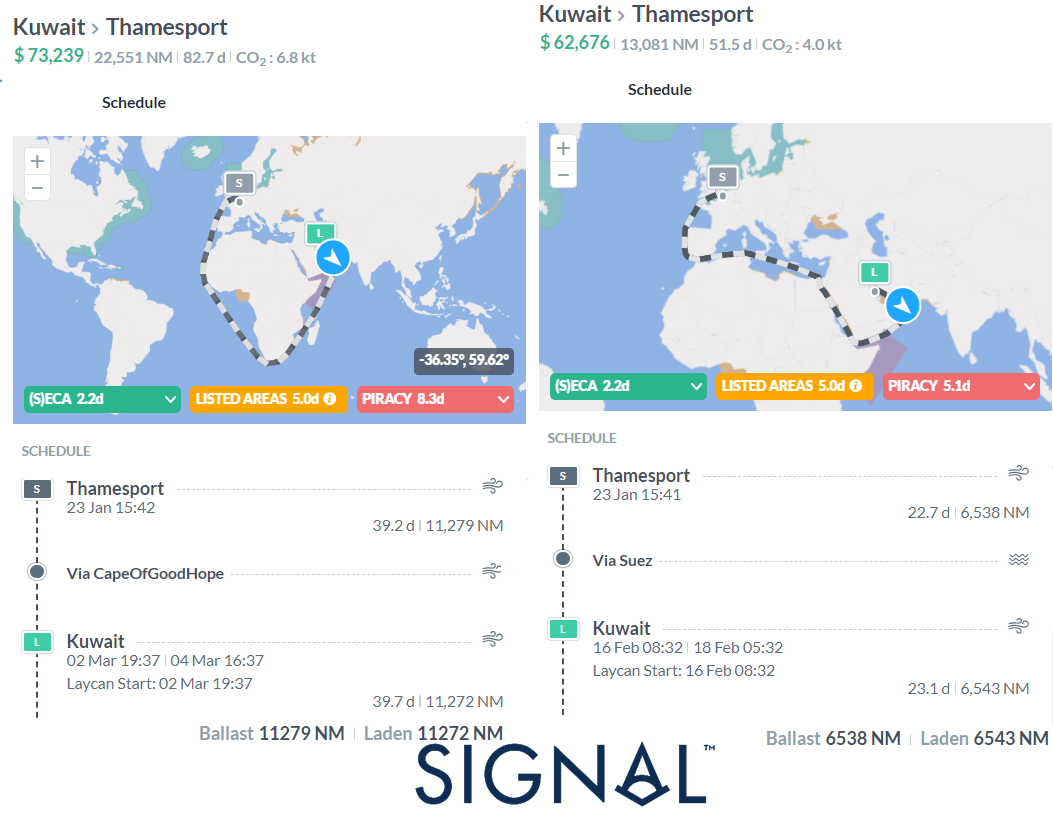
What can be the impact on emissions in case of a deviation? In this last section of our analysis, we have drawn a scenario of a deviation via the Cape of Good Hope impact.
In the image below, consider the case of a specific vessel (Panamax tanker, 75k dwt, built in 2010, loaded in Kuwait with discharge in Themesport, UK). On the right side, the scenario via the Cape of Good Hope is illustrated, offering a straightforward comparison to the left side of the image depicting the route via the Suez Canal. Notably, the distance in nautical miles (NM) has increased by 70%, with a consequential impact on CO2 emissions measured in kilotons. This example provides insights into the environmental and economic implications of choosing alternative maritime routes.
Source: Signal Group



Related News.

Columbia Group calls for greater focus on retaining women at sea as second She Beyond Conference takes place
Columbia Group has called on the maritime industry to create a future where women can thrive, progress and lead at sea, as it celebrated the second…

Neptune Group Welcomes “NIKOS TRAVLOS”
The new vessel proudly bears the name of Neptune's founder, who laid the foundation for the creation and enduring evolution of the Group. Her…

Wildcat Defense enters into exclusive agreement to acquire Fraser Shipyards
American family firm takes the next step in its strategy to rebuild U.S. shipbuilding and repair capacity, following its offer for Austal USA.…

Kawasaki signs strategic partnership MOU with Romania’s Transgaz for Onshore Hydrogen Gas Transport
Establishing a model for large-scale hydrogen supply and transport via pipelines Kawasaki Heavy Industries, announced at the Romania–Japan…

UK P&I Club and TT Club secure regulatory approval for Thomas Miller acquisition
The UK P&I Club and TT Club announce the successful completion of their joint acquisition of the Thomas Miller Holdings group, marking a major…

Valenciaport presents its Sandbox at PEIC’26 as a tool to bridge the gap between innovation and implementation
The opening session featured a discussion between Valenciaport President Mar Chao and Valenciaport Foundation Director Antonio Torregrosa. The…

Major investments strengthen Gothenburg RoRo Terminal
Expanded terminal areas, new rail connections and modernised quays are among the investments that have strengthened Gothenburg RoRo Terminal in…

ABP appoints key roles in the Humber
Associated British Ports has made two key appointments at its container terminals strengthening its unitised operations at the ports of Immingham…

Xinhua Silk Road 2026 North Bund Forum unveils 20 shipping-related achievements
The 2026 North Bund Forum opened in Shanghai on October 20 with 20 key shipping-related achievements spanning international cooperation, green…

Ports encouraged to prepare now for advanced nuclear in maritime and clean energy
New joint Lloyd’s Register and British Ports Association paper sets out a practical readiness pathway for ports considering nuclear-powered vessels,…
Subscribe to our newsletter!
if you dont want to swim alone in the ocean of news, sign up for the newsletter, and you will receive daily all the important news of world shipping!
