
Maritime security risks in the Red Sea have escalated due to the latest spate of attacks on commercial ships in the key oil trade chokepoint, and could spur further rises in already-high regional insurance costs if the trend continues, market participants said Dec. 6.
Risks to shipping in the Red Sea and Bab el-Mandeb area — through which about 10% of global seaborne oil flows — ratcheted up in the wake of the Israel-Hamas war after Iranian-backed Houthis in Yemen expressed their support for the Palestinians. From a car carrier to tankers to dry bulkers, an entire range of commercial ships have recently come under attack by Houthis, prompting navies and coast guards to issue advisories on the heightened need for security.
The UK’s Maritime Trade Operations is issuing regular alerts urging caution to shipping whenever it receives information on uncrewed aerial systems or drones moving in the region.
“If these attacks continue or the war theater widens, higher premiums will be levied on ships linked to vulnerable nationalities, but current geopolitical realities have already been factored in,” one maritime insurance executive said.
Even before the onset of the latest conflict in Gaza, an international shipping transit system was already in place due to the war in Yemen. The Bab el-Mandeb Strait is so narrow that when passing northbound, ships are barely seven nautical miles from the Yemen coastline.
When Houthi rebels publicly threatened to attack ships with any affiliation to Israel after Oct. 7, the group of international shipping industry associations did not change the recommendation to use the already laid out shipping transit corridor at Bab el-Mandeb.
But last month, the same group urged shippers to avoid the official, IMO-designated shipping lanes through Iranian waters in the strategic Strait of Hormuz due to the growing risk of attacks from Iran.
Risk premium
Currently, Long Range, or LR tankers, which carry up to 90,000 mt cargoes, command an additional $150,0000 security charge for each voyage when moving refined products from the Middle East and India to Africa.
There is no change in this charge after the recent escalation of conflict, which is just an additional income above the freight agreed upon, said a chartering source in Dubai.
For relatively smaller Medium Range, or MR tankers, which carry up to 40,000 mt cargoes each, this additional charge was absorbed into the freight three years ago and has not been levied separately ever since, the source said.
Freight is the function of the market availability of tankers and so far, the conflict has not added to these costs for most voyages, charterers loading cargoes across the Persian Gulf and the Red Sea said.
The premium varies from tanker to tanker, depending on its ownership, size, age, extension depreciation, value and time duration spent in the high-risk area, the executive said. This premium is passed on by owners to charterers based on actual costs incurred.
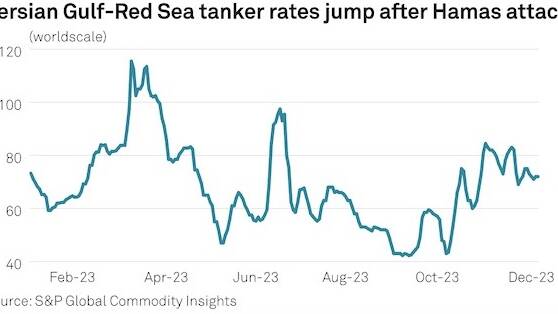
Overall freight rates for tankers transitioning the chokepoint have also risen sharply since the conflict started.
Rates for dirty oil tankers on the Persian Gulf to Red Sea route almost doubled after Oct. 7, according to assessments by Platts – a unit of S&P Global Commodity Insights – jumping from Worldscale 43.5 to Wsc 84.5 on Nov. 1. They have since retreated to Wsc 72, according to Platts.
Charterers in North Asia and Singapore said the additional war risk premium for a single Persian Gulf-North Asia voyage on a Long Range 2 tanker could range anywhere from $5,000 to $60,000 for every seven days combined. Charterers are billed for seven or 14 days, depending on the agreement which varies from ship to ship and there is an incremental amount for every 12-24 hours above this duration that is charged on a prorated basis.
Israeli-linked ships
For the last two months, ships that are calling at Israeli ports or have ownership links, flags or technical management of that country’s origin are also paying higher war risk premia, sources said.
“During the vetting of ships taken on charter, companies are now very particular to look at Israeli links of any kind,” said a tanker broker in Singapore.
Even if the ship carries a flag other than Israel’s and is managed or owned by companies that are registered elsewhere but have large investors or top executives who are Israeli citizens, charterers will strike a hard bargain to get a lower freight or not take it at all, the broker said.
“There continue to be severe risks of seizures and attacks posed by the Houthis to Israeli-affiliated shipping off Yemen’s waters, and of similar incidents in the Gulf at least for so long as Israel’s operations in Gaza have not ended,” S&P analysts said in a Nov. 30 note.
Nevertheless, such attacks still form a tiny part of the overall traffic of thousands of ships in the Persian Gulf and the Red Sea region, so some charterers do not mind taking vessels that are more vulnerable as it reduces their own transport cost, sources said.
As a result, the marine risk criteria are creating sporadic opportunities for charterers to hire Israel-linked ships at a discount.
Brokers and other shipping executives declined to disclose such discounted deals as they are done privately, but said it is a cost-saving opportunity that most will immediately shun if the conflict escalates.
Source: Platts



Related News.

Cyprus Maritime Innovation takes Centre Stage at SMM Hamburg 2026
Underscoring its expanding role as a premier international hub for cutting-edge maritime technology and sustainable shipping, the Republic of Cyprus…

Trump seeks to refill US oil reserve with Venezuela deal but faces long delay
U.S. President Donald Trump said on the 30th (local time) that he would refill the U.S. Strategic Petroleum Reserve, which has been depleted with…
US Navy Official visits South Korean Shipyards in private
With U.S. President Donald Trump pushing a plan to allow overseas construction of U.S. warships, attention is focusing on whether the building of…
SES and De Boer Marine expand collaboration with FlexMaritime deployment across Global Markets
SES, a leading space solutions company, and De Boer Marine, a leading provider of top-quality marine equipment and maritime connectivity services,…

New ESG guidance to help maritime industry turn sustainability into commercial advantage
New framework helps shipowners and ports align ESG strategy with access to capital, charterer expectations and long-term asset value. Maritime…

Britannia P&I Club analysis finds four in five crew deaths linked to illness rather than accidents
New report highlights cardiovascular disease as leading cause of fatalities and raises concerns over mental health risks among younger seafarers.…

The Swedish Club launches new Loss Prevention podcast, Knot Another Lesson
The Swedish Club has launched Knot Another Lesson, a new podcast exploring the practical lessons, emerging risks and operational challenges shaping…

Lloyd’s Register appoints Jens Grunenberg as Senior Representative for Germany
Lloyd’s Register has appointed Jens Grunenberg as its Senior Representative for Germany, effective 1 September. Based in Hamburg, Grunenberg will…
Indian Register of Shipping sets sights on Hamburg for European Expansion
Indian Register of Shipping, a leading international classification society and full member of the International Association of Classification…
MOL completes Merger of 6 Ship Management Companies
Unifying Management of Over 200 Vessels and Strengthening Safety Mitsui O.S.K. Lines, announced that it has completed the integration of the MOL…
Subscribe to our newsletter!
if you dont want to swim alone in the ocean of news, sign up for the newsletter, and you will receive daily all the important news of world shipping!
