Continued economic instability impacts Port of Antwerp Bruges’ throughput figures

Market share of containers on the rise
The Eurozone economy is under pressure from interest rates, which have risen sharply. Despite the drop in energy prices, the global economic situation also remains volatile and future indicators point to a continued economic downturn. As a result of this uncertain economic climate, containerised trade flows are falling around the world. For Port of Antwerp-Bruges, this is reflected in a 6.5% drop in container throughput in terms of tonnage, and 6.8% in TEUs, compared to the same period in 2022. Despite the decline in container throughput, Port of Antwerp-Bruges’ market share in the Hamburg – Le Havre range nevertheless grew by 1% point, to 30.6% in the first half of this year.
Conventional breakbulk is holding up relatively well despite the weak economic climate, with throughput volumes in line with the pre-covid period. Compared to the same period in 2022, which was marked by a strong post-covid recovery, throughput is down 18.6%. Due to a drop in European steel production and lower demand, throughput of steel, the main commodity group within this segment, is down 17.6%.
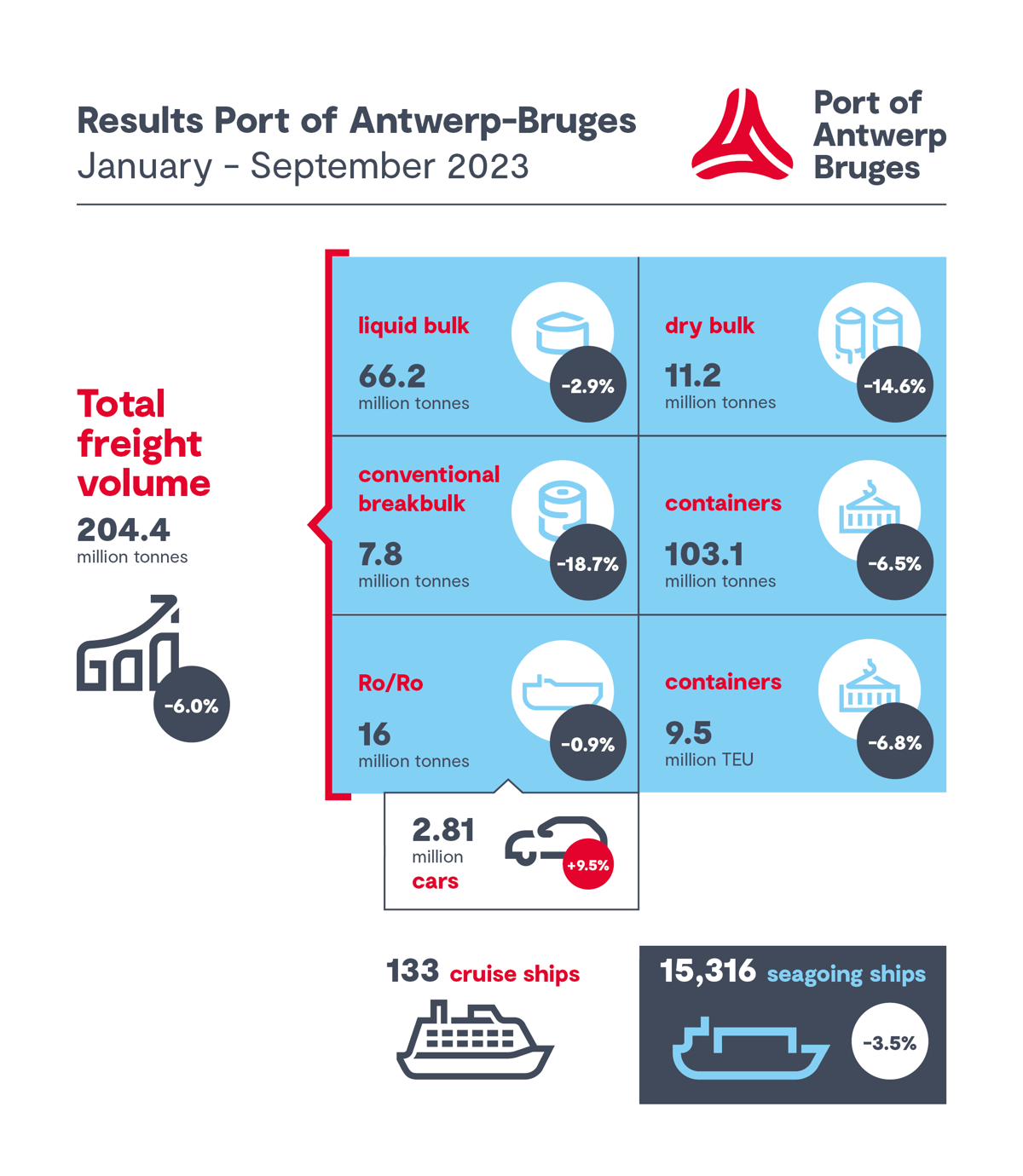
The dry bulk segment fell by 14.6%. Throughput of fertilizers, the largest product group within dry bulk, decreased by 24.2% after nine months, but has shown an upward trend since the summer which is expected to continue in the last quarter.
Compared to the peak in 2022, coal throughput is now showing a decline (-36%). In contrast, throughput of sand and gravel grew by 7.4%, while volumes of iron ore, scrap and non-ferrous ores fell by 70%, 5% and 2%, respectively.
The liquid bulk segment saw a decline of 2.9%. Throughput of liquid fuels grew by 8.7% thanks to a strong growth of 42.7% in throughput of diesel compared to throughput of gasoline (-3.7%) and naphtha (-22.7%). Throughput of LNG (-6.7%) is also down. Although chemical exports are up 5.4%, a drop in imports (-18.3%) led to a decrease of total chemicals’ throughput by 11.5%. The competitiveness of the chemical sector in Europe is under pressure due to high energy, raw materials and labour costs combined with low global demand.
Roll-on/roll-off traffic remains unchanged (0.9%). Throughput of transport equipment grew by 8.9% thanks to growth in the throughput of new cars (+12.6%) to 2.67 million units. In addition to transport equipment, 7 million tons of unaccompanied cargo (excluding containers) was shipped on RoRo vessels (-1.4%). The portion of this cargo related to Ireland grew by 18.5%, while traffic to and from the UK fell (-3.8%).
In the first 9 months of 2023, Zeebrugge welcomed 133 cruise ships and 351,000 passengers. With these figures, it promises to be a record year, as the autumn and winter months are traditionally busier cruise months than the summer season.
In the first nine months, 15,316 seagoing vessels called at Port of Antwerp-Bruges, which is a decrease by 3.5%. The total gross tonnage of these vessels grew by 4.4% to 496.3 million GT.
On an annual basis, seagoing and inland vessels make over 300,000 movements in the port. These are ships arriving, departing, and moving within the port, or just passing through. Thanks to an extensive network of radars and cameras, Port of Antwerp-Bruges can continuously monitor these ship movements, thereby closely monitoring shipping and controlling the waterways and berths efficiently and safely.
Future-proof world port on the path to climate neutrality
To ensure Port of Antwerp-Bruges maintains its position as a world port, it must be possible for even the very largest container ships to continue calling at the port in the future. That means the draught upon arrival needs to be 16 metres. In October, the MSC Tessa broke a draught record at Deurganck Dock. The increase in the draught considerably increases the loading capacity of the ships.
The port is also taking the lead with an ambitious climate plan, with the aim of being climate neutral by 2050. In addition to greening its own fleet, Port of Antwerp-Bruges is working with companies in the sector on a wide range of solutions and projects which are crucial in achieving climate neutrality, such as hydrogen imports and CCUS (Carbon Capture, Usage & Storage), or CO2 capture and transport, for which the Fluxys C-Grid joint venture was launched in September.
Jacques Vandermeiren, CEO Port of Antwerp-Bruges: “The continued economic and geopolitical concerns have been visible in the figures for several quarters now. The competitiveness of European industry is under pressure due to high energy, raw materials and labour costs combined with low global demand. The indicators do not yet show any improvement for the near future, and container throughput will still be impacted in the 4th quarter by cancelled voyages from the Far East. Despite the fact that our throughput is falling less than the average in the Hamburg-Le Havre range and we are gaining market share, we will have to face the fact that 2023 will not be a top year.”
Annick De Ridder, Vice-Mayor of the City of Antwerp and President of the board of directors of Port of Antwerp-Bruges: “Our port is the economic engine of Flanders. That engine has held up well despite a difficult economic climate thanks to the entire port community who always gives its best. As a result, Port of Antwerp-Bruges’ market share rose even in the Hamburg – Le Havre Range. The recently broken depth record is important for future growth and proves that, as the first port of call, we are accessible to the very largest vessels in circulation.”
Dirk De fauw, Mayor of the city of Bruges and Vice President of Port of Antwerp-Bruges: “The economy, and by extension ports, are confronted with disappointing results around the world. But I am confident that the two complementary platforms will allow us to demonstrate our resilience and continue to reinforce our strong position in the international logistics chain. But a future-proof global port goes beyond traditional cargo handling. That’s why we are playing a leading role in the transition to a circular economy, both within our own organisation, on the port platform and beyond, through an ambitious climate plan to be climate neutral by 2050.”



Related News.

Poland’s additional national requirements distort competition says Danish Shipping
Poland has introduced a national survey requirement for smaller foreign-flagged vessels operating in Polish waters. This creates significant…

Battery Vessels could help electrify most of Global Shipping Emissions
Battery-electric ships are economical only if the pack is cycled frequently, so they have been confined to short-sea, ferry and harbour vessels…

Mintra and Ledgid explore collaboration to connect Maritime digital identity, learning and workforce development
Mintra® and LEDGID are exploring opportunities to bring together complementary capabilities in digital learning, maritime training, professional…

World Shipping Council calls for global agreement on shipping emissions as industry investment surpasses $200 billion USD
The World Shipping Council (WSC) is calling on governments to agree on binding global greenhouse gas regulations for international shipping without…

What happened to the ITF whistleblower’s complaint?
In January 2026, a whistleblower complained that International Transport Workers’ Federation (ITF) General Secretary Stephen Cotton had manipulated…

Growing regulatory scrutiny puts seafarer wellbeing firmly on maritime safety agenda, VIKAND warns
Seafarer wellbeing is coming under greater regulatory scrutiny as international rules and guidance increasingly recognise crew health and welfare as…

Good Times Bad Times the Premium Stays with the Strait
In October, we wrote that if the transfer network off Oman kept pace, Gulf crude would carry China's refill and keep drawing tonnage east,…

Allied Weekly Market Review Week 47
Pls find below the Allied - Weekly Market Review - Week 47 ALLIED - Weekly Market Report- Week 47


Climate TRACE releases September 2026 Emissions Data
Climate TRACE reported that global greenhouse gas (GHG) emissions for the month of September 2026 totaled 4.7 billion tonnes CO₂e. This remains…
Subscribe to our newsletter!
if you dont want to swim alone in the ocean of news, sign up for the newsletter, and you will receive daily all the important news of world shipping!
