Trade Route Market Update

The world’s trade routes are in a state of flux, disrupted by unprecedented events. The pandemic, the conflict in Ukraine, and now the Israel-Hamas tension have rewritten the rules of global trade.
In this changing landscape, staying informed is not just an option; it’s a necessity. To make smart decisions about your container logistics business, one must keep a close watch on events such as these and its impact on their business.
In a world where the old rules no longer apply, knowledge truly is power.
Global Overview
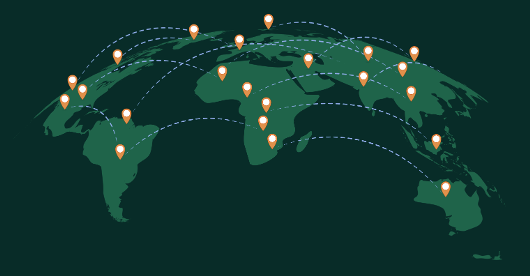
Overall, we witness minimal volatility across trade routes in the month of October so far which keeps container prices stable. This also indicates that the container demand remains unchanged mostly across the key trade routes.
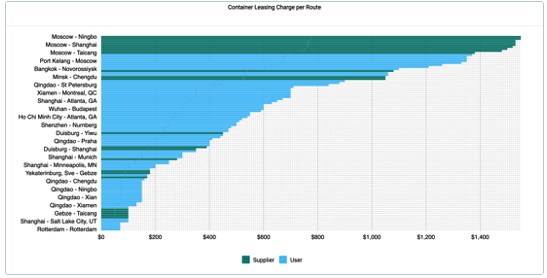
As we compare the different leasing rates in October across stretches, Russia to China has the most expensive per diem charges, followed by Port Kelang in Malaysia to Moscow. The volatility in Russia is indicated in the chart (below) owing to uncertainty and risk involved in container movement in and out of Russia.
Most Transacted Stretches
Here we have identified five significant trade routes, based on the volume of containers exchanged along these routes in 2023.
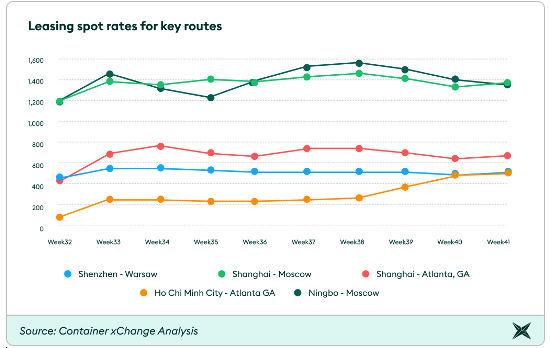
The chart above shows the demand hotspots for containers this October namely, China and Vietnam. The demand is coming mostly from the US. Alongside US, Moscow stands second for demand of containers. To read more about the China to Russia trade situation, here is our recently published analytical piece that narrates the current state of container excess in Russia.
Since the demand for containers on the China to Russia stretch is strong, the leasing spot rates are the highest on our platform as compared to the other stretches.
Shenzhen to Warsaw consistently maintains lower rates, showcasing its cost-effectiveness for shippers. Meanwhile, the Shanghai to Moscow route experiences relatively high and stable rates throughout, indicating a robust and consistent trade relationship between these two cities as well as stronger demand for containers on this route compared to others.
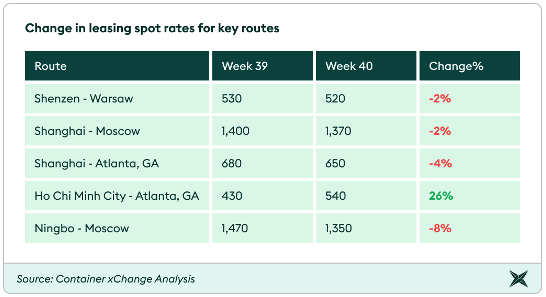
Intriguingly, Ho Chi Minh City to Atlanta, GA exhibits a substantial increase in rates from week 38 (18-24 September 2023) onwards.
Vietnam’s growing importance as a supply chain destination is underscored by its strong trade ties with the US, which is now its second-largest trading partner after China, with bilateral trade reaching $79 billion in first eight months of 2023. This surge in interest from US investors in Vietnam’s green energy and semiconductor manufacturing sectors points to the substantial increase in leasing spot rates from Vietnam to the US.
In contrast, Vietnam’s emergence as a favored destination for US investors is contributing to decreasing the gap in leasing spot rates between Vietnam and China to the US, firmly positioning Vietnam as an attractive hub for investment and trade diversification. Despite being a major player in the global supply chain, China’s leasing spot rates to the US have remained relatively stable.
“In this ever-shifting trade landscape, one thing is clear: every trade route is a tale of opportunities and challenges. Black swan events like the pandemic, war in Ukraine and now the Israel- Hamas conflict remind container logistics players to rethink their container logistics strategy. Volatility has led to tangible shifts in shipping trade lanes. While the intra-Asia trade remained stable by far, the Israel Hamas conflict gives reasons to stay cautious. China trade resurgence is going to again bring some hopes back for carriers.” Commented Christian Roeloffs, cofounder and CEO of Container xChange.
On the Asia-Europe stretch, the inclusion of Türkiye in the India-EU trade route offers promise amidst political complexities, while Central Asia and the South Caucasus create a bridge connecting the EU and China. The flexibility of the Asia-Europe trade route, as demonstrated by MSC, showcases the necessity for adaptability in a shifting market.
Christian Roeloffs added – “However, the recent Israel-Palestinian conflict serves as a stark reminder of the challenges and complexities in establishing new trade corridors. Similarly, the relationship between Pakistan and Afghanistan underscores the potential for economic cooperation in neighboring states, promising substantial rewards despite historical and political complexities.”
Asia-North America
While the turmoil in Israel has the potential to cause multifold impact, here is all about the situation in our most recent analytical piece on the israel situation
Challenges affecting the Malacca Strait
The Malacca Strait, a crucial passage uniting the Indian and Pacific Oceans, faces growing stress due to the US-China trade rivalry. This leads to a noticeable reduction in trade volume and marks the strait as a pivotal security and economic chokepoint for Southeast Asian nations.
In an evolving Indo-Pacific landscape, China’s rise as a global player challenges the once-unipolar world. The US, a premier player, faces questions about its past engagement, notably evaluating the implications of Henry Kissinger’s influential outreach to China.
A staggering 90,000 ships annually congest the Malacca Strait, causing navigational challenges. To ensure trade reliability, calls for alternative routes and enhanced connectivity become imperative.
US trade initiatives in a global context:
The US actively seeks permanent normal trade relations with Central Asian nations through the C5+1 partnership, encompassing Kazakhstan, Kyrgyzstan, Tajikistan, Turkmenistan, and Uzbekistan. This initiative fosters stronger ties and opens doors for new trade connections.
In a quest for bolstered economic development, energy security, and enhanced connectivity, the US scales up infrastructure investments. This effort particularly targets the Trans-Caspian trade route, known as the “Middle Corridor.”
As global commerce faces complex waters, the need for adaptation and strategic thinking becomes paramount. In the midst of geopolitical shifts and economic rivalries, nations and businesses must create opportunities amidst challenges.
Asia Europe
Türkiye’s key role in the IMEC trade route:
Türkiye’s strategic significance as a bridge between Europe and Asia takes the spotlight in the evolving India-EU trade route. Its NATO membership enhances regional security, while the country’s robust infrastructure capabilities promise to contribute significantly to the corridor’s growth.
Challenges like political complexities and geopolitical tensions are acknowledged but outweighed by the promise of enhanced trade and geopolitical influence.
Forging a new trade connection Central Asia and South Caucasus
Amid Russia’s waning influence in the region, Central Asia and the South Caucasus draw closer, forming a potential bridge between the EU and China. Recent developments, including a roadmap for the Middle Corridor’s development, highlight the region’s commitment to facilitating trade between the two areas. Rising transshipment levels underscore their growing interdependence, shaping evolving trade dynamics between Asia and Europe.
MSC’s Adaptive Moves in Asia-North Europe Trade:
Market dynamics and shifting demands prompt changes in the Asia-North Europe trade route. The Mediterranean Shipping Company (MSC) takes proactive steps to adjust its capacity, including omitting certain sailings to align with current demand.
This strategic move, seen as a potential industry precedent, reflects the ever-evolving nature of global trade, emphasizing the need for flexibility and efficiency in the Asia-Europe trade route.
Intra-Asia
Challenges in new trade corridors:
The Israel-Palestine conflict casts doubt on the India-Middle East-Europe Economic Corridor (IMEC), a Western rival to China’s Belt and Road initiative. IMEC relies on a stable Saudi Arabia-Israel connection through Haifa port, owned by India’s Adani group. This highlights the challenges in building long-term trade routes amid regional political complexities.
Pakistan-Afghanistan: Toward Economic Cooperation:
Pakistan and Afghanistan face geopolitical hurdles but can pivot to economic cooperation. Their trade balance has fluctuated, but both countries stand to gain from increased trade. A TDAP study identifies untapped potential in Afghanistan, exceeding $20 billion in trade value, making a compelling case for enhanced economic cooperation.



Related News.
Cyprus Maritime Innovation takes Centre Stage at SMM Hamburg 2026
Underscoring its expanding role as a premier international hub for cutting-edge maritime technology and sustainable shipping, the Republic of Cyprus…

Trump seeks to refill US oil reserve with Venezuela deal but faces long delay
U.S. President Donald Trump said on the 30th (local time) that he would refill the U.S. Strategic Petroleum Reserve, which has been depleted with…
US Navy Official visits South Korean Shipyards in private
With U.S. President Donald Trump pushing a plan to allow overseas construction of U.S. warships, attention is focusing on whether the building of…
SES and De Boer Marine expand collaboration with FlexMaritime deployment across Global Markets
SES, a leading space solutions company, and De Boer Marine, a leading provider of top-quality marine equipment and maritime connectivity services,…

New ESG guidance to help maritime industry turn sustainability into commercial advantage
New framework helps shipowners and ports align ESG strategy with access to capital, charterer expectations and long-term asset value. Maritime…

Britannia P&I Club analysis finds four in five crew deaths linked to illness rather than accidents
New report highlights cardiovascular disease as leading cause of fatalities and raises concerns over mental health risks among younger seafarers.…

The Swedish Club launches new Loss Prevention podcast, Knot Another Lesson
The Swedish Club has launched Knot Another Lesson, a new podcast exploring the practical lessons, emerging risks and operational challenges shaping…

Lloyd’s Register appoints Jens Grunenberg as Senior Representative for Germany
Lloyd’s Register has appointed Jens Grunenberg as its Senior Representative for Germany, effective 1 September. Based in Hamburg, Grunenberg will…
Indian Register of Shipping sets sights on Hamburg for European Expansion
Indian Register of Shipping, a leading international classification society and full member of the International Association of Classification…

MOL completes Merger of 6 Ship Management Companies
Unifying Management of Over 200 Vessels and Strengthening Safety Mitsui O.S.K. Lines, announced that it has completed the integration of the MOL…
Subscribe to our newsletter!
if you dont want to swim alone in the ocean of news, sign up for the newsletter, and you will receive daily all the important news of world shipping!
