BIMCO Shipping Number of the Week
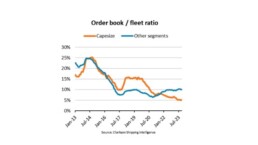

Capesize order book slips to 5% of fleet as contracting fall
“At the start of October, the capesize order book was at 20 million DWT, a mere 5% of the capesize fleet. The contracting of newbuild capesize ships has gradually decreased since its peak in 2013 and only 5 million DWT were contracted so far in 2023, down 4% y/y. Low freight rates paired with a young fleet are keeping the order book small,” says Filipe Gouveia, Shipping Analyst at BIMCO.
Contracting of newbuild ships typically increases following periods of high freight rates. For capesizes, freight rates depend heavily on China, as 63% of their cargoes have China as their destination. Capesize ships are the largest in the dry bulk fleet and transport most of the world’s iron ore.
2021 was the most recent year when freight rates surged, causing newbuilding contracting to reach 17 million DWT. However, in 2022 contracting fell 52% as rates slipped due to Covid lockdowns and weaker Chinese demand. In the first three quarters of 2023, freight rates and contracting remained low, as China’s economic recovery was weaker than foreseen, and the real estate crisis remained unresolved.
“Capesize deliveries are estimated to reach 11 million DWT in 2023, 37% below the 5-year average, and to further decrease to 7 million DWT in both 2024 and 2025. This low fleet growth could offer some support to capesize freight rates over the short- to medium-term and as result support a recovery in contracting,” says Gouveia.
On top of the low freight rates, the lower need for immediate fleet renewal among capesizes may also explain the smaller orderbook. The average capesize ship is two years younger than the average bulk carrier and only 15% of capesize ships, or 54 million DWT, are older than 14 years.
Decarbonisation is an important force driving fleet renewal. While shipowners may opt to retrofit younger ships, they may choose to replace older inefficient ships. For capesizes, the transition to alternative fuels may be easier than for smaller segments, since they operate in a reduced number of trade lanes. This makes it easier to ensure the supply of the necessary fuels in relevant ports.
“Capesizes could emerge as frontrunners in the adoption of alternative fuels among bulk carriers, even though they are the youngest fleet. 55% of their order book is for ships which are either capable or ready to run on LNG, methanol or ammonia, a much higher share than the 17% average for the entire dry bulk order book,” says Gouveia.
Source: BIMCO



Related News.

Beyond Technical Skills: WISTA Cyprus explores the human side of leadership
WISTA Cyprus hosted The Art of Leadership & Emotional Mastery, an interactive workshop held on 15 October at the Alasia Hotel in Limassol,…

The human cost of sending merchant mariners into war zones extends far beyond the immediate danger of missiles and drones. It raises a harder question: who is really protecting the seafarer?
Who protects the seafarer? I have spent much of my professional life at sea. I am a Master Mariner. I have stood on the bridge, made decisions…

Loss of bridge control: Human failure is normal – context is key
When bridge control is lost in a functioning system, it can be easy to blame human error. But accidents rarely happen because of one mistake…

Danish Shipping announces the transport of live animals by sea new rules should improve safety for animals, seafarers and the environment
Revised rules on the transport of live animals by sea are being negotiated in the EU. Danish Shipping wants to ensure good animal welfare,…

Japan’s flawed shipping proposal leaves developing countries adrift
A new analysis by Opportunity Green warns governments of the wide-ranging risks posed by Japan’s proposal at the International Maritime Organization…

Intermodal Report Week 42 2026
Pls find below the Intermodal Report - Week 42 2026 Intermodal Report Week 42 2026

Allied Weekly Market Review Week 42
Pls find below the Allied - Weekly Market Review - Week 42 ALLIED - Weekly Market Report- Week 42
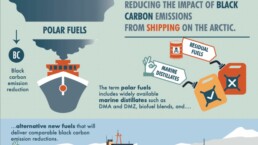
EU Arctic Strategy NGOs welcome EU ambition on on cutting shipping’s Arctic Black Carbon Emissions
Responding to today’s publication of the EU’s Arctic Strategy, which definitively states the EU’s intention to support International Maritime…

The final quarter of 2026 is expected to see softer bauxite flows
Chinese front-loading is expected to have run its course, pointing to softer bauxite flows in 2026 Q4. Global bauxite flows increased by 2.8% y/y…

DP World Foundation and Belewan new container terminal mark groundbreaking of AED 3.7 million school project in Indonesia
Classrooms of Hope initiative expands to Belawan, Medan with a new junior high school designed to provide modern learning facilities and greater…
Subscribe to our newsletter!
if you dont want to swim alone in the ocean of news, sign up for the newsletter, and you will receive daily all the important news of world shipping!
