Container shipping has a Europe problem and it’s getting worse


With all the attention on U.S. consumers and inventory levels, Europe’s importance to shipping lines can get lost in the shuffle. The Asia-Europe trade is pivotal to container shipping operators — and this trade is now under severe pressure.
Judah Levine, head of research at Freightos (NASDAQ: CRGO), said in a market report Tuesday that trans-Pacific spot rates remain well above 2019 levels “but carriers are not having the same success in the Asia-Europe lanes.”
The Freightos Baltic Daily Index (FBX) now puts China-North Europe spot rates below $1,000 per forty-foot equivalent unit, the lowest they’ve been since FBX began publishing its indexes.
War adds to Europe’s inflation woes
The Ukraine-Russia war has had major effects on tanker and dry bulk trade flows. Container shipping is seeing fallout as well, as economic pressure curbs volumes.
“The war has exerted a notable drag on real activity [in Europe] and pushed up inflation considerably,” said a study by the Swiss National Bank published Friday.
“The war has reduced domestic and external demand by having weighed on consumer sentiment and foreign GDP and … has led to a rise in domestic inflation, which has exerted a further dampening effect.”
Negative consequences will intensify, the study warned. “The adverse effects are likely to unfold over the coming years and become much stronger, particularly with regard to the impact on real economic activity.”
Economic impacts driven by the war come on top of inflation driven by COVID-era policies.
The European Commission reduced its economic outlook for the European Union in its latest forecast, released Sept. 11. “Weakness in domestic demand, in particular consumption, shows that high and still-increasing consumer prices for most goods and services are taking a heavy toll — more than expected,” it said.
The commission now predicts real GDP growth of only 0.8% for the EU in 2023. In contrast, the Conference Board consensus is for U.S. GDP growth of 2.2% this year.
Carriers have high exposure to Asia-Europe trade
Exposure to Europe varies widely among ocean carriers, but in most cases, it’s highly material to earnings.
China’s Cosco Group, the world’s fourth-largest liner operator, carried more containers in the Asia-Europe trade than in the trans-Pacific during the first half of this year. Asia-Europe accounted for 19.3% of Cosco’s H1 volumes, the trans-Pacific 18.5%.
Germany’s Hapag-Lloyd, the No. 5 carrier, had 18.2% of its H1 volumes in the Asia-Europe lane compared to 14.7% on the trans-Pacific.
The Asia-Europe and Asia-U.S. trades are almost equally important to Denmark’s Maersk, the world’s No. 2 carrier, with Europe at 22.8% of H1 volumes and the U.S. at 23.7%.
Japan’s Ocean Network Express had 22.5% of its H1 volume in Asia-Europe, below its Asia-North America share, at 32.5%. Israel’s Zim (NYSE: ZIM) had only 14.9% of its H1 volumes in Europe (the cross-Suez Mediterranean trade), with a much higher proportion — 37% — in the trans-Pacific.
Megamax deliveries flood European trade lanes
Asia-Europe spot rates are being hit by a one-two punch of weak demand and record-breaking capacity growth.
“Global container-ship capacity [has been] growing at an average rate of over 190,000 TEUs [twenty-foot equivalents] a month since April, after accounting for new ship deliveries and capacity upgrades and deducting scrapped capacity and other deletions,” Linerlytica reported on Monday.
“This pace of growth is the fastest rate ever recorded for the container markets and is set to continue for the next two years,” it said.
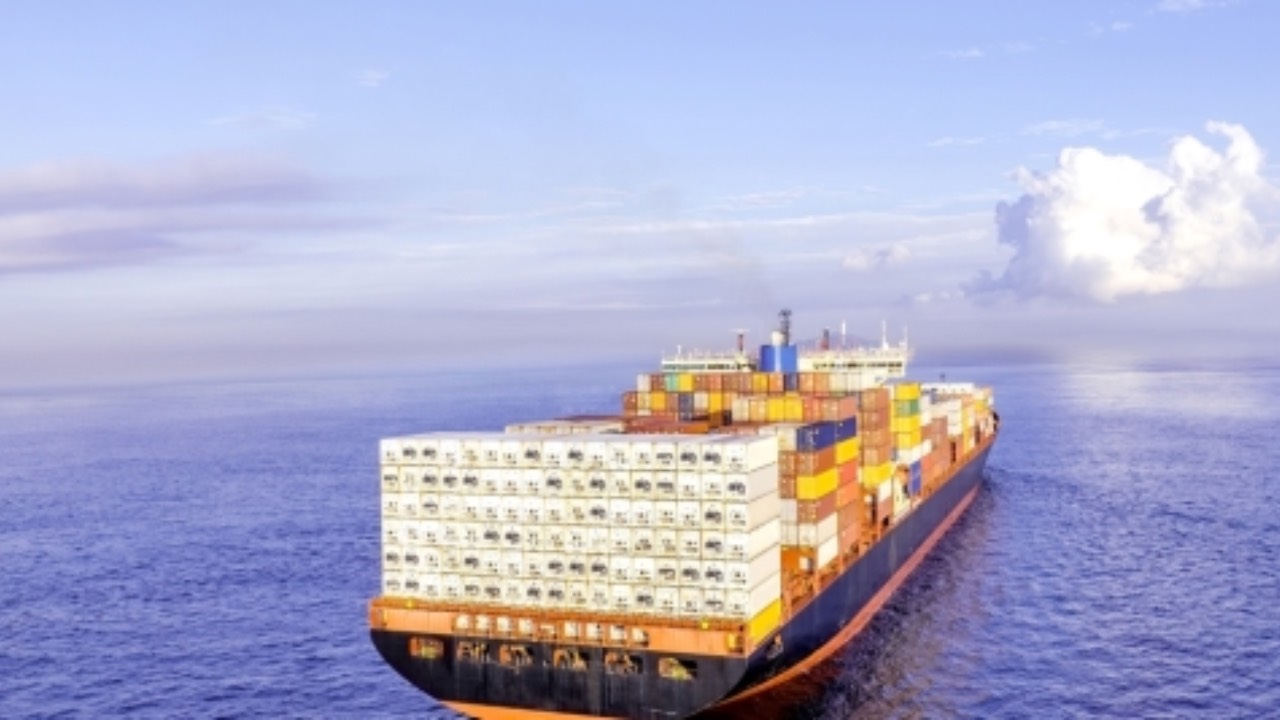
Fleet growth is having an outsized effect on the Asia-Europe lane because the newbuildings currently being delivered are skewed toward the so-called Megamax category: vessels with capacity of 23,000-24,000 TEUs. These vessels are specifically designed for Asia-Europe; terminals in other trades are not equipped to handle them.
According to data from Alphaliner, the majority of Megamaxes on order will be delivered this year. Deliveries in 2024 will heavily favor Neopanamaxes (vessels with capacity of 13,000-15,000 TEUs), shifting capacity pressure toward the Asia-U.S. trades.
Both spot and contract rates sinking
Asia-Europe spot rates are already at their lowest levels in years, with no relief in sight on the demand front, and, if the Swiss National Bank study is correct, more pressure ahead.
Spot rates in the Asia-Europe lane enjoyed a brief upswing in August, but have since slumped back down. The FBX China-North Europe assessment had fallen to $999 per FEU as of Tuesday, with the FBX China-Mediterranean index at $1,600 per FEU.
The Drewry World Container Index (WCI) spot assessment for Shanghai to Rotterdam, Netherlands, was down to $1,172 per FEU for the week ending Thursday. The WCI assessment for Shanghai to Genoa, Italy, had declined to $1,531 per FEU.
Contract rates, which follow in the direction of spot rates with a lag, are also plunging in Europe.
According to data from Xeneta, average long-term rates in the Far East-North Europe lane have declined 69% year to date, to $2,285 per FEU as of Tuesday. Average long-term rates in the Far East-Mediterranean lane are down 63% year to date, to $2,332 per FEU.
Spot rates heading toward 2015-2016 lows
How low can Asia-Europe rates go?
As noted by Vespucci Maritime CEO Lars Jensen in a recent online post, the only time Asia-Europe rates have been consistently lower than they are today was in 2015-2016. At that time, container lines were embroiled in a fierce price war.
Linerlytica warned: “Severe rate discounting, especially on the Asia-Europe route, has already brought rates to below 2019 levels, with the risk of a further slump to 2016 levels a real possibility in the absence of immediate capacity reduction measures.”
FBX index data does not go back to that earlier era of distress, but Drewry’s WCI data does.
The WCI Shanghai-Rotterdam index was highly volatile in 2015-2016. In some weeks, it exceeded the current index level of $1,172 per FEU. In other weeks, it sank to jaw-droppingly low numbers: a mere $358 per FEU in June 2015 and all-time low of $336 per FEU in March 2016.
Container lines were in severe financial distress in 2015-2016. South Korea’s Hanjin went bankrupt and was liquidated.
The difference this time around is that ocean carriers are flush with cash, courtesy of their historic windfall during the COVID-era boom, providing a financial runway to weather the crash in Asia-Europe rates, at least for now.
Source: Freight Waves by Greg Miller



Related News.

Cyprus Maritime Innovation takes Centre Stage at SMM Hamburg 2026
Underscoring its expanding role as a premier international hub for cutting-edge maritime technology and sustainable shipping, the Republic of Cyprus…

Trump seeks to refill US oil reserve with Venezuela deal but faces long delay
U.S. President Donald Trump said on the 30th (local time) that he would refill the U.S. Strategic Petroleum Reserve, which has been depleted with…
US Navy Official visits South Korean Shipyards in private
With U.S. President Donald Trump pushing a plan to allow overseas construction of U.S. warships, attention is focusing on whether the building of…
SES and De Boer Marine expand collaboration with FlexMaritime deployment across Global Markets
SES, a leading space solutions company, and De Boer Marine, a leading provider of top-quality marine equipment and maritime connectivity services,…

New ESG guidance to help maritime industry turn sustainability into commercial advantage
New framework helps shipowners and ports align ESG strategy with access to capital, charterer expectations and long-term asset value. Maritime…

Britannia P&I Club analysis finds four in five crew deaths linked to illness rather than accidents
New report highlights cardiovascular disease as leading cause of fatalities and raises concerns over mental health risks among younger seafarers.…

The Swedish Club launches new Loss Prevention podcast, Knot Another Lesson
The Swedish Club has launched Knot Another Lesson, a new podcast exploring the practical lessons, emerging risks and operational challenges shaping…

Lloyd’s Register appoints Jens Grunenberg as Senior Representative for Germany
Lloyd’s Register has appointed Jens Grunenberg as its Senior Representative for Germany, effective 1 September. Based in Hamburg, Grunenberg will…

Indian Register of Shipping sets sights on Hamburg for European Expansion
Indian Register of Shipping, a leading international classification society and full member of the International Association of Classification…
MOL completes Merger of 6 Ship Management Companies
Unifying Management of Over 200 Vessels and Strengthening Safety Mitsui O.S.K. Lines, announced that it has completed the integration of the MOL…
Subscribe to our newsletter!
if you dont want to swim alone in the ocean of news, sign up for the newsletter, and you will receive daily all the important news of world shipping!
