
Fuel is one of the biggest costs in ocean shipping, and fuel pricing has seen some big changes in recent months, featuring new dynamics that haven’t been seen in years.
Prior to the IMO 2020 regulation implemented on Jan. 1, 2020, most of the world’s commercial ships ran on 3.5% sulfur fuel known as high sulfur fuel oil (HSFO). Ships with exhaust-gas scrubbers can continue to burn HSFO under IMO 2020, while others — the majority of the commercial fleet — have switched to more expensive fuel with 0.5% sulfur known as very low sulfur fuel oil (VLSFO).
The vessels with scrubbers that burn cheaper HSFO are predominantly larger container ships, tankers and bulkers doing long-haul runs. The discount of HSFO to VLSFO — the so-called Hi-5 spread — equates to savings on the fuel bill. The bigger the spread, the more ships with scrubbers save.
That spread has collapsed. Not only has it fallen from record highs seen after Russia’s invasion of Ukraine, it has tumbled back to levels last seen during the pandemic.
VLSFO-HSFO spread drops to $73 per ton
Ship & Bunker publishes the average price of marine fuels at the world’s top 20 refueling hubs. On Wednesday, the discount of HSFO to VLSFO dropped to just $73 per ton.
The last time it was this low was in early December 2020. The all-time low was $45 per ton in November 2020. The peak — $420.50 per ton — was hit last July.
The average discount of HSFO to VLSFO has been near or below $100 per ton since early June. This is bad news for ships with scrubbers, increasing the payback period for the installation costs.
When the spread spiked a year ago, pre-2012-built very large crude carriers with scrubbers were saving $24,000 per day in fuel costs, according to data from Clarksons Securities. On Wednesday, the savings were only $3,400 per day. Larger dry bulk carriers with scrubbers were saving $18,000 per day when the spread peaked a year ago. On Wednesday, they were saving just $2,400 per day.
Shipping lines scale back fuel surcharges
The spread is falling because VLSFO and HSFO prices are going in different directions. After peaking in mid-2022, both fell sharply and roughly in unison during the second half of last year. They began diverging this February.
According to Ship & Bunker data, the average price of VLSFO at the top 20 refueling hubs was $595.50 per ton on Wednesday. That’s down 15% from the average price on Feb. 1. The average price of HSFO at the top 20 hubs was $522.50 per ton on Wednesday, up 12% from Feb. 1.
Average VLSFO and HSFO prices are down 37% and 40%, respectively, from record highs after the invasion. In the container shipping sector, this has led to reduced Bunker Adjustment Factor (BAF) charges to cargo shippers.
Data from Distribution Publications Inc. (DPI) for five carriers – CMA CGM, Cosco, Evergreen, OOCL and Zim (NYSE: ZIM) – shows Asia-West Coast BAFs averaging $587 per forty-foot equivalent unit in the third quarter of 2023, down 33% from the high reached in Q3 2022 and back to levels last seen in Q1 2022.
The five carriers’ BAFs for the Asia-East Coast route are averaging $1,073 per FEU in Q3 2023, on par with Q1 2022 levels and down 33% from the high in Q3 2022, when fuel pricing was driven up by the Ukraine-Russia war.
LNG now 16% cheaper than VLSFO in Rotterdam
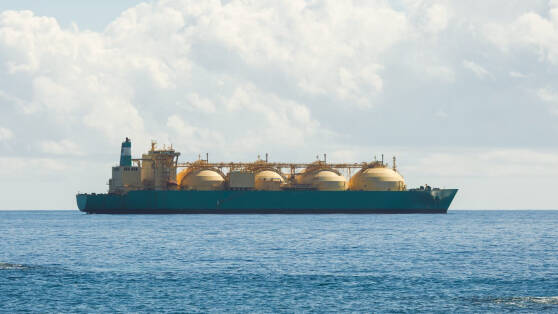
Beyond the unusually small VLSFO-HSFO spread, the other anomaly in today’s marine fuels market relates to liquefied natural gas, which is now cheaper than VLSFO or HSFO in the port of Rotterdam, Netherlands, for the first time in over two years.
LNG fuel was initially promoted to shipping (including cruise shipping) in the mid-2010s as a better way to comply with IMO 2020 than burning VLSFO or installing scrubbers. More recently, it has been pitched — more controversially — as a way for shipping to reduce greenhouse gas emissions.
There are 936 dual-fuel commercial ships capable of burning LNG currently on the water, with an additional 876 on order, according to Clarksons Research. But for most of these ships to actually use LNG, it needs to be competitively priced versus VLSFO.
The war caused LNG fuel prices to spike, with existing dual-fuel ships burning VLSFO, not LNG, as a result of the price differential.
More recently, European natural gas prices have plunged from war-induced highs as the continent cut industrial production and replaced Russian pipeline imports with seaborne LNG flows from the U.S.
As a result, the LNG fuel price in Rotterdam has come down and into line with fuel oil. LNG dipped below VLSFO pricing in May and June and has just done so again. The LNG price has been lower than the VLSFO price over the past nine days and below the HSFO price for the past three days.
Ship & Banker calculates the price of LNG based on the cost of the amount of LNG that provides the equivalent energy of 1 ton of HSFO. On that basis, it assessed the price of LNG in Rotterdam on Wednesday at $465 per ton, 16% below VLSFO and 4% below HSFO.
“We are now in a situation where the usage of LNG is financially advantageous compared to VLSFO,” said Alan Murphy, CEO of consultancy Sea-Intelligence.
Source: Freight Waves by Greg Miller



Related News.

Cyprus Maritime Innovation takes Centre Stage at SMM Hamburg 2026
Underscoring its expanding role as a premier international hub for cutting-edge maritime technology and sustainable shipping, the Republic of Cyprus…

Trump seeks to refill US oil reserve with Venezuela deal but faces long delay
U.S. President Donald Trump said on the 30th (local time) that he would refill the U.S. Strategic Petroleum Reserve, which has been depleted with…
US Navy Official visits South Korean Shipyards in private
With U.S. President Donald Trump pushing a plan to allow overseas construction of U.S. warships, attention is focusing on whether the building of…

SES and De Boer Marine expand collaboration with FlexMaritime deployment across Global Markets
SES, a leading space solutions company, and De Boer Marine, a leading provider of top-quality marine equipment and maritime connectivity services,…

New ESG guidance to help maritime industry turn sustainability into commercial advantage
New framework helps shipowners and ports align ESG strategy with access to capital, charterer expectations and long-term asset value. Maritime…

Britannia P&I Club analysis finds four in five crew deaths linked to illness rather than accidents
New report highlights cardiovascular disease as leading cause of fatalities and raises concerns over mental health risks among younger seafarers.…

The Swedish Club launches new Loss Prevention podcast, Knot Another Lesson
The Swedish Club has launched Knot Another Lesson, a new podcast exploring the practical lessons, emerging risks and operational challenges shaping…

Lloyd’s Register appoints Jens Grunenberg as Senior Representative for Germany
Lloyd’s Register has appointed Jens Grunenberg as its Senior Representative for Germany, effective 1 September. Based in Hamburg, Grunenberg will…

Indian Register of Shipping sets sights on Hamburg for European Expansion
Indian Register of Shipping, a leading international classification society and full member of the International Association of Classification…
MOL completes Merger of 6 Ship Management Companies
Unifying Management of Over 200 Vessels and Strengthening Safety Mitsui O.S.K. Lines, announced that it has completed the integration of the MOL…
Subscribe to our newsletter!
if you dont want to swim alone in the ocean of news, sign up for the newsletter, and you will receive daily all the important news of world shipping!
