

At a UN summit, countries have agreed to curb shipping emissions to net zero “by or around 2050”.
At the annual meeting of the International Maritime Organization (IMO), countries agreed to cut emissions by 20% by 2030 and 70% by 2040, compared to 2008 levels, and 100% by or around 2050. Small island nations and richer countries had called for a 50% reduction by 2030 and 96% by 2040.
Kitack Lim, Secretary-General of the IMO, described the deal as a “monumental development [that] opens a new chapter towards maritime decarbonisation”. But campaigners warn that the deal is flawed and will fail to bring the shipping industry in line with the Paris Agreement goal of limiting global temperature rise to 1.5C by the end of this century.
Shipping is a highly polluting industry, responsible for nearly 3% of global emissions and generating around one billion tonnes of greenhouse gases each year – roughly the same amount as Germany’s carbon footprint. If it were a country, the shipping industry would be the sixth largest polluter in the world.
Reducing maritime emissions rapidly in the next three decades will require new regulations, infrastructure and fuels. But what might green shipping of the future look like?
Wind-powered ships
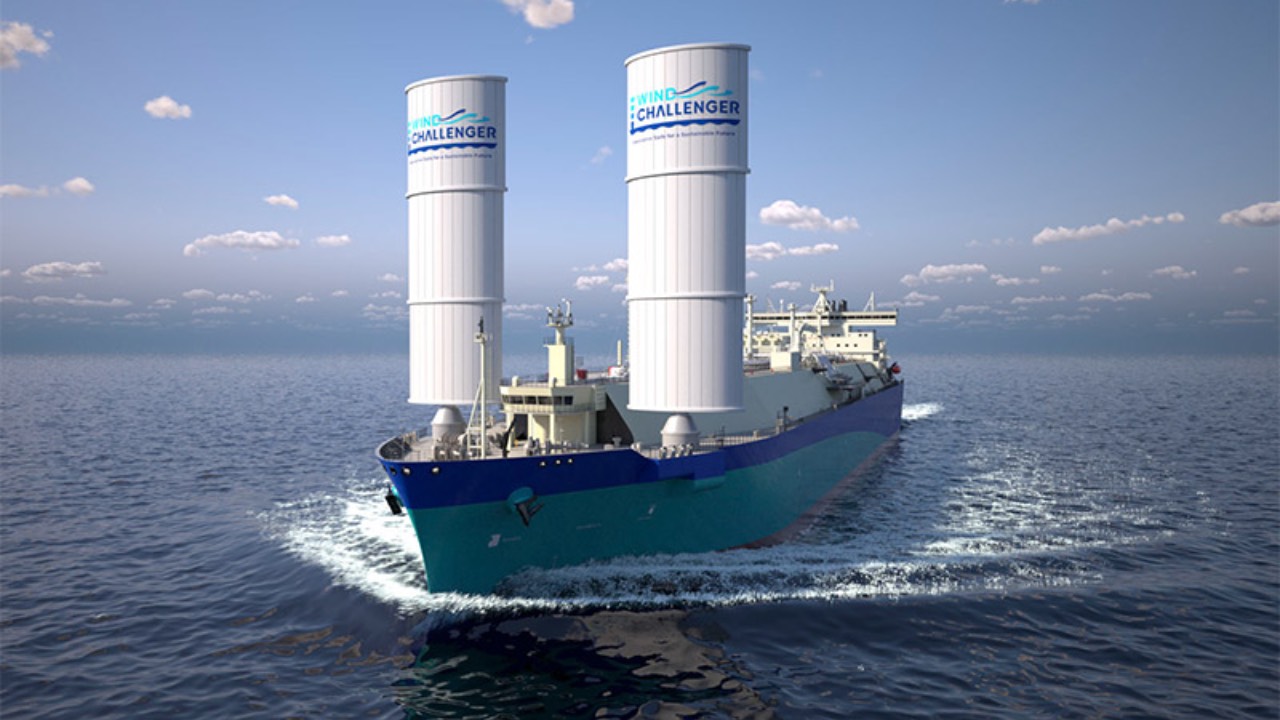
The shipping industry can reduce its reliance on fossil fuels by turning to an ancient technology: sails. Wind propulsion is considered one of the most promising energy sources available for the rapid decarbonisation of shipping. Swedish company Oceanbird has built a prototype ship with four rigid sails. Wind power not only propels the ship forward but also aids its manoeuvrability and agility on the water. One of the biggest challenges is encouraging governments and investors to adopt wind propulsion and retrofit ships, while wind propulsion is still early-stage.
Hydrogen
Deploying clean fuels such as hydrogen is critical if the shipping industry is to reach net zero by 2050. Green hydrogen – generated by using renewable energy, such as wind or solar power, to extract hydrogen from water molecules – is emissions-free. But there are some major challenges when deploying hydrogen: the fuel must be stored at cryogenic temperatures of -253C (-423F) and crew must be trained how to handle it as the fuel is highly flammable. (Read more about the fuel that could transform shipping).
Methanol
Maersk, the world’s second-largest container shipping company, is betting big on green methanol to help it decarbonise. The company has ordered a total of 25 methanol-powered ships to date. Green methanol is a low-carbon fuel which can be produced from sustainable biomass or by using renewable electricity to split water into oxygen and hydrogen, which is combined with carbon dioxide. Unlike hydrogen, green methanol does not have to be stored under pressure or extreme cold, and many ports already have infrastructure in place to store the fuel. But the process is complex: CO2 must be captured out of the atmosphere, technology which is still emerging, expensive and as yet unproven.
Electric boats
Batteries charged using renewable electricity are another way to curb shipping emissions. But there are limits to the distances they can power. Currently, renewable batteries are an option only for smaller ships making short journeys, such as ferries and river boats, not for large cargo ships crossing oceans. Instead, ship owners are looking to power cargo ships with a combination of wind power and solar panels. Japanese renewable energy systems company Eco Marine Power, for example, has developed “EnergySails”: rigid sails fitted with solar panels, which allow ships to use both solar and wind energy at the same time.
Green infrastructure
A rapid uptake of green fuels on vessels will require abundant new infrastructure at ports to produce and store them, and to allow ships to refuel. Ports must invest in hydrogen-generating electrolysers, renewable energy capacity, such as wind and solar power, as well as battery and hydrogen storage facilities. Most ships will also need to be retrofitted to enable them to run on green fuels, use wind propulsion and digital software to improve their efficiency and optimise routes.
Source: BBC



Related News.
Cyprus Maritime Innovation takes Centre Stage at SMM Hamburg 2026
Underscoring its expanding role as a premier international hub for cutting-edge maritime technology and sustainable shipping, the Republic of Cyprus…

Trump seeks to refill US oil reserve with Venezuela deal but faces long delay
U.S. President Donald Trump said on the 30th (local time) that he would refill the U.S. Strategic Petroleum Reserve, which has been depleted with…
US Navy Official visits South Korean Shipyards in private
With U.S. President Donald Trump pushing a plan to allow overseas construction of U.S. warships, attention is focusing on whether the building of…
SES and De Boer Marine expand collaboration with FlexMaritime deployment across Global Markets
SES, a leading space solutions company, and De Boer Marine, a leading provider of top-quality marine equipment and maritime connectivity services,…

New ESG guidance to help maritime industry turn sustainability into commercial advantage
New framework helps shipowners and ports align ESG strategy with access to capital, charterer expectations and long-term asset value. Maritime…

Britannia P&I Club analysis finds four in five crew deaths linked to illness rather than accidents
New report highlights cardiovascular disease as leading cause of fatalities and raises concerns over mental health risks among younger seafarers.…

The Swedish Club launches new Loss Prevention podcast, Knot Another Lesson
The Swedish Club has launched Knot Another Lesson, a new podcast exploring the practical lessons, emerging risks and operational challenges shaping…
Lloyd’s Register appoints Jens Grunenberg as Senior Representative for Germany
Lloyd’s Register has appointed Jens Grunenberg as its Senior Representative for Germany, effective 1 September. Based in Hamburg, Grunenberg will…

Indian Register of Shipping sets sights on Hamburg for European Expansion
Indian Register of Shipping, a leading international classification society and full member of the International Association of Classification…
MOL completes Merger of 6 Ship Management Companies
Unifying Management of Over 200 Vessels and Strengthening Safety Mitsui O.S.K. Lines, announced that it has completed the integration of the MOL…
Subscribe to our newsletter!
if you dont want to swim alone in the ocean of news, sign up for the newsletter, and you will receive daily all the important news of world shipping!
