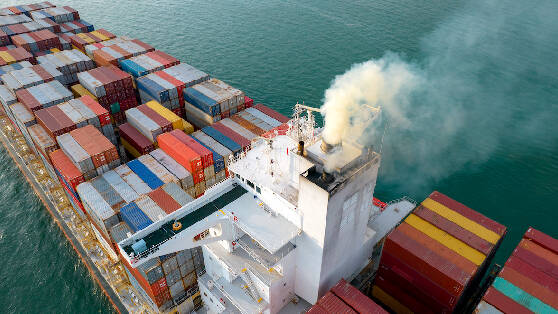

High cost of carbon credits
According to DNV’s Director Environment Maritime Eirik Nyhus, the EU ETS will lead to additional costs for the industry of roughly up to €10 billion a year once fully implemented in 2026, due to the need to acquire carbon credits corresponding to GHG emissions. This will effectively increase fuel-related costs by about 50%.
EU ETS sets stricter requirements over time
The expansion of EU ETS to shipping, due to introduced initially for cargo and passenger ships above 5,000gt over a three-year period from 1 January 2024, will require shipping companies to buy EU Allowances (EUAs) to cover their annual emissions with each EUA equivalent to 1 tonne of CO2. Companies will initially be liable for 40% of their CO2 emissions in 2024, rising to 70% in 2025 and 100% in 2026. This EU ETS revision became law in June. All emissions on voyages and port calls within the EU/EEA, and 50% of emissions on voyages into or out of the EU/EEA, will be subject to the EU ETS once fully implemented.
Annual emissions reported under the EU’s MRV (Monitoring, Reporting and Verification) regime will form the basis of a verified company emissions report that will determine the volume of allowances to be purchased and surrendered to the authorities by 30 September each year following the reporting year with heavy penalties for non-compliance.
Multiple commercial transactions under EU ETS required
Nyhus explains that in addition to the legal compliance aspect, the EU ETS will also have an immediate financial impact on shipping companies as they will start building up liabilities for emissions from 2024. Purchasing EUAs can be a significant expense for shipping companies which is likely to have implications for pricing and other terms of contractual agreements among different stakeholders, including charterers and cargo owners, he adds.
The EU ETS will trigger multiple commercial transactions among stakeholders to cover EUA costs in relation to voyage charters and these will need to be settled on an ongoing basis using accurate data to meet financial obligations to buy the right number of EUAs. Emissions must also be quantified for environmental reporting to the authorities, as well as other stakeholders such as banks, charterers and investors, to measure progress on decarbonization.
Emissions data verification solution
DNV has therefore launched the real-time data verification solution Emissions Connect™, a collaborative data-sharing tool accessible to all stakeholders – ship manager, owner, operator, charterer and cargo owner – on the Veracity platform to support such transactions. This provides a single source of truth for trusted, reliable and verified emissions data available in real time for all contractual parties for operational control and accurate accounting of emissions at every part of the value chain to facilitate financial settlements under the EU ETS.
Emissions Connect™ provides valuable services beyond verified emissions data
In addition, Emissions Connect™ can generate a verified voyage statement based on common standardized datasets to give an accurate record of emissions performance that can be shared with third parties in relation to regulatory compliance, as well as the Poseidon Principles and Sea Cargo Charter. It is also possible to simulate and benchmark the emissions performance of different voyage planning scenarios.
DNV’s Principal Consultant in Shipping Advisory, Knut Ljungberg, says Emissions Connect™ will help companies to manage increased administrative complexity with budgeting and reporting in relation to EUAs. “Shipping companies will need to establish procedures to purchase EUAs and budget for the estimated cost of allowances, as well as determine contractual liabilities across the value chain, to manage and minimize their financial risk,” he says.
CII requirements aim to drive decarbonization
Shipping companies also face new IMO reporting requirements starting this year for the Carbon Intensity Indicator (CII) that applies a rating of A–E for vessels above 5,000gt based on grams of CO2 emitted per cargo carrying capacity and nautical mile. Every vessel must have an operational plan to improve its CII rating in the mandatory Ship Energy Efficiency Management Plan (SEEMP) Part III and low-rated vessels that fail to comply could risk sanction, including trading bans.
The CII rating of a ship is set to become an increasingly important factor in charter terms, essentially determining its competitiveness and ability to trade over the longer term. This imposes a balance sheet risk that can have an impact on shareholder value, access to capital and commercial attractiveness.
Stay competitive with DNV’s ship specific Decarbonization Plan solution
Both CII and EU ETS cost calculations are now included among benchmarking criteria used in DNV’s Decarbonization Plan, a ship-specific solution optimized for compliance to relevant targets with minimal costs for the expected lifetime of the vessel. This is intended to ensure the vessel remains competitive in the market and prevent it from becoming a stranded asset. The plan for each vessel is compiled into a fleet overview and can be used to generate the required SEEMP-III documents.
The dynamic plan, which is updated in line with regulatory changes, can determine the compliance status of a vessel against applicable frameworks – including IMO regulations, Poseidon Principles and Sea Cargo Charter – and also takes into account factors such as trading patterns, docking schedule, vessel speed, CO2 tax and fuel prices. DNV experts working together with the shipping company can then evaluate a range of operational and technical measures, such as propulsion improvements or alternative fuels, and assess the cost-benefit of these to find the optimal decarbonization strategy.
In the case of the EU ETS, simulations can be carried out to predict costs based on trade routes, fuel price, carbon price changes and different CO2 tax levels, Ljungberg explains.
“Higher fuel-related costs due to the EU ETS will improve the business case for emissions-reduction measures due to a shorter payback time. Stricter regulations and rising costs for emissions will therefore accelerate the transition to low-carbon shipping,” he says.
Source: DNV



Related News.

Cyprus Maritime Innovation takes Centre Stage at SMM Hamburg 2026
Underscoring its expanding role as a premier international hub for cutting-edge maritime technology and sustainable shipping, the Republic of Cyprus…

Trump seeks to refill US oil reserve with Venezuela deal but faces long delay
U.S. President Donald Trump said on the 30th (local time) that he would refill the U.S. Strategic Petroleum Reserve, which has been depleted with…
US Navy Official visits South Korean Shipyards in private
With U.S. President Donald Trump pushing a plan to allow overseas construction of U.S. warships, attention is focusing on whether the building of…
SES and De Boer Marine expand collaboration with FlexMaritime deployment across Global Markets
SES, a leading space solutions company, and De Boer Marine, a leading provider of top-quality marine equipment and maritime connectivity services,…

New ESG guidance to help maritime industry turn sustainability into commercial advantage
New framework helps shipowners and ports align ESG strategy with access to capital, charterer expectations and long-term asset value. Maritime…
Britannia P&I Club analysis finds four in five crew deaths linked to illness rather than accidents
New report highlights cardiovascular disease as leading cause of fatalities and raises concerns over mental health risks among younger seafarers.…

The Swedish Club launches new Loss Prevention podcast, Knot Another Lesson
The Swedish Club has launched Knot Another Lesson, a new podcast exploring the practical lessons, emerging risks and operational challenges shaping…

Lloyd’s Register appoints Jens Grunenberg as Senior Representative for Germany
Lloyd’s Register has appointed Jens Grunenberg as its Senior Representative for Germany, effective 1 September. Based in Hamburg, Grunenberg will…
Indian Register of Shipping sets sights on Hamburg for European Expansion
Indian Register of Shipping, a leading international classification society and full member of the International Association of Classification…
MOL completes Merger of 6 Ship Management Companies
Unifying Management of Over 200 Vessels and Strengthening Safety Mitsui O.S.K. Lines, announced that it has completed the integration of the MOL…
Subscribe to our newsletter!
if you dont want to swim alone in the ocean of news, sign up for the newsletter, and you will receive daily all the important news of world shipping!
