Panama Canal commemorates seventh anniversary of the Neopanamax Locks
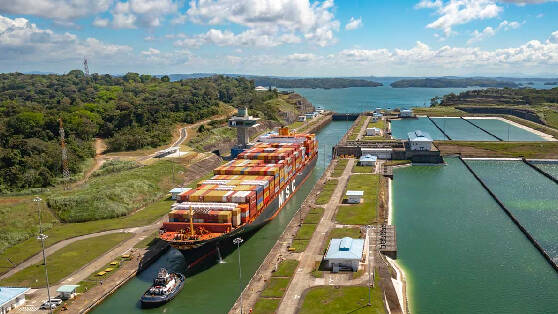

On June 26, 2016, thousands of people observed the beginning of a new era for the country with the inauguration of the Panama Canal expansion.
The new locks gave way to the transit of the container ship COSCO SHIPPING PANAMA, marking a before and after for the movement of cargo around the world, while the Canal fulfilled its mission to bring greater benefits to the country.
The Canal Expansion became the largest enhancement project undertaken since the Canal’s original opening in 1914, allowing the waterway to provide shipping lines, retailers, manufacturers and consumers with greater shipping options, better maritime service, enhanced supply chain reliability and sustainability.
The expansion also opened the waterway to 90 percent of the global LNG fleet for the first time in 2016, offering significant time savings for LNG producers in the United States and Latin America when exporting to the South America West Coast and Asia.
Additionally, it increased the route’s emission savings for customers by allowing them to transport even greater amounts of cargo in less voyages, reducing time, fuel, and emissions significantly.
As a result, it has caused a ripple effect on the local and global economy, impacting shipping and trade, as ports worldwide expand to accommodate larger ships, and benefitting those across the supply chain in every region the Panama Canal serves.
Consistent with its commitment to its customers, until the first week of June, over 20,600 vessels have safely transited the Neopanamax locks since their inauguration in 2016.
Expansion figures
The Neopanamax Locks were initially expected to serve vessels with a maximum of 12,600 twenty-foot equivalent units (TEUs); however, the Panama Canal team quickly managed to exceed this threshold, thanks in part to the experience they gained operating the locks and their close collaboration with customers.
Their ability to support larger vessels such as the Zephyr, which has a total capacity of 16,285 TEUs, enabled the Neopanamax Locks to accommodate 53 percent of the total Panama Canal tons that transited the waterway in FY2022.
The Neopanamax Locks continue to account for more than 50 percent of the Canal’s total tonnage, with more than 270 million Panama Canal tons (PC/UMS) between June 2022 and last May.
Connectivity
Given its privileged and strategic geographic location, Panama and the Panama Canal offer unsurpassed advantages to the world’s maritime commerce.
Ships from all parts of the world transit the Panama Canal daily, and 13 to 14 thousand vessels transit the Canal every year. The waterway serves more than 180 maritime routes, connecting 170 countries and reaching approximately 1,920 ports in the world.
Transiting the Panama Canal considerably reduces voyage time for vessels traveling from the U.S. Gulf Coast to markets in Asia.
Sailing from the US East Coast to Asia through the Expanded Canal takes 20 days, compared to 35.6 days for voyages through Cape Horn, 31.6 days through Cape of Good Hope, or 29.5 days if transiting through the Suez Canal.
Green Route
The Canal’s all-water route requires fewer cargo movements compared to freight transportation via air, truck or rail. Given the shorter traveling distance and larger TEU capacity it offers, the Canal reduces fuel consumption and therefore emissions, having a positive impact on the reduction of global greenhouse gases compared to other routes.
The waterway is more than a shortcut. In addition to offering safe, reliable, and efficient service, the Panama Canal offers unmatched environmental advantages to its customers.
Water and climate challenges
This seventh anniversary comes with important challenges on water and climate.
The Panama Canal is closely monitoring the development of weather events affecting water availability in the Canal Watershed, which according to forecasts, could worsen with the arrival of the El Niño phenomenon.
Due to the extended drought, in advance, the Panama Canal informed its customers that based on the current and projected levels of our water reservoirs to enforce maximum authorized drafts in the Neopanamax and Panamax Locks.
In response, the Canal is enforcing water saving measures during the rainy months to aid water recovery throughout the surrounding lakes and, thus, guarantee resources for human consumption without affecting transits. Although, current estimates indicate that the economic impact is unavoidable.



Related News.

Cyprus Maritime Innovation takes Centre Stage at SMM Hamburg 2026
Underscoring its expanding role as a premier international hub for cutting-edge maritime technology and sustainable shipping, the Republic of Cyprus…

Trump seeks to refill US oil reserve with Venezuela deal but faces long delay
U.S. President Donald Trump said on the 30th (local time) that he would refill the U.S. Strategic Petroleum Reserve, which has been depleted with…
US Navy Official visits South Korean Shipyards in private
With U.S. President Donald Trump pushing a plan to allow overseas construction of U.S. warships, attention is focusing on whether the building of…
SES and De Boer Marine expand collaboration with FlexMaritime deployment across Global Markets
SES, a leading space solutions company, and De Boer Marine, a leading provider of top-quality marine equipment and maritime connectivity services,…

New ESG guidance to help maritime industry turn sustainability into commercial advantage
New framework helps shipowners and ports align ESG strategy with access to capital, charterer expectations and long-term asset value. Maritime…
Britannia P&I Club analysis finds four in five crew deaths linked to illness rather than accidents
New report highlights cardiovascular disease as leading cause of fatalities and raises concerns over mental health risks among younger seafarers.…
The Swedish Club launches new Loss Prevention podcast, Knot Another Lesson
The Swedish Club has launched Knot Another Lesson, a new podcast exploring the practical lessons, emerging risks and operational challenges shaping…
Lloyd’s Register appoints Jens Grunenberg as Senior Representative for Germany
Lloyd’s Register has appointed Jens Grunenberg as its Senior Representative for Germany, effective 1 September. Based in Hamburg, Grunenberg will…
Indian Register of Shipping sets sights on Hamburg for European Expansion
Indian Register of Shipping, a leading international classification society and full member of the International Association of Classification…
MOL completes Merger of 6 Ship Management Companies
Unifying Management of Over 200 Vessels and Strengthening Safety Mitsui O.S.K. Lines, announced that it has completed the integration of the MOL…
Subscribe to our newsletter!
if you dont want to swim alone in the ocean of news, sign up for the newsletter, and you will receive daily all the important news of world shipping!
