ABS uses Simulation and Modeling to tackle Ammonia’s Safety Challenge
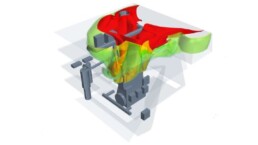

In a pioneering safety development, ABS is using advanced modeling and simulation technologies to develop emergency response methods to assist ports and crew in responding to ammonia leaks or spills.
It is the first step towards a comprehensive and fast ammonia release response system, capable of predicting the behavior of an ammonia plume and directing emergency mitigation services accordingly.
Thanks to its potential for zero-carbon emissions, ammonia is widely viewed as a promising fuel solution for a more sustainable industry but its high toxicity presents significant operational challenges on board and ashore.
“ABS has always been a safety pioneer, so we are well placed to tackle the significant operational risks presented by this critical piece of the net-zero jigsaw puzzle. Our advanced simulation and modeling approach is already shining a light on the unique behaviors of this fuel in a range of scenarios. This will inform the strategies of ports, crews and emergency services and enable immediate and informed response to an ammonia release. This is the sweet spot for ABS, the nexus of advanced technology, regulation and safety and we are on course to deliver a significant safety development for the industry,” said Christopher J. Wiernicki, ABS Chairman, President and CEO.
An industry leader in modeling and simulation, ABS combined those techniques with Computational Fluid Dynamics (CFD) to create a high-fidelity model designed to replicate ammonia dispersion patterns in the engine room. Using this new model, ABS specialists studied the impact of various ventilation approaches on the behavior of ammonia plumes resulting from leakages from the fuel lines, revealing optimum methods to vent the ammonia plume.
Leveraging this industry-leading approach, a dynamic model will be able to swiftly predict the response of an ammonia plume to a range of parameters such as wind speed and direction, humidity, cubic meters per second and relationship of the vessel to port. In addition to dispersion analysis, agent-based discrete event simulations to study the response of crew, port authorities, and emergency services after dispersion will be conducted.



Related News.

Poland’s additional national requirements distort competition says Danish Shipping
Poland has introduced a national survey requirement for smaller foreign-flagged vessels operating in Polish waters. This creates significant…

Battery Vessels could help electrify most of Global Shipping Emissions
Battery-electric ships are economical only if the pack is cycled frequently, so they have been confined to short-sea, ferry and harbour vessels…

Mintra and Ledgid explore collaboration to connect Maritime digital identity, learning and workforce development
Mintra® and LEDGID are exploring opportunities to bring together complementary capabilities in digital learning, maritime training, professional…

World Shipping Council calls for global agreement on shipping emissions as industry investment surpasses $200 billion USD
The World Shipping Council (WSC) is calling on governments to agree on binding global greenhouse gas regulations for international shipping without…

What happened to the ITF whistleblower’s complaint?
In January 2026, a whistleblower complained that International Transport Workers’ Federation (ITF) General Secretary Stephen Cotton had manipulated…

Growing regulatory scrutiny puts seafarer wellbeing firmly on maritime safety agenda, VIKAND warns
Seafarer wellbeing is coming under greater regulatory scrutiny as international rules and guidance increasingly recognise crew health and welfare as…

Good Times Bad Times the Premium Stays with the Strait
In October, we wrote that if the transfer network off Oman kept pace, Gulf crude would carry China's refill and keep drawing tonnage east,…

Allied Weekly Market Review Week 47
Pls find below the Allied - Weekly Market Review - Week 47 ALLIED - Weekly Market Report- Week 47


Climate TRACE releases September 2026 Emissions Data
Climate TRACE reported that global greenhouse gas (GHG) emissions for the month of September 2026 totaled 4.7 billion tonnes CO₂e. This remains…
Subscribe to our newsletter!
if you dont want to swim alone in the ocean of news, sign up for the newsletter, and you will receive daily all the important news of world shipping!
