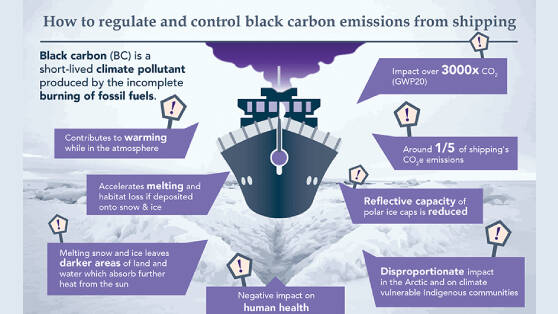

As a meeting of the International Maritime Organization’s Pollution Prevention and Response committee opens today (PPR 10), the Clean Arctic Alliance [1] calls on the IMO to radically reduce the impact of black carbon emissions from shipping on Arctic sea and glacier ice, by putting in place a compulsory requirement for ships across the whole Arctic to use cleaner fuels, by switching to distillate fuels.
This follows an open letter published by the Clean Arctic Alliance to IMO Secretary General Kitack Lim, asking him to personally call on all IMO members to now treat the Arctic climate crisis with the urgency that it demands.
“The reduction in black carbon emissions, which are a potent climate forcer, would be achieved through a mandatory fuel switch from dirty residual fuels to distillate fuels by ships operating across the broader Arctic, given the impact that shipping in and close to the Arctic regions can have on sea and glacier ice”, said Dr Sian Prior, Lead Advisor to the Clean Arctic Alliance, a coalition of 20 international non-profit organisations [2].
“The recent IPCC Synthesis Report makes clear that rapid, deep and sustained action is needed across all sectors [3]. To remain on or below a 1.5oC warming trajectory, ship climate impacts must be halved by 2030, with full decarbonisation close to 2040. This must include immediate cuts in black carbon emissions from ships, especially from those operating in and near to the Arctic”, said Prior.
“It is frustrating that the changes needed to rapidly reduce black carbon emissions from ships were not agreed and implemented when discussions on measures to reduce black carbon commenced over a decade ago,”she added. “Reducing black carbon emissions does not require the development of new fuels, or new technology, it simply requires cleaner fuel choices and the shipping sector catching up with what has been required of land-based power and transport systems for over a decade.”
The Clean Arctic Alliance also calls on IMO Members to bring forward proposals to designate Emission Control Areas (ECAs) in the Arctic and adjacent sea areas such as the north Atlantic where black carbon emitted from ships can reach the Arctic. Other measures that can reduce black carbon emissions in need of urgent action include the development of a strict aromatic fuel standard, as well as putting in place a requirement for installation of diesel particulate filters on ships operating in the Arctic.
“The Arctic, its wildlife and its people, are running out of time”, added Prior. “In 2010, the IMO Member States recognised the need for action to reduce black carbon emissions from ships – thirteen years later, the IMO must finally support mandatory action for measures that can be implemented quickly, such as a switch to cleaner fuels and use of filters, designation of emission control areas and the development of aromatic fuel standard.”



Related News.

Cyprus Maritime Innovation takes Centre Stage at SMM Hamburg 2026
Underscoring its expanding role as a premier international hub for cutting-edge maritime technology and sustainable shipping, the Republic of Cyprus…

Trump seeks to refill US oil reserve with Venezuela deal but faces long delay
U.S. President Donald Trump said on the 30th (local time) that he would refill the U.S. Strategic Petroleum Reserve, which has been depleted with…
US Navy Official visits South Korean Shipyards in private
With U.S. President Donald Trump pushing a plan to allow overseas construction of U.S. warships, attention is focusing on whether the building of…
SES and De Boer Marine expand collaboration with FlexMaritime deployment across Global Markets
SES, a leading space solutions company, and De Boer Marine, a leading provider of top-quality marine equipment and maritime connectivity services,…

New ESG guidance to help maritime industry turn sustainability into commercial advantage
New framework helps shipowners and ports align ESG strategy with access to capital, charterer expectations and long-term asset value. Maritime…

Britannia P&I Club analysis finds four in five crew deaths linked to illness rather than accidents
New report highlights cardiovascular disease as leading cause of fatalities and raises concerns over mental health risks among younger seafarers.…
The Swedish Club launches new Loss Prevention podcast, Knot Another Lesson
The Swedish Club has launched Knot Another Lesson, a new podcast exploring the practical lessons, emerging risks and operational challenges shaping…

Lloyd’s Register appoints Jens Grunenberg as Senior Representative for Germany
Lloyd’s Register has appointed Jens Grunenberg as its Senior Representative for Germany, effective 1 September. Based in Hamburg, Grunenberg will…
Indian Register of Shipping sets sights on Hamburg for European Expansion
Indian Register of Shipping, a leading international classification society and full member of the International Association of Classification…
MOL completes Merger of 6 Ship Management Companies
Unifying Management of Over 200 Vessels and Strengthening Safety Mitsui O.S.K. Lines, announced that it has completed the integration of the MOL…
Subscribe to our newsletter!
if you dont want to swim alone in the ocean of news, sign up for the newsletter, and you will receive daily all the important news of world shipping!
