Overfishing falls in the Mediterranean and Black Sea, but fisheries resources remain under significant stress

New UN report highlights the need for stronger management measures
Overfishing in the Mediterranean and Black Sea has fallen significantly in the past decade, but exploitation of most commercial species is far from sustainable, according to a report by the General Fisheries Commission of the Mediterranean of the Food and Agriculture Organization of the United Nations .
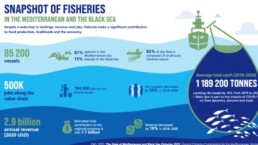
The latest edition of The State of Mediterranean and Black Sea Fisheries (SoMFi) found excessive exploitation has diminished in the region, particularly for key species subject to multilateral management plans. However, 73 percent of commercial species are still overfished and fishing pressure, while lower than in the past, is still double than what is considered sustainable.
“In the 2030 Strategy, GFCM Members have set new goals to address this issue. They know that reversing the declining trend of aquatic resources is crucial, as is linking profitability and sustainability outcomes,” said Miguel Bernal, newly appointed GFCM Executive Secretary. “The new strategy provides an ambitious vision and requires bolder collective efforts than before.”
The biennial report found that production in the fisheries sector has fallen by around 15 percent since 2020, partly due to the COVID-19 pandemic, and so too have industry revenues and jobs.
Its release comes at a crucial time as the international community gears up to participate in the 15th Conference of the Parties to the Convention on Biological Diversity and expected to negotiate a new Global Biodiversity Framework, an opportunity to highlight the meaningful contribution of fisheries to the sustainable use and conservation of biodiversity.
SoMFi is the flagship publication of the GFCM, a FAO regional fisheries management organization. Thanks to the consolidation of quality standards in the past two years, this year’s SoMFi is the first to analyze trends in the fisheries sector at the regional level.
Sustainable fisheries require effective management
While most key commercial species are not yet exploited sustainably, nearly all of them show a decrease in fishing pressure to levels below the regional average, the report found.
Stocks of European hake in the Mediterranean, turbot in the Black Sea and common sole in the Adriatic Sea, which are under one or more management plans, showed a striking reduction in overfishing, and some of these species already revealed signs of biomass rebuilding.
The GFCM has implemented 10 multiannual fisheries management plans targeting priority stocks and involving nearly 7 000 vessels. It has also established 10 fisheries restricted areas which are helping to reduce exploitation and improve conservation of stocks and deep-sea ecosystems across more than 1.7 million square kilometres of the Mediterranean and Black Sea.
Manuel Barange, the director of FAO’s Fisheries and Aquaculture Division, said SoMFi highlighted the challenges in ensuring sustainability in this critical region.
“The Mediterranean and Black Sea is one of the most overexploited fishing regions in the world, but one where we have also seen a strong commitment in recent years to manage resources effectively,” Barange said.
“A Blue Transformation of the fisheries sector is the only way to ensure it continues to underpin food production and livelihoods for present and future generations.”
Coastal livelihoods at risk from an ageing workforce and job losses
Fisheries in the Mediterranean and Black Sea generate an annual revenue of $2.9 billion and generates an estimated half a million jobs throughout the value chain. An average 1 in every 1 000 coastal residents in the region is a fisher, and in some coastal areas that number can be up to 10 times higher.
However, the workforce is ageing. In 2020, more than half of all crew were over the age of 40, while only 10 percent were under the age of 25. According to the latest data in SoMFi this trend is worsening.
Small-scale fisheries accounts for 82 percent of the vessels and 59 percent of the jobs. It also employs the highest number of young people, but small-scale fishers earn typically less than half the wage earned by fishers on industrial fleets.
The GFCM consists of 23 member countries and its main objective is to ensure the conservation and the sustainable use of living marine resources, as well as the sustainable development of aquaculture.



Related News.

Navigating the Multi-Orbit Era: In Conversation with Intellian’s Jon Harrison at SMM 2026
At SMM 2026 in Hamburg, the rapid evolution of maritime satellite communications took centre stage. Across the exhibition halls, discussions among…

Cyprus ports need joint energy and investment strategy, shipping agents chief says
Cyprus needs a coordinated strategy for shipping, energy and environmental protection to support port investment and modernisation, Cyprus shipping…

MASO Public Affairs introduces MASO Regulatory Intelligence
A new subscription service helping businesses understand what is changing and what it means for them MASO Public Affairs introduces MASO Regulatory…

Anglo-Eastern helps turn CMBTECH’s ammonia ambition into an operational reality
From early feasibility study and risk-based design to newbuilding supervision, crew readiness and technical management, Anglo-Eastern drew on its…

Escalation of attacks threatens to derail recovery in Middle East oil exports
World oil demand is forecast to fall by 2.5 mb/d y-o-y in 4Q26 and 2.6 mb/d on average in 2026. As the Iran war manifests itself through restricted…

New study finds shipping pays twice its share to EU ETS earmarked revenues should triple to help build market for sustainable fuels and technologies
Shipping is responsible for around 10% of EU ETS emissions but pays almost 20% of the ETS bill. Unlike other sectors, it has never received free…

MSARC strengthens maritime mass rescue readiness through training and national live exercise off Dakar, Senegal
Joint MSARC–FHAS programme combines three days of SAR training with a national multi-agency live exercise The Maritime Search and Rescue Council ,…

Sogese report deliveries are still being delayed as container freight rates fluctuate
FOR IMPORTERS Spot rates into the Mediterranean are back at January levels, Far East to Europe reliability sits at pandemic lows, and nearly…

Glencore begins trading on Australian Securities Exchange
Glencore has begun trading on the Australian Securities Exchange under the ASX code GLC. Gary Nagle, Glencore’s CEO, said it was an exciting day for…

BIMCO Shipping Number of the Week
Suez Canal container ship transits exceed 50% of pre-disruption levels "During the first two weeks of October, weekly container ship capacity…
Subscribe to our newsletter!
if you dont want to swim alone in the ocean of news, sign up for the newsletter, and you will receive daily all the important news of world shipping!
