Navigating the Multi-Orbit Era: In Conversation with Intellian’s Jon Harrison at SMM 2026


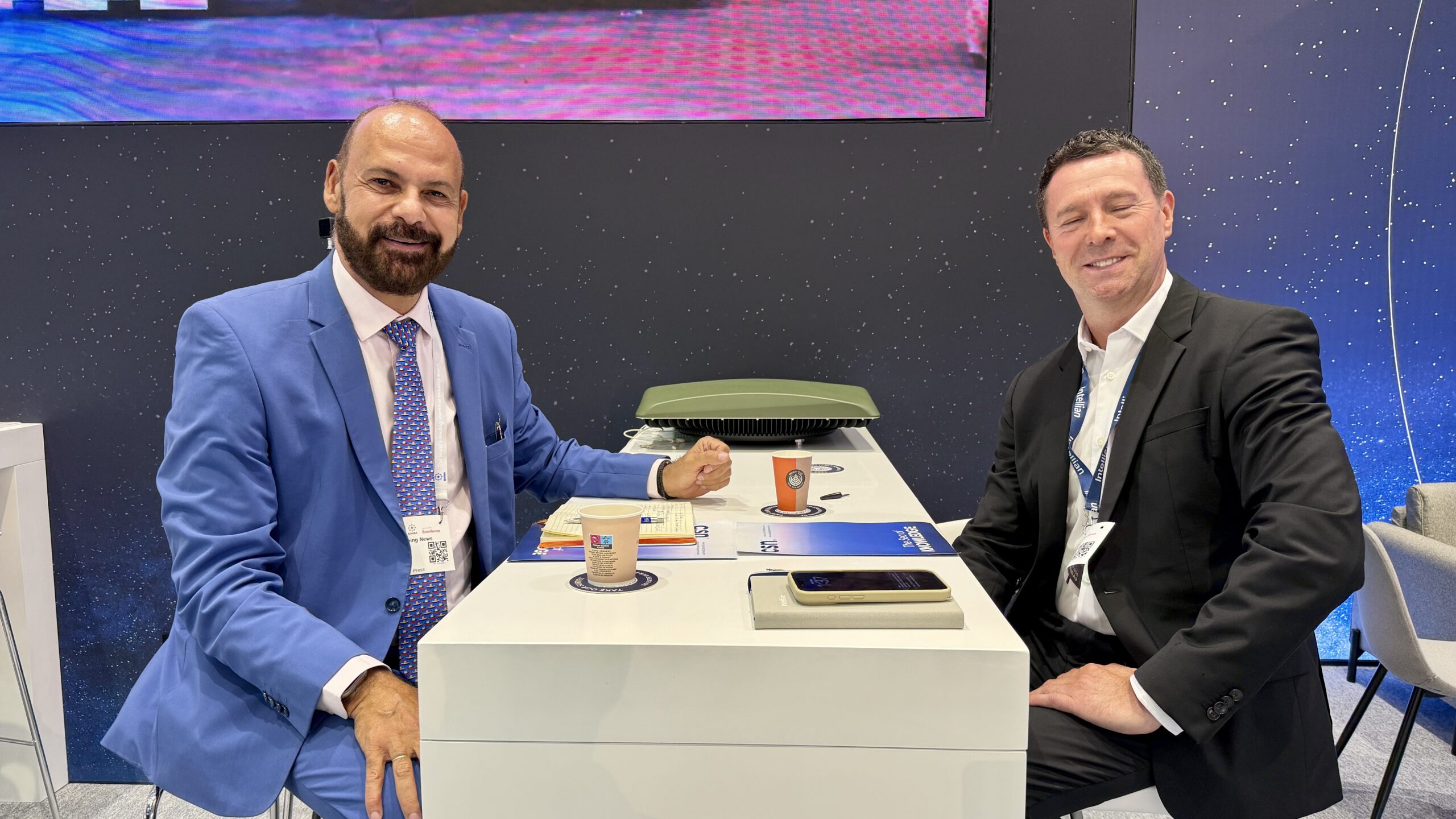
At SMM 2026 in Hamburg, the rapid evolution of maritime satellite communications took centre stage. Across the exhibition halls, discussions among shipowners, managers, and technology providers made one reality abundantly clear: the industry has moved well past the debate of choosing between low Earth orbit (LEO) and geostationary (GEO) networks. Maritime connectivity has entered a multi-orbit era defined by hybrid resilience, where the true differentiator lies in how intelligently these networks can be combined. During the exhibition, I sat down with Jon Harrison, Vice President at Intellian, to examine how modern antenna design and strategic network integration are reshaping vessel communications.
Jon Harrison serves as Vice President at Intellian Technologies, where he plays a leading role in guiding the company’s global market expansion, strategic industry partnerships, and commercial terminal portfolio. With extensive experience across the international satellite communications and maritime technology sectors, Jon brings deep insight into the practical demands of shipboard operations. His focus centres on helping shipowners, service providers, and technology partners navigate the transition toward multi-orbit, multi-band architectures through robust and scalable hardware solutions.
Our conversation began with the shifting mindset of shipowners. As Jon pointed out, the primary question is no longer which satellite network to purchase, but how to blend different orbits effectively. LEO constellations deliver impressive low latency and high throughput, while established GEO and MEO networks provide capacity depth, coverage diversity, and long-term reliability. Meanwhile, L-band connectivity remains essential for critical and safety-related functions. His advice to vessel operators is straightforward: avoid designing connectivity around a single constellation, and instead focus on business applications and desired outcomes. Key factors such as trading routes, bandwidth requirements, latency tolerance, critical system availability, and overall cost must lead the strategy. Hardware choices must also be future-ready so that today’s antenna installation does not leave a vessel locked into an outdated architecture five years down the line. A clear example at SMM is how Intellian’s flat panels provide the OneWeb LEO component for Inmarsat NexusWave, while the VS60 delivers the ViaSat-3 GEO layer, illustrating the industry’s decisive shift toward multi-band hybrid networks.
A major technical milestone discussed was the commercial rollout of Intellian’s enterprise flat panel antenna, the OW11FM, engineered for the Eutelsat OneWeb network. Jon highlighted that the benefits begin with physical practicality. Deck space aboard modern commercial vessels is increasingly constrained, and the OW11FM weighs approximately 20.5 kilograms, making it manageable for a single technician to install using a single coaxial cable for both power and encrypted data. By employing electronic beam steering, the terminal removes the mechanical complexity inherent to conventional stabilised dishes, lowering lifetime maintenance demands. Crucially, the unit features an advanced blockage-mitigation architecture designed to maintain high throughput even when shipboard obstructions, such as cranes, funnels, and superstructures, obscure the view of the sky. As Jon noted, the message is not simply that flat panels replace parabolic antennas, but rather that flat-panel technology makes high-performance LEO connectivity far easier to deploy and maintain across large commercial fleets.
Flexibility remains equally vital for parabolic systems, a principle demonstrated by Intellian’s XEO platform. In commercial shipping, vessels frequently encounter changing network conditions, regional congestion, adverse weather, or altered charter routes that necessitate switching frequency bands. Historically, moving between Ku-band and Ka-band demanded physical conversion kits, replacement feeds, and a specialist engineer boarding the ship. The XEO platform eliminates that operational headache by enabling electronic switching between Ku and Ka frequencies via a single software command. With multi-orbit support built in, ship operators can leverage high-capacity Ka-band services while retaining instant access to Ku-band for geographic resilience. Jon underscored that true operational continuity does not come from relying on a single exceptional link, but from maintaining multiple viable paths and the ability to transition between them without crew intervention.
While broadband data rates capture significant industry attention, safety remains the bedrock of maritime communications. Intellian has expanded its GMDSS portfolio over the Iridium Certus network with the launch of the C100M, joining the established C200M and C700 terminals. This establishes a dedicated safety solution across every Iridium service tier, providing genuinely global coverage that includes critical polar routes. The engineering philosophy prioritises streamlined compliance: the C100M supports both coaxial and NMEA 2000 cabling, allowing many vessels to reuse existing cabling during retrofits rather than running new infrastructure through the ship. Furthermore, processing is integrated into a bridge-mounted Safety Control Unit, eliminating the requirement for a separate below-deck unit, saving space, and giving officers immediate access to Distress Alerts, Safety Voice, and Maritime Safety Information.
Delivering this level of technical capability onboard requires tight alignment between hardware manufacturers and network integrators. Jon discussed Intellian’s long-term partnership with Marlink, underpinned by a five-year strategic agreement focused on joint hybrid development across GEO, MEO, and LEO networks. While Intellian builds scalable terminal hardware, Marlink absorbs complexity through SD-WAN orchestration and managed services. On a modern vessel, operational data, engine monitoring, video calls, ERP transactions, and crew media streams all carry distinct network priorities. Platforms like Marlink’s XChange NextGen use application-aware routing to automatically steer traffic over the most suitable satellite link based on packet loss, latency, and cost policy. This model has already demonstrated clear commercial value at scale, including the deployment across more than 300 vessels within the CMA CGM fleet.

With expanded connectivity, however, comes increased exposure to cyber risks. Jon acknowledged that higher bandwidth, increased cloud adoption, and growing numbers of connected endpoints inevitably expand the vessel’s attack surface. Cybersecurity must be addressed by design from the outset rather than treated as a secondary consideration. While Intellian integrates foundational safeguards, such as onboard firewalls and rigorous firmware controls into its terminals, the terminal remains just one element of a vessel’s wider security posture. Ship operators and service providers must enforce robust network segmentation, SD-WAN protection, and continuous monitoring, keeping crew welfare networks entirely segregated from business IT and operational technology (OT) systems. The solution to cyber risk is not to throttle connectivity, but to architect it responsibly.
Our discussion concluded with the evolving expectations surrounding seafarer welfare and its direct link to commercial performance. Modern crews view fast, reliable internet as a fundamental condition of employment, comparing onboard connectivity directly to the digital standards they enjoy at home. Readily available access to family, entertainment, and online training now plays a direct role in crew recruitment and retention. Importantly, the expanded bandwidth supporting crew wellbeing is also transforming shore-side operational collaboration. Cloud applications, predictive machinery maintenance, real-time voyage planning, and emissions reporting are now routine realities. Because intelligent routing platforms can segregate crew data from critical ship systems, operators no longer have to compromise between seafarer welfare and operational efficiency.
Ultimately, as the shipping industry continues to navigate digital transformation, success will depend on three clear principles: providing shipowners with genuine choice across orbits and frequencies, stripping unnecessary complexity away from vessel crews, and building true resilience through intelligent, multi-layered connectivity.



Related News.

Cyprus ports need joint energy and investment strategy, shipping agents chief says
Cyprus needs a coordinated strategy for shipping, energy and environmental protection to support port investment and modernisation, Cyprus shipping…

MASO Public Affairs introduces MASO Regulatory Intelligence
A new subscription service helping businesses understand what is changing and what it means for them MASO Public Affairs introduces MASO Regulatory…

Anglo-Eastern helps turn CMBTECH’s ammonia ambition into an operational reality
From early feasibility study and risk-based design to newbuilding supervision, crew readiness and technical management, Anglo-Eastern drew on its…

Escalation of attacks threatens to derail recovery in Middle East oil exports
World oil demand is forecast to fall by 2.5 mb/d y-o-y in 4Q26 and 2.6 mb/d on average in 2026. As the Iran war manifests itself through restricted…

New study finds shipping pays twice its share to EU ETS earmarked revenues should triple to help build market for sustainable fuels and technologies
Shipping is responsible for around 10% of EU ETS emissions but pays almost 20% of the ETS bill. Unlike other sectors, it has never received free…

MSARC strengthens maritime mass rescue readiness through training and national live exercise off Dakar, Senegal
Joint MSARC–FHAS programme combines three days of SAR training with a national multi-agency live exercise The Maritime Search and Rescue Council ,…

Sogese report deliveries are still being delayed as container freight rates fluctuate
FOR IMPORTERS Spot rates into the Mediterranean are back at January levels, Far East to Europe reliability sits at pandemic lows, and nearly…

Glencore begins trading on Australian Securities Exchange
Glencore has begun trading on the Australian Securities Exchange under the ASX code GLC. Gary Nagle, Glencore’s CEO, said it was an exciting day for…

BIMCO Shipping Number of the Week
Suez Canal container ship transits exceed 50% of pre-disruption levels "During the first two weeks of October, weekly container ship capacity…

Intermodal Report Week 41 2026
Pls find below the Intermodal Report - Week 41 2026 Intermodal Report Week 41 2026
Subscribe to our newsletter!
if you dont want to swim alone in the ocean of news, sign up for the newsletter, and you will receive daily all the important news of world shipping!
