World’s first multi-fuel LNG battery hybrid PCTC Auto Advance and sistership Auto Aspire christened at Zeebrugge ceremony
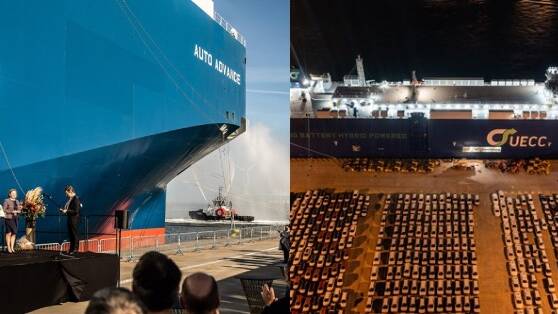

UECC’s pioneering newbuild trio of multi-fuel LNG battery hybrid PCTCs “will make a real difference for the environment and for business” as new green regulations are set to shift the market playing field, CEO Glenn Edvardsen said at the naming ceremony for flagship Auto Advance and its sistership Auto Aspire this week.
The two newbuilds were formally named by appointed Godmother Rosemary Lister, Head of Raw Material, Indirect and Supply Chain Purchasing at Toyota Motor Europe, at the October 26 ceremony in Zeebrugge attended by over 100 guests, who were also given a guided tour of the Auto Advance.
Attendees included UECC customers, owners, suppliers, partners and port authorities, as well as the Mayor of Bruges/Zeebrugge Dirk De fauw. Representatives from UECC’s owners NYK and Wallenius Lines, along with company staff, were also in attendance.
The christening of the Auto Advance was performed in traditional manner by Mrs. Lister with the cracking of a champagne bottle on the hull to a fanfare of vessel horns and a tugboat spraying water, while the Auto Aspire was named in a virtual ceremony.
The Auto Advance has already been trading in North European waters for the past year following delivery last November from China’s Jiangnan Shipyard.
‘Industry leadership’
Edvardsen told the audience that the shipping industry could only advance to make progress towards decarbonisation by deciding to move in a different direction. UECC’s owners and board of directors had done just that more than a decade ago by making bold investments in newbuilds and alternative low-carbon fuels to drastically reduce the company’s emissions profile, he said.
“By putting the environment at the top of its corporate agenda, UECC has taken industry leadership in response to the climate challenge. Growing market demands for green operations and new environmental regulations will radically change the way we do business in future,” he said.
The Auto Advance and its sisterships are the first vessels of their kind to be brought into operation, combining a multi-fuel LNG engine with a hybrid battery solution and smart energy management system in an innovative configuration designed for reduced fuel consumption and energy efficiency.
They have been developed by leading sustainable shortsea Ro-Ro carrier UECC together with Jiangnan’s in-house design institute, as well as Wallenius Marine and NYK, in what was described by Edvardsen as “a triumph of engineering, teamwork and international co-operation”.
“This could not have been achieved without the hard work, dedication and expertise of the entire workforce at Jiangnan Shipyard and the UECC design and site team that consisted of Wallenius Marine, NYK and UECC people, who had to overcome difficulties with lockdowns due to the Covid-19 pandemic to keep construction of the vessels on track,” he said.
In step with regulations
The deliveries of the three newbuilds over the past year have proven timely given the IMO’s CII and EEXI/EEDI regulations to cut the carbon intensity of both new and existing vessels are due to kick in from 1 January 2023.
All three PCTCs already exceed the IMO requirement for a 40% reduction in carbon intensity by 2030 that is the purpose of these regulations, according to Edvardsen.
Furthermore, the cost of running ships on conventional marine fuels in Europe is set to increase with the removal of a tax exemption on bunker suppliers in the EEA from next year under the Energy Taxation Directive.
Pollutive ships will also be increasingly penalised with the expected extension of the EU’s Emissions Trading System to shipping from 2024, which could add as much as 50% to the cost of fossil fuel consumption, based on recent carbon pricing, due to the need to buy emissions allowances, according to UECC.
Shifting playing field
Edvardsen believes these regulations will shift the market playing field in favour of environment-focused operators amid increasing demands from cargo owners and charterers for a more sustainable logistics chain.
He said LNG is currently the most environment-friendly fuel available, with an estimated reduction of 25% in CO2 emissions, and the PCTCs’ engine is also adaptable for future low-carbon fuels such as bio-LNG as these become available. “UECC has taken advantage of available low-carbon fuel technology to enhance the sustainability of its operations,” he said.
“With new IMO carbon intensity regulations just around the corner and the looming prospect of higher costs for using conventional marine fuel, we are convinced that our timely investments in these newbuilds will make a real difference for the environment and for business. That is called sustainability progress,” Edvardsen concluded.



Related News.
Cyprus Maritime Innovation takes Centre Stage at SMM Hamburg 2026
Underscoring its expanding role as a premier international hub for cutting-edge maritime technology and sustainable shipping, the Republic of Cyprus…

Trump seeks to refill US oil reserve with Venezuela deal but faces long delay
U.S. President Donald Trump said on the 30th (local time) that he would refill the U.S. Strategic Petroleum Reserve, which has been depleted with…
US Navy Official visits South Korean Shipyards in private
With U.S. President Donald Trump pushing a plan to allow overseas construction of U.S. warships, attention is focusing on whether the building of…
SES and De Boer Marine expand collaboration with FlexMaritime deployment across Global Markets
SES, a leading space solutions company, and De Boer Marine, a leading provider of top-quality marine equipment and maritime connectivity services,…
New ESG guidance to help maritime industry turn sustainability into commercial advantage
New framework helps shipowners and ports align ESG strategy with access to capital, charterer expectations and long-term asset value. Maritime…
Britannia P&I Club analysis finds four in five crew deaths linked to illness rather than accidents
New report highlights cardiovascular disease as leading cause of fatalities and raises concerns over mental health risks among younger seafarers.…
The Swedish Club launches new Loss Prevention podcast, Knot Another Lesson
The Swedish Club has launched Knot Another Lesson, a new podcast exploring the practical lessons, emerging risks and operational challenges shaping…
Lloyd’s Register appoints Jens Grunenberg as Senior Representative for Germany
Lloyd’s Register has appointed Jens Grunenberg as its Senior Representative for Germany, effective 1 September. Based in Hamburg, Grunenberg will…
Indian Register of Shipping sets sights on Hamburg for European Expansion
Indian Register of Shipping, a leading international classification society and full member of the International Association of Classification…
MOL completes Merger of 6 Ship Management Companies
Unifying Management of Over 200 Vessels and Strengthening Safety Mitsui O.S.K. Lines, announced that it has completed the integration of the MOL…
Subscribe to our newsletter!
if you dont want to swim alone in the ocean of news, sign up for the newsletter, and you will receive daily all the important news of world shipping!
