Wartsila’s report provided COP27 once in a generation opportunity to lay foundations for Africa’s clean energy future

The climate change conference COP27 offers a unique opportunity to increase energy access and lay the foundations for decarbonisation across Africa, but wealthy nations must deliver on their climate finance pledges to unlock the continent’s potential, according to a new report.
‘Pathways for Africa’s Energy Future,’ a report from the technology group Wärtsilä, provides power system modelling of three African countries, Nigeria, South Africa and Mozambique. It finds that they can leapfrog some developed nations by not embedding inflexible fossil fuel-based systems. To enable such a massive transformation a combination of climate finance, effective planning and system reforms will be essential.
The report demonstrates that replacing coal with renewable energy combined with flexibility from engines and energy storage is the most effective way to reduce energy costs, increase energy access and improve reliability. The modelling found that renewable energy and flexibility can generate enough energy to provide power for close to 100 million people in South Africa, Mozambique and Nigeria who currently do not have energy access, if it were matched with the required grid infrastructure. These systems will require a total investment of around USD 119 billion over the next decade, which will not be possible unless wealthy nations deliver on the promise made in 2009 to deliver USD 100 billion annually in climate finance from 2020.2
Håkan Agnevall, President and CEO, Wärtsilä Corporation said: “Despite contributing less than 3% of the world’s energy‐related carbon emissions, African countries are among the hardest hit by climate change. COP27, hosted in Egypt, is the perfect opportunity to deliver on global climate finance pledges so that, as a global community, we can seize this moment to act and unlock Africa’s renewable potential. That investment must be combined with effective planning and system reforms to increase energy access and create the renewable energy systems of the future.”
Wärtsilä modelled power system decarbonisation pathways for three countries in Africa, each with different starting points and facing differing challenges. Key findings:
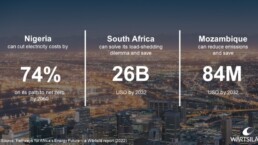
- Nigeria can cut electricity costs by 74% on its path to net zero by 2060. Wärtsilä’s modelling shows that Nigeria can build a 100% renewable net zero power system by 2060, comprising around 1,200 GW of clean capacity, in line with its ’30-30-30’ and net zero targets.3 The impact is significant, with the cost of electricity generation predicted to drop by 74% by 2060 compared to 2022 levels and emissions dropping to zero.
- South Africa can solve its load-shedding dilemma and save USD 26 billion by 2032. By adding 40 GW of wind and solar PV, South Africa can build a power system that would meet current and future energy demand. This can deliver a 17% reduction in power system emissions and reduce energy system costs by USD 10 billion per year by 2032.
- Mozambique can reduce emissions and save USD 84 million. By adding 200 MW of low-cost renewable energy annually, Mozambique can build 3 GW of clean capacity by 2032, supported by 205 MW of new energy storage capacity and 1 GW of grid balancing engine capacity. This would cut 5.6 million tonnes of carbon emissions between 2022-2032 and save USD 84 million on the cost of electricity production.
Wärtsilä produced this modelling using independent market simulation software PLEXOS to support African countries that wish to shape multi-year plans to build their optimal power systems for the future. Across the continent, countries can help to stimulate investment by setting out clear strategies to build well-functioning flexible renewable grids, showcasing the new opportunities those conditions create, such as green hydrogen production. Regulatory reform is also needed to place a value on flexibility and encourage the market. Doing so will help to lay the foundations for more flexible and reliable grids able to support high levels of renewable energy, while increasing energy access.



Related News.

Crewing After 2026: How AI Will Take Over the Routine in 2027
The crewing market of late 2026 is not the market of 2025. Artificial intelligence has moved from presentations into daily crewing work, while the…

Dualog launches secure maritime AI service amid surge in seafarer AI use
The new service, Sparks lets crew and shore teams search company emails, documents and conversations without exposing sensitive fleet information to…

Time Ticking: Two weeks for Governments to Green-Light Framework for Cutting Shipping Emissions
As a crucial fortnight of meetings opens at the International Maritime Organization opens in London, the Clean Shipping Coalition calls on member…

“K” LINE signs contract for construction of two LPG dual-fuel VLGCs
Kawasaki Kisen Kaisha, announces today that it has signed agreements with South Korea-based HD Hyundai Samho regarding the construction of two LPG…

Equinor and VNG sign 18-year gas sales agreement for supplies to Germany
Equinor will supply natural gas to the German energy company VNG until the end of 2044. The 18-year agreement is the longest gas sales agreement…

Open letter to MEPs to reject the motion for a resolution and support the inclusion of Indian ship recycling yards on the European List
Dear Members of the European Parliament, Ahead of this week’s plenary vote, European Shipowners | ECSA, BIMCO, the Cruise Lines International…

ShipVet appoints James Stairmand as Chief Executive Officer
Founder Captain Fintan Cullen moves to a non-executive role as the company builds on investment in its vetting team and technology. ShipVet, the…

USD ≈7bn lost per year the hidden cost of how shipping trades
New Torvald Klaveness study quantifies around USD 7bn a year in potentially avoidable costs in dry bulk and product tanker shipping, with a possible…

APM Terminals Maasvlakte II and Port of Rotterdam Authority take next step in terminal development
APM Terminals Maasvlakte II and the Port of Rotterdam Authority are moving forward in terminal’s development with preparations for a new phase of…

ABP inspiring the next generation
ABP host 500 young people to explore maritime and transport careers More than 500 young people from across Hampshire and the Solent explored career…
Subscribe to our newsletter!
if you dont want to swim alone in the ocean of news, sign up for the newsletter, and you will receive daily all the important news of world shipping!
