Starting in November, transhipments by feeder ship between the major terminals in the Port of Hamburg will reduce road congestion
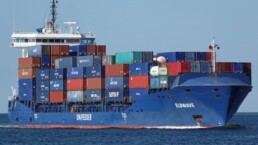

As of November 1, 2022, feeder ships can be strategically used for container transfers between the major terminals in the Port of Hamburg. The projected benefits include providing relief the port infrastructure by reducing the number of truck journeys between the terminals, shorter waiting times at the terminals and a related decrease in CO2 emissions. The way is paved by Danish shipping company Unifeeder as initiator, together with the Hamburg software specialist DAKOSY and DIHLA DAKOSY Interessengemeinschaft Hamburger Linienagenten Collectively they have created a digital process that also covers customs handling.
Every day in the Port of Hamburg, container transhipments which are not loaded at the same terminal happen on a huge scale. In total, the Port of Hamburg had approximately 3.3 million TEU of transhipments in 2021, although not every transfer results in a transshipment. “Ship-based transshipments can take several thousand containers off the road each year. Every container we can move via waterway means a reduction in C02,” DIHLA Managing Director Alexander Geisler points out.
Use case: Unifeeder sees migration potential of 50 percent
“For these container transhipments, we see a high potential to switch from road to waterway by using our existing shipping capacity. As the largest feeder carrier in Northern Europe, we have up to 85 terminal calls per week in Hamburg and can therefore offer sufficient resources to transport additional containers within the port,” says Florian Pein, Area Director West and Central Europe at Unifeeder, outlining the concept. The service that has emerged from this includes container transfers by feeder ship between the HHLA terminals CTA, CTT and CTB, as well as Eurogate and, in the near future, the Süd-West Terminal. Looking further ahead, Unifeeder is endeavoring to switch 50 percent of its transhipment operations from trucks to feeder carriers. This alternative is of particular importance to Pein, especially in light of the shortage of qualified truck drivers. “We have been feeling the effects of the declining number of young truck drivers for years. This is increasingly leading to a serious lack of transhipment resources and leads to long waiting times in the Port of Hamburg,” emphasizes Pein.
Integration into the digital Port Community System with live testing
DAKOSY, DIHLA and Unifeeder jointly established the framework for the digital processes and customs handling of feeder transhipments. The basis is the Port Community System operated by DAKOSY, featuring the integration of a new module. “The application is also of interest to other feeder carriers and can be used by them starting in November,” emphasizes DAKOSY project manager Franz Schwanke, who also adds: “The module has already proven itself in live testing. During the three-month pilot phase, Unifeeder transferred about 50 containers per month.”
Integrated customs handling
The main challenge of the project was to lay the groundwork for the digital customs processing of transhipments. “Normally, an export customs procedure must be initiated as soon as a container is loaded onto a feeder ship. In consultation with the customs office, we have now created an integration function in both the IMP import platform and the EMP export platform that can be used to handle transhipments properly from a customs point of view,” Schwanke explains.
The transhipment manifest as the key to the customs process
The so-called transhipment manifest was newly introduced into the process. With this manifest, the feeder carrier signals via EDI interface or via the IMP web application that it wants to make a transhipment by feeder ship. As a result, a change of custodian is triggered through an automated process and no export transaction is initiated. The manifest also notifies the departure and destination terminals of the planned transhipment and provides them with status messages along the way. This allows the terminals to optimize their internal processes as well.
DIHLA provides preliminary financing
DIHLA has covered the initial financing for the digital processes required to implement feeder transhipments. Managing director Alexander Geisler explains their motivation: “For us, ship-based transhipments in the port are the right way to go. The current real-life constraints have shown that there is a need for this. Now the groundwork has been laid for digital customs handling. This paves the way to provide relief for the road infrastructure in the port and, taking into account existing shipping capacities and digital infrastructure, to be more environmentally friendly and thus moving toward the future.”



Related News.

OL Shipping Group in Tokyo: Capt. Eberhard Koch calls for realistic solutions to Maritime Decarbonisation
An intensive and engaging couple of days in Tokyo brought together leading figures from the international maritime community, providing a valuable…

Regatta for Peace one of the largest ever in Cyprus
Cyprus will host the first European stop on a global sailing journey leading up to the 2027 America’s Cup in Naples. More than 120 sailors…
The propulsion technology powering the marine energy transition
The marine industry is under increasing pressure to future-proof fleets, balancing the need to reduce emissions and improve efficiency. Propulsion…

Signal Ocean acquires Lgmar
Signal Ocean announced the acquisition of Lgmar, the Athens-based company behind Telix, a maritime email and communication platform in daily use…

Canada clean power push challenged by interprovincial grid limits, says GlobalData
Canada is entering a pivotal phase of power-sector expansion as federal tax credits, the phase-out of coal-fired generation, and accelerating…

Maritime safety depends on human factors and leadership, not procedures alone
Interim survey findings point to a gap between seafarers’ perceptions of risk and injury data Seafarers may misjudge when and where they are most at…

New BIMCO contracts tackle ship recycling and energy-saving retrofits
BIMCO adopted two new contractual solutions designed to help you manage important operational and regulatory challenges: the revised…
Stena Line to acquire vessel and make changes to its network
Stena Line has reached an agreement to acquire the RoRo vessel Somerset from CLdN. Subject to closure and transfer, the vessel would begin operating…
DORIC WEEKLY INSIGHT 16 OCTOBER 2026
Please find below the DORIC Market Insight for the week ending 16th October 2026. Weekly Report 16.10.2026

Important information for port clients and freight carriers effective November 1, a new traffic overpass and port checkpoint will open for traffic to the Port of Riga on Kundziņsala
Starting November 1 of this year, a new traffic overpass connecting Tvaika Street to Kundziņsala will open to facilitate traffic to and from the Port…
Subscribe to our newsletter!
if you dont want to swim alone in the ocean of news, sign up for the newsletter, and you will receive daily all the important news of world shipping!
