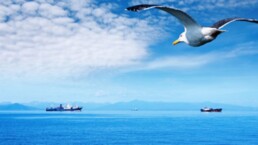

Amendment to treaty on dumping of waste at sea will remove sewage sludge from list of wastes which may be given dumping permit.
The amendment to the London Protocol will remove sewage sludge from the list of permissible wastes – wastes which may be considered for dumping at sea.
Parties to the treaties which regulate the dumping of wastes at sea have adopted an amendment to ensure that the dumping of sewage sludge at sea would be prohibited worldwide.
The amendment to the London Protocol will remove sewage sludge from the list of permissible wastes – wastes which may be considered for dumping at sea.
The amendment was adopted by the 44th Consultative Meeting of Contracting Parties to the London Convention and the 17th Meeting of Contracting Parties to the London Protocol (LC 44/LP 17), which met at the international Maritime Organization (IMO) Headquarters from 3-7 October 2022. IMO is the Secretariat for both treaties.
The amendment will enter into force for each Contracting Party immediately on notification of its acceptance, or 100 days after the date of the adoption if that is later.
Sewage sludge is a waste that has been considered for dumping at sea under both the London Convention and London Protocol. Decades ago, a substantial volumes of sewage sludge was permitted to be dumped at sea. However, the London Convention and Protocol parties previously commissioned a world-wide review of current practices of managing or dumping sewage sludge at sea. The last meeting concluded that the practice had declined considerably over recent decades, that it was already prohibited under many regional conventions and through domestic legislation, and that alternatives existed for the use of the sewage sludge.
The Contracting Parties agreed that there was sufficient evidence and justification for amending Annex 1 of the London Protocol to remove sewage sludge from the list of permissible wastes. The proposal to amend the treaty was submitted by the Republic of Korea and Mexico.
Under the London Protocol all dumping is prohibited, except for possibly acceptable wastes on the so-called “reverse list” (Annex 1). The list of materials which may be considered for dumping at sea will now include: dredged material (the bulk of material given permits); fish wastes; inert, inorganic geological material; specific bulky items; vessels and platforms or other manmade structures at sea; organic material of natural origin; and carbon dioxide (CO2) streams from carbon dioxide capture processes.
Marine geoengineering techniques identified for further evaluation
The meeting agreed a statement on marine geoengineering.
Read more here.
50 years of the London Convention
In 2022, IMO is marking 50 years since the adoption of the London Convention. The adoption of the Convention was a major achievement, which, along with the 1972 United Nations Conference on the Environment in Stockholm, constituted the first steps to truly put the environment at centre stage and take responsibility for the harm humans have done to the ocean.
Download infographic illustrating the main steps taken under the London Convention since 1972.
The purpose of the London Convention is to control all sources of marine pollution and prevent pollution of the sea through regulation of dumping into the sea of waste materials. A so-called “black- and grey-list” approach is applied for wastes, which can be considered for disposal at sea according to the hazard they present to the environment. For the blacklist items dumping is prohibited. Dumping of the grey-listed materials requires a special permit from a designated national authority under strict control and provided certain conditions are met. All other materials or substances can be dumped after a general permit has been issued.
The purpose of the Protocol is similar to that of the Convention, but the Protocol is more restrictive: application of a “precautionary approach” is included as a general obligation and a “reverse list” approach is adopted, which implies that all dumping is prohibited unless explicitly permitted.
The London Protocol entered into force on 24 March 2006. The London Protocol has 53 Parties to the Protocol. (Read more here).
Conference – Protecting the Ocean – Moving forward at 50: London Convention & Stockholm Declaration
IMO and the World Maritime University (WMU) are holding a joint academic conference (10-13 October) to discuss ocean and climate related topics under the framework of the London Convention and Stockholm Declaration’s 50th anniversaries. Read more here.



Related News.

OL Shipping Group in Tokyo: Capt. Eberhard Koch calls for realistic solutions to Maritime Decarbonisation
An intensive and engaging couple of days in Tokyo brought together leading figures from the international maritime community, providing a valuable…
Regatta for Peace one of the largest ever in Cyprus
Cyprus will host the first European stop on a global sailing journey leading up to the 2027 America’s Cup in Naples. More than 120 sailors…
The propulsion technology powering the marine energy transition
The marine industry is under increasing pressure to future-proof fleets, balancing the need to reduce emissions and improve efficiency. Propulsion…
Signal Ocean acquires Lgmar
Signal Ocean announced the acquisition of Lgmar, the Athens-based company behind Telix, a maritime email and communication platform in daily use…

Canada clean power push challenged by interprovincial grid limits, says GlobalData
Canada is entering a pivotal phase of power-sector expansion as federal tax credits, the phase-out of coal-fired generation, and accelerating…

Maritime safety depends on human factors and leadership, not procedures alone
Interim survey findings point to a gap between seafarers’ perceptions of risk and injury data Seafarers may misjudge when and where they are most at…

New BIMCO contracts tackle ship recycling and energy-saving retrofits
BIMCO adopted two new contractual solutions designed to help you manage important operational and regulatory challenges: the revised…
Stena Line to acquire vessel and make changes to its network
Stena Line has reached an agreement to acquire the RoRo vessel Somerset from CLdN. Subject to closure and transfer, the vessel would begin operating…
DORIC WEEKLY INSIGHT 16 OCTOBER 2026
Please find below the DORIC Market Insight for the week ending 16th October 2026. Weekly Report 16.10.2026

Important information for port clients and freight carriers effective November 1, a new traffic overpass and port checkpoint will open for traffic to the Port of Riga on Kundziņsala
Starting November 1 of this year, a new traffic overpass connecting Tvaika Street to Kundziņsala will open to facilitate traffic to and from the Port…
Subscribe to our newsletter!
if you dont want to swim alone in the ocean of news, sign up for the newsletter, and you will receive daily all the important news of world shipping!
