

Iron and steel’s US$1.4 trillion shot at decarbonisation
The industrialised world cannot function without steel. It is essential to everything from the buildings we live in to the ways we get around. Wood Mackenzie estimates that meeting global steel demand will require 2.2 billion tonnes of production by 2050 – a 15% increase from 2021. From iron ore mining to steel manufacturing, the industry is highly carbon intensive. And while steel itself is recyclable, iron and steel production emit a combined 3.4 billion tonnes of carbon annually, equal to 7% of global emissions.
The steel industry, therefore, faces a huge challenge in achieving net zero emissions by 2050. Under our 1.5 °C Accelerated Energy Transition Scenario (AET-1.5), which is broadly aligned with the most ambitious goal of the Paris Climate Agreement, the decarbonisation of the iron and steel sectors will require around US$1.4 trillion of investment. The iron and steel industry will also require support from global carbon policy. To date, most national carbon markets are nascent and concentrated in mature economies.
As more than 60% of steel production comes from China, Beijing must implement aggressive carbon pricing and taxation if steel’s high carbon footprint is to be addressed. The European Union’s (EU) carbon border adjustment mechanism and the potential for similar moves by other major economies could support faster change in producing countries such as China and India. But even with the successful global roll-out of wider carbon border taxes, the upside impact may be limited – only 20% of global steel consumption is traded.
The willingness of consumers to pay a premium for green steel will be another challenge. While investor pressures on large multinational consumers (such as automakers and heavy machinery manufacturers) is having some impact, the construction industry is still largely unreceptive to green price hikes. But the scale of the challenge offers enormous opportunities, too. Decarbonising steel production will require a revolution at every stage of the industrial value chain, from mining to consumption.
To achieve net zero by 2050, three-quarters of steel production will have to use low-carbon technologies. Sectors including renewable power, low-carbon hydrogen and carbon capture utilisation and storage (CCUS) will be major beneficiaries of the industry’s move towards net zero emissions.
The scale of the challenge
Wood Mackenzie’s base-case energy transition outlook foresees an average global warming outcome of between 2.2 °C and 2.4 °C by mid-century. Under our AET-1.5 scenario, we assume that the iron and steel industry successfully decarbonises to achieve global net zero emissions by 2050. This 1.5 °C pathway requires 2050 steel emissions to fall by more than 90% from current levels.
This is a staggeringly big ask, given that our base-case steel emissions scenario assumes a decline of just one-third from current levels by 2050. There is an urgent need to act now to decarbonise the iron and steel industry, and business as usual is no longer sustainable. In this edition of Horizons, we analyse the what, when and how of getting to a 2050 net zero pathway. The largest factor in achieving net zero for steel will be switching to electric arc furnaces (EAFs) from the blast furnaces (BF-BOFs) that dominate current production and emit up to four times more carbon.
To reduce emissions to the degree required, EAFs will need to be powered by renewable energy, demonstrate greater energy efficiency and elevate the quality of metallics. Ultimately, the industry must pursue a complete switchover from predominantly hydrocarbon-based energy to renewable power along the value chain, from mining to steelmaking. In parallel, the industry needs to increase its use of less carbon-emissive feedstock, such as green hydrogen and scrap, in steelmaking.
The availability of competitively priced green hydrogen at scale is a must in delivering decarbonisation goals. Commercialising new technologies, such as hydrogen-based direct reduced iron (DRI) and molten oxide electrolysis running on renewable energy, could reduce emissions to zero. Carbon management through the development and deployment of CCUS will also need to play a key role in offsetting unabated emissions, though this will tail off in the long term as newer technologies that eliminate carbon emissions achieve commercialisation.
The largest factor in achieving net zero for steel will be switching to electric arc furnaces (EAFs)
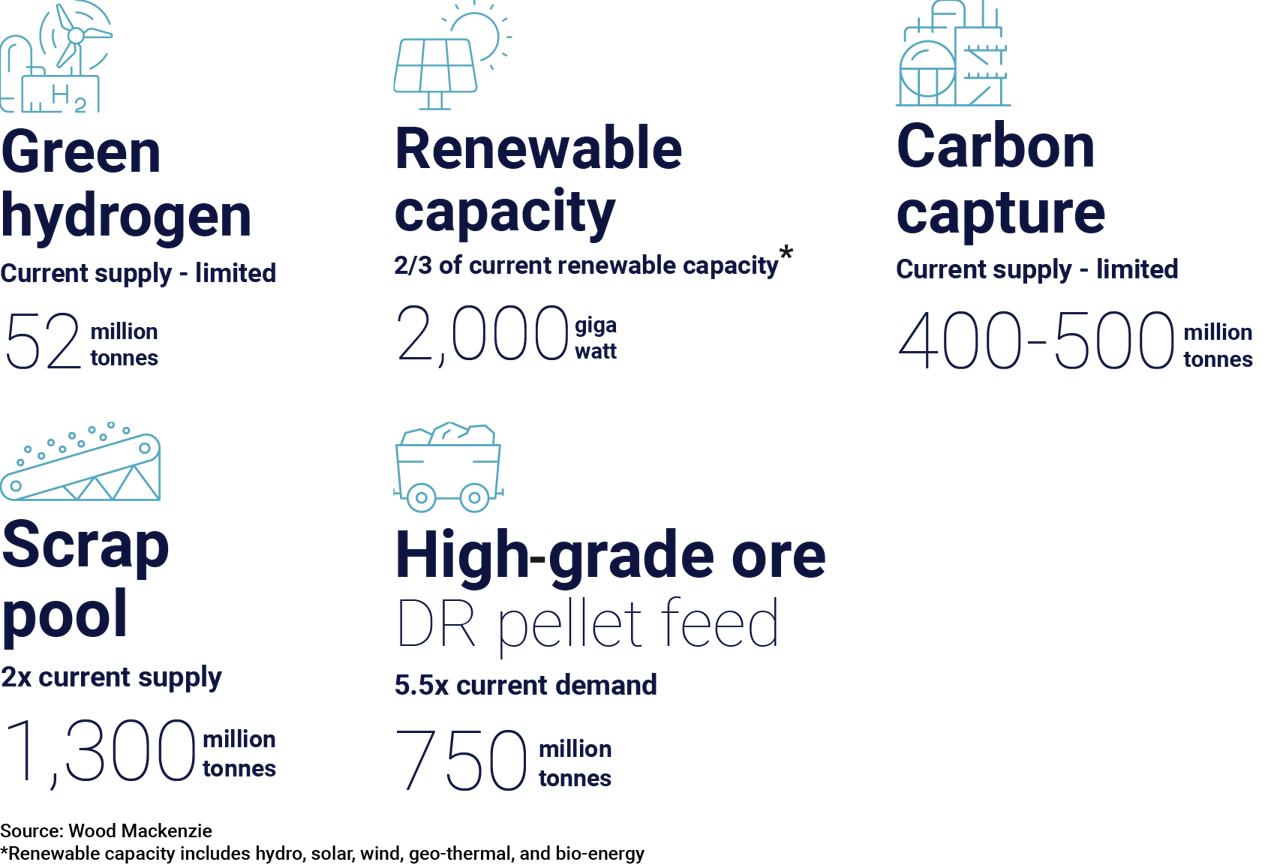
Quantifying the scale of this challenge is sobering:
- The industry will require around 50 Mtpa of competitively priced green hydrogen. Commercial viability versus conventional steelmaking routes requires green hydrogen supply at US$2/kg.
- Switching to clean energy will require around 2,000 GW of dedicated renewable generation capacity, equivalent to two-thirds of current global renewable generation capacity.
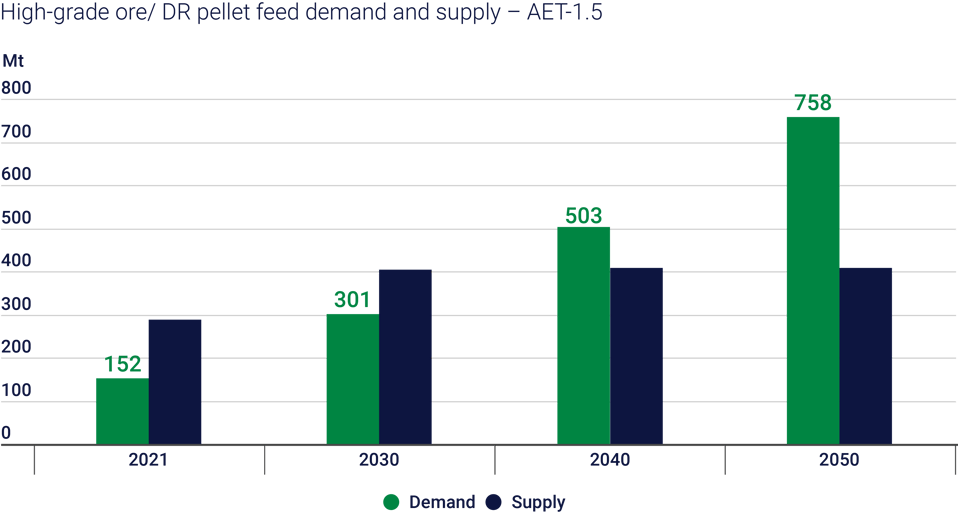
- High-grade iron ore consumption will have to increase five fold to 750 million tonnes.
- Transitioning to greener feedstock will require a doubling of the global scrap pool from current levels to 1.3 billion tonnes (entailing recovery rates of more than 80%).
- The industry will need to capture and store 470 Mt of carbon to reach its emission target.
Figure 1: Multiple ecosystem enablers to be activated
Of the top 25 steelmakers, only 13 have set a date for achieving net zero
Regional differences remain
A quick glance at iron and steel producers’ climate change reports reveals that only the largest have publicly set out a green pathway. Of the top 25 steelmakers, only 13 have set a date for achieving net zero and only a handful have committed any capital to the cause.
The top five iron ore miners have also set net zero targets, with three committing to intermittent capital outlay until 2030. These three miners aim to spend US$16-17 billion through 2030 to shave 30-35% off their operational emissions, translating into a little over 10% of their annual capital budgets.
However, mid-sized and smaller players have yet to make any noise on the green front, never mind any capital allocation. An increased focus on carbon emissions by these companies will be ensuring their longer-term survival, particularly until a green premium on steel rewards investment in decarbonising their production.
Footing the bill for a green steel value chain
Achieving net zero by 2050 presents a US$1.4 trillion investment opportunity for players across the iron and steel value chain. This will entail upgrading existing steelmaking routes, adopting new technologies and offset measures and exploring new high-grade iron ore mines. Figure 2: Iron and steel investments to reach net zero by 2050
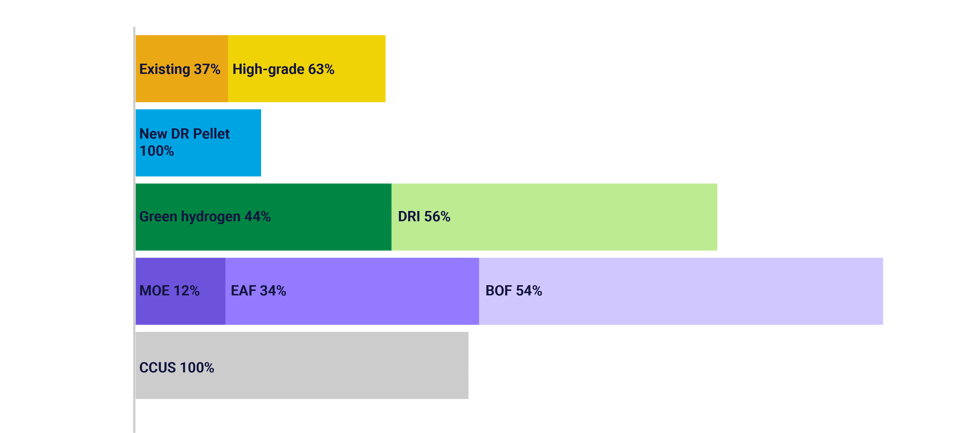
Source: Wood Mackenzie Note: Iron ore mining investments include capital investments on decarbonising existing mine sites and developing new high-grade ore mines. DR pelletisation includes capital investments to set up new DR-grade pellet capacities. Iron making includes setting up DRI furnaces and hydrogen ecosystem (electrolyser, hydrogen storage, etc.). Steelmaking refers to BOF, EAF, and MOE furnaces.
Of the US$1.4 trillion investment:
Chinese steel emissions must fall by more than 95% from current levels by 2050 to reach the net zero target
Regional disparities to emerge en route to net zero
China accounts for around 62% of global steel emissions, so any chance of steel decarbonisation success will depend on its commitment. Chinese steel emissions must fall by more than 95% from current levels by 2050 to reach the net zero target.
This would appear to be an insurmountable task, given that 90% of the nation’s steel production is through the highly polluting blast furnace route. Chinese steelmakers will have to balance managing a relatively young fleet of blast furnaces and investing in new, greener steelmaking technologies. Beijing’s steel output curtailment policy has helped to improve the nation’s emissions profile. Such indirect control measures will continue to support decarbonisation in the long run.
China’s decarbonisation efforts will also be helped by falling demand as its economic growth slows. Along with China, mature economies, such as the EU, the US, Japan and South Korea, will have to front-load steel investments in the first half of the forecast period. In contrast, India, South America and Southeast Asia are unlikely to make significant investment in green steel until around 2035. Two-thirds of the investment by iron ore miners will be dedicated to the exploration of new high-grade ore mines and abating emissions from existing operations.
Forward integration into pellet manufacturing for DRI manufacturing capacity will consume the rest. Capital investment is only one piece of the puzzle, however. Steelmakers will also have to shoulder additional operating expenditure for newer, low-emission technologies and carbon taxes on unabated emissions. We believe that, down the line, steelmakers will recover these costs in the form of green premiums.
Green premiums are inevitable
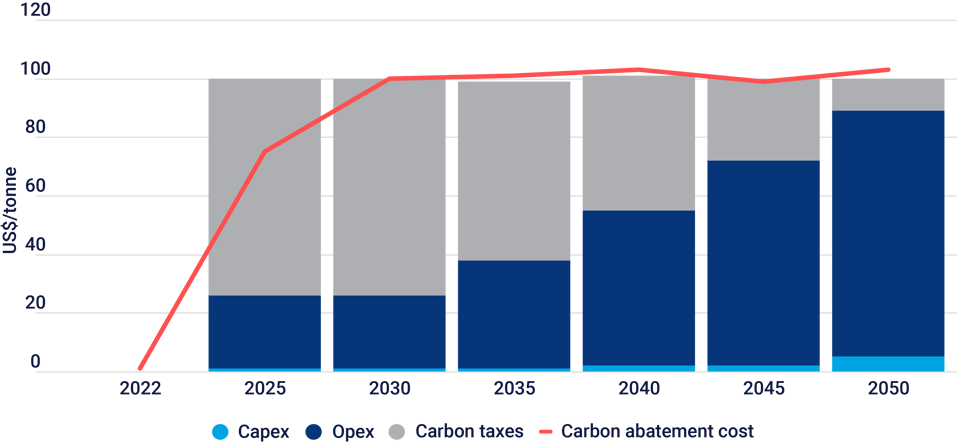
With the cost and pace of decarbonisation varying by region, mature economies will decarbonise quicker than their emerging counterparts, though they will incur higher carbon abatement costs. We estimate that steelmakers will have to cough up US$100 per tonne, or about 15-20% of their total production cost, to align themselves with a 1.5 °C goal by 2050. Mature steel-consuming economies will end up spending 1.5 times more than emerging economies. India and Southeast Asia, being highly cost-sensitive markets, will adopt a more cautious approach to decarbonisation. These regions are less inclined to invest capital in upcoming green technologies. We believe emerging economies are more likely to follow the evolving green trends once commercialisation has been achieved, translating into lower abatement costs. Figure 3: Steel – carbon abatement costs under a 1.5°C pathway
Source: Wood Mackenzie
The carbon abatement cost comprises green premiums from capital expenditure on green projects, higher operational costs due to the switchover to new technologies and a carbon tax on unabated emissions. Carbon taxes will make up a significant chunk of green premiums up to 2035. The proportion will decline in the longer term with the deployment of new, cleaner steelmaking technologies. As the technological curve matures, capital and operational expenditure will rise. Adopting new steelmaking technologies will boost the share of capital expenditure in the 10 years to 2050 to 5%. Operational spending will contribute heavily to carbon abatement costs as new technology adoption sees steelmakers incur higher production costs than conventional routes. The least emission-intensive technologies (such as scrap-EAF and hydrogen-DRI-EAF) will move up the cost curve in tandem with the rise in raw-material and clean power costs. They will also be subject to less carbon tax, however, as their emission footprints will be far lower. The green premiums may lessen, but they cannot be done away with entirely. Ultimately, it is the consumer who must pay. The tail end of the value chain will bear the brunt of green premiums. Steelmakers will have to swallow the green hikes in raw material costs (for example, iron ore) and, in all likelihood, pass on their carbon abatement costs to steel end-users.
Miners will have to play their part by decarbonising mining sites and investing in new high-grade ore mines to support green steel. Demand for high-grade, low-impurity iron ore will grow fivefold over the next three decades under an AET-1.5 scenario, necessitating logistically challenging and expensive mining projects, especially in Guinea and Brazil. Failure to successfully unlock these resources will heighten the risk of raw material shortages. Commissioning any new mining project involves myriad unknowns; the addition of environmental, social and governance (ESG) risks is merely the latest. Portfolio diversification towards high-grade ore mines, the divestment of polluting and low-grade mines, and investments in beneficiation and floatation will be at the heart of miners’ strategy to stay relevant in the green game. Figure 4: Iron ore requirements under our AET-1.5 scenario
Source: Wood Mackenzie
Source: Wood Mackenzie
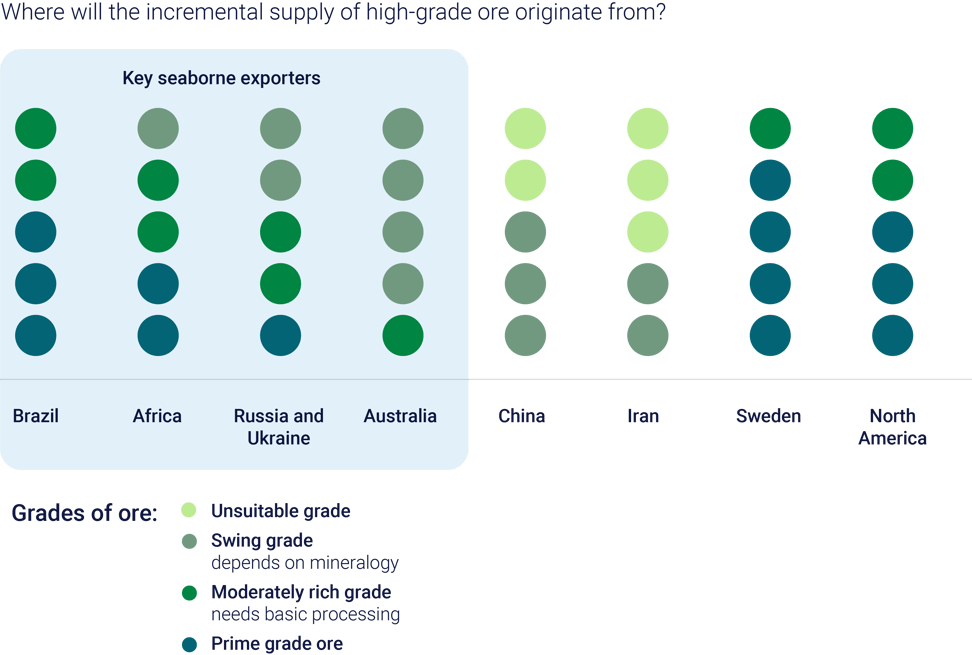
Brazil and Africa look set to emerge as key net exporters for DRI and DR pellet/ pellet feed
Of the current supply hubs, Brazil has the greatest potential for green iron ore products, thanks to the prime quality of its ore. Elsewhere, FMG’s soon-to-be commissioned Iron Bridge project and the recently announced Hawsons Iron project will be critical if Australia is to compete in a 1.5 °C world. Any expansion by other high-grade ore producers, such as Sweden and Canada, will increasingly feed rising captive demand for hydrogen-based DRI projects in their regions. The contentious Simandou project in Guinea will help the country unlock its potential, especially given the large scale of the operation and the potential to produce high-grade direct shipping ore.
Forward integration
The search for high-grade mines, along with miners’ plans to integrate forward into DR pellet and hydrogen-DRI manufacturing, will open up new supply opportunities and alter trade flows. Brazil and Africa look set to emerge as key net exporters for DRI and DR pellet/pellet feed, while Australia and the Middle East will try to keep pace. The EU, China, Japan and South Korea would be the usual suspects for higher incremental demand for DRI and DR-grade pellets. India and the CIS will also add capacity but will be domestically centred markets.
Solving the net zero equation
Governments and large companies are increasingly committing to net zero targets but can’t refrain for long from pursuing short-term efficiency measures and long-term technological investments.
What should iron ore miners do?
The mining community will have to work closely with steelmakers to support the latter’s decarbonisation drive. Miners have already signed multiple technical collaborations with steelmakers across the EU, Japan, South Korea, China and India to develop greener products.
They could consider a three-point strategy:
- Invest in new technologies and high-grade mine sites
- Divest from carbon-intensive operational mechanisms and portfolio diversification (product and energy mix)
- Integrate further into the steel value chain (pelletisation, green-DRI and green pig-iron).
What should steelmakers do?
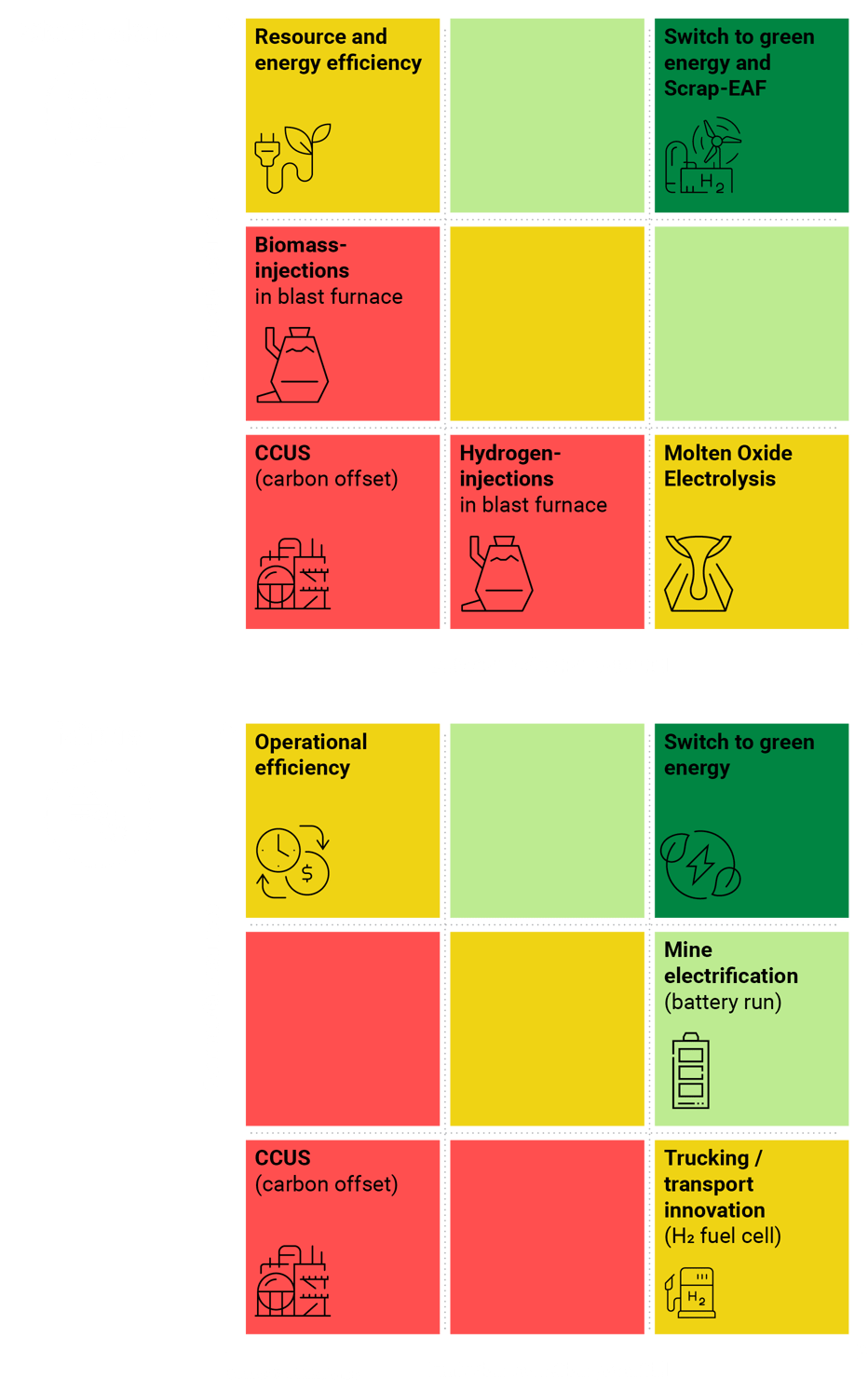
Near-term efforts will have to involve a mix of the following elements:
- Resource efficiency: blend more scrap, ferro-coke, high-grade raw materials and biomass into existing steelmaking
- Energy efficiency: top-gas recycling, heat recovery, invest in renewable energy
- Optimisation of current and new fleets of furnaces: replace archaic ones with new technology, such as smelting reduction
- Blend green hydrogen with gas for iron making until it reaches commercial scale.
Conclusion: Risk, meet opportunity

Achieving net zero will entail a fundamental transformation of steel and its value chain and is, therefore, fraught with risks. These include:
- Fragmented geographical implementation, which could disrupt trade patterns and lead to the underutilisation of younger furnace fleets in emerging economies
- Sectoral vulnerability to energy price fluctuations, such as those seen in the last few months (this could become more frequent under faster energy transition scenarios and impact the costs of steelmaking)
- Green premiums and the ensuing cost inflation could hurt steel demand from price-sensitive consumers
- Greenwashing by iron and steelmakers under the guise of ESG compliance
- Steel equipment technology providers (the world will need 470 Mt of new DRI and 1,100 Mt of new EAF furnace installation under AET-1.5 over the next three decades)
- Players across the hydrogen ecosystem, which will need to produce a dedicated 52 Mt for the steel industry (electrolysers, hydrogen storage, transport)
- Green energy producers and solar/wind equipment manufacturers (2,000 GW of dedicated renewable capacity by 2050 for the steel sector under AET-1.5)
- Electric vehicles and hydrogen-run haulage trucks at plant and mine sites for transportation Other technical support services



Related News.
Cyprus Maritime Innovation takes Centre Stage at SMM Hamburg 2026
Underscoring its expanding role as a premier international hub for cutting-edge maritime technology and sustainable shipping, the Republic of Cyprus…

Trump seeks to refill US oil reserve with Venezuela deal but faces long delay
U.S. President Donald Trump said on the 30th (local time) that he would refill the U.S. Strategic Petroleum Reserve, which has been depleted with…
US Navy Official visits South Korean Shipyards in private
With U.S. President Donald Trump pushing a plan to allow overseas construction of U.S. warships, attention is focusing on whether the building of…
SES and De Boer Marine expand collaboration with FlexMaritime deployment across Global Markets
SES, a leading space solutions company, and De Boer Marine, a leading provider of top-quality marine equipment and maritime connectivity services,…
New ESG guidance to help maritime industry turn sustainability into commercial advantage
New framework helps shipowners and ports align ESG strategy with access to capital, charterer expectations and long-term asset value. Maritime…
Britannia P&I Club analysis finds four in five crew deaths linked to illness rather than accidents
New report highlights cardiovascular disease as leading cause of fatalities and raises concerns over mental health risks among younger seafarers.…
The Swedish Club launches new Loss Prevention podcast, Knot Another Lesson
The Swedish Club has launched Knot Another Lesson, a new podcast exploring the practical lessons, emerging risks and operational challenges shaping…

Lloyd’s Register appoints Jens Grunenberg as Senior Representative for Germany
Lloyd’s Register has appointed Jens Grunenberg as its Senior Representative for Germany, effective 1 September. Based in Hamburg, Grunenberg will…
Indian Register of Shipping sets sights on Hamburg for European Expansion
Indian Register of Shipping, a leading international classification society and full member of the International Association of Classification…
MOL completes Merger of 6 Ship Management Companies
Unifying Management of Over 200 Vessels and Strengthening Safety Mitsui O.S.K. Lines, announced that it has completed the integration of the MOL…
Subscribe to our newsletter!
if you dont want to swim alone in the ocean of news, sign up for the newsletter, and you will receive daily all the important news of world shipping!
