Water lubricated propeller shaft bearings found to reduce fuel consumption
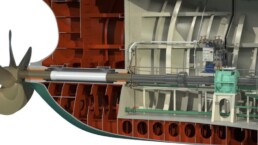

Peer-reviewed research by Thordon Bearings into the hydrodynamic lubrication efficiency of a ship’s propeller shaft bearing has found that the use of seawater-lubricated elastomeric polymer bearings reduces fuel consumption.
The environmental and financial benefits of adopting a seawater-lubricated propeller shaft system are well documented, but this is the first indication that the arrangement reduces hydrodynamic resistance enough to improve fuel consumption, compared to a conventional oil-lubricated bearing arrangement.
The ground-breaking research is based on new methodology for calculating the performance of seawater-lubricated bearings, which, until now, has been based on decades-old theory developed for oil-lubricated propeller shaft bearings.
“Classic rigid surface bearing theory is valid and commonly used for oil-lubricated metal bearings. However, two major factors of seawater-lubricated bearings, namely low lubricant viscosity and deformability [of the polymer bearing surface], make the application of rigid surface bearing calculations susceptible,” Thordon Bearings’ Chief Research Engineer, Dr. Gary Ren, says in his peer-reviewed paper published in the July edition of the Elsevier journal Tribology International.
“We believe Dr Ren’s method is more accurate, because it takes into account the characteristics of seawater as a lubricant, the polymer materials used, bearing pressures, viscosity, friction and so on,” said Elena Corin, Senior Manager, Special Marine Projects, Thordon Bearings. “This is the first time anyone has investigated whether there are differences in friction coefficient between the two types of bearings. And there are!”
Corin furthered that the new methodology provides “strong evidence” to quantitatively support the benefits of a Thordon COMPAC system.
“By applying the results, we were able to determine the minimum required shaft speed for hydrodynamic lubrication efficiency, the coefficient of friction as well as the water film thickness at any given load and shaft speed,” she said.
“Test results confirmed that fuel losses due to the friction coefficient [hydrodynamic resistance] of an oil-lubricated propeller shaft bearing system can be reduced by as much as 85% by using seawater-lubricated polymer bearings.”
Thordon Bearings used the methodology to compare the fuel consumption of a Panamax containership and an Aframax tanker operating a 640mm (25.2in) diameter oil-lubricated propeller shaft bearing versus the same ships operating an open COMPAC seawater-lubricated bearing system.
Each vessel was assumed to run on VLSFO (very low sulphur fuel oil) at a global average price of US$890/mt, operating for 70% of the time.
“The results confirmed that fuel losses due to the friction coefficient (hydrodynamic resistance) of an oil-lubricated propeller shaft bearing system can be reduced by as much as 85%.
“Fuel costs will depend on the operational profile of the vessel, but we conservatively estimate annual savings of at least US$10,000 per vessel,” said Corin. “This is in addition to the other life cycle cost savings associated with a Thordon seawater-lubricated bearing system.”
Commenting on the research findings, Craig Carter, Thordon Bearings’ Vice President Business Development, said: “Reducing friction coefficient is another reason why a seawater-lubricated propeller shaft bearing system pays dividends for ship owners and operators, commercially and environmentally. When you consider the operational cost of running an oil-lubricated propeller shaft over 25-years, a seawater-lubricated shaft line pales by comparison.”
Thordon Bearings is now carrying out research to assess the carbon emissions reduction attributes of vessels using a seawater-lubricated system to help shipowners meet CII (Carbon Intensity Indicator) requirements.
From January 1st, 2023, shipowners will be required to document their Attained Annual CII and verify it against the Required Annual CII to determine their vessels’ operational carbon intensity rating. Savings in fuel consumption and subsequent reduction of CO2 emissions are the focus of the CII measure.



Related News.

OL Shipping Group in Tokyo: Capt. Eberhard Koch calls for realistic solutions to Maritime Decarbonisation
An intensive and engaging couple of days in Tokyo brought together leading figures from the international maritime community, providing a valuable…

Regatta for Peace one of the largest ever in Cyprus
Cyprus will host the first European stop on a global sailing journey leading up to the 2027 America’s Cup in Naples. More than 120 sailors…
The propulsion technology powering the marine energy transition
The marine industry is under increasing pressure to future-proof fleets, balancing the need to reduce emissions and improve efficiency. Propulsion…
Signal Ocean acquires Lgmar
Signal Ocean announced the acquisition of Lgmar, the Athens-based company behind Telix, a maritime email and communication platform in daily use…

Canada clean power push challenged by interprovincial grid limits, says GlobalData
Canada is entering a pivotal phase of power-sector expansion as federal tax credits, the phase-out of coal-fired generation, and accelerating…

Maritime safety depends on human factors and leadership, not procedures alone
Interim survey findings point to a gap between seafarers’ perceptions of risk and injury data Seafarers may misjudge when and where they are most at…

New BIMCO contracts tackle ship recycling and energy-saving retrofits
BIMCO adopted two new contractual solutions designed to help you manage important operational and regulatory challenges: the revised…
Stena Line to acquire vessel and make changes to its network
Stena Line has reached an agreement to acquire the RoRo vessel Somerset from CLdN. Subject to closure and transfer, the vessel would begin operating…
DORIC WEEKLY INSIGHT 16 OCTOBER 2026
Please find below the DORIC Market Insight for the week ending 16th October 2026. Weekly Report 16.10.2026

Important information for port clients and freight carriers effective November 1, a new traffic overpass and port checkpoint will open for traffic to the Port of Riga on Kundziņsala
Starting November 1 of this year, a new traffic overpass connecting Tvaika Street to Kundziņsala will open to facilitate traffic to and from the Port…
Subscribe to our newsletter!
if you dont want to swim alone in the ocean of news, sign up for the newsletter, and you will receive daily all the important news of world shipping!
