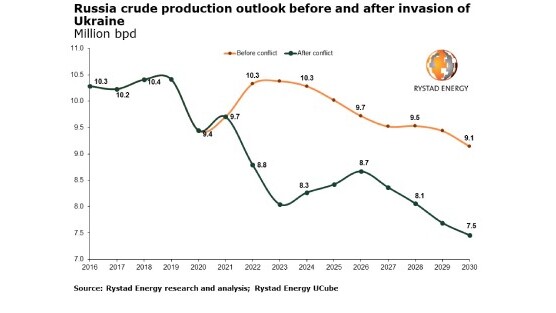

Despite the severe oil production cuts expected in Russia this year, tax revenue will increase significantly to more than $180 billion due to the spike in oil prices, Rystad Energy research shows. This is 45% and 181% higher than in 2021 and 2020, respectively. Russia’s progressive tax system means that taxes increase in line with higher oil price ranges. With the oil and gas sector remaining the keystone of the country’s economy and with Western sanctions over the invasion of Ukraine starting to mount up, Russia is looking east for export opportunities.
Russian oil volumes are estimated to drop by 2 million barrels per day (bpd) by 2030 compared to 2021, while gas production will grow marginally, but will still be lower than pre-conflict estimates. Extremely high gas prices in Europe as well as liquefied natural gas (LNG) prices in Asia will generate around $80 billion of tax flows in Russia in 2022. Russia’s recent move to block gas sales to Bulgaria and Poland will not have a significant impact on revenues.
After Russia invaded Ukraine in late February, European buyers started to shun Russian crude amid sanction-related fears. The first issues with oil exports were expected in March, but this was only the case for the first three weeks of the month. Loadings began to recover on 24 March, supported by more orders from China and India. Russian crude exports were still resilient in April. Tensions between Europe and Russia are, however, increasing and may result in crude embargoes.
“Europe’s dependence on Russian energy has been a deliberate and decades-long and mutually beneficial relationship. In this early phase of sanctions and embargoes, Russia will benefit as higher prices mean tax revenues are significantly higher than in recent years. Pivoting exports to Asia will take time and massive infrastructure investments that in the medium term will see Russia’s production and revenues drop precipitously,” says Daria Melnik, senior analyst at Rystad Energy
Sanctions and alternative destinations for Russian exports
If further sanctions on Russian energy exports come into place, then the most likely scenario is a gradual phase-out of Russian oil in Western markets that will take several months to complete. Russia’s ability to redirect all unwanted cargoes from the West to Asia are limited, meaning that, in the case of embargoes, Russia will be forced to cut production further as it lacks storage capacity for extra crude volumes. In April, Russian crude output already started to fall amid lower oil demand and refinery runs inside the country.
It will take some time for Russia to retune its logistic chains and find enough buyers for its crude beyond Europe and the US. It will also take some time for the Russian economy to get over sanctions and create additional demand for oil inside the country. As such, crude output will only start recovering in mid-2023. However, many shut-in wells may not come back into production, meaning that some Russian spare capacity will be destroyed.
The situation will be aggravated by a lack of investments and foreign technologies, which will lead to lower drilling activity. Russia is, as a result, not expected to return to pre-conflict production levels even by 2026. In the long term, Russian crude output on mature fields will decline steeper than was expected before the conflict as foreign enhanced oil recovery technologies will be unavailable for the country. Russia has pinned its hopes on China to diversify its gas markets as Europe is set to reduce its energy dependence on Russia.
The Power of Siberia 1 pipeline will initially serve as Russia’s main gas supply artery to China. Gazprom completed feasibility studies in the first quarter 2022 on the Soyuz-Vostok gas pipeline – the Power of Siberia 2 project (50 billion cubic meters of annual capacity). On 28 February, Russia government approval for the line was granted. The pipeline will stretch from Yamal in Western Siberian to northern China, running through Mongolia. By tapping into the vast reserves in Western Siberia, Russia will enhance its ability to divert gas flows towards Asia instead of Europe. Along with pipeline gas, Russia is expected to increase LNG exports to China as the first train of the Arctic LNG-2 project prepares to commence operations.

Source: Rystad Energy



Related News.

Cyprus Maritime Innovation takes Centre Stage at SMM Hamburg 2026
Underscoring its expanding role as a premier international hub for cutting-edge maritime technology and sustainable shipping, the Republic of Cyprus…

Trump seeks to refill US oil reserve with Venezuela deal but faces long delay
U.S. President Donald Trump said on the 30th (local time) that he would refill the U.S. Strategic Petroleum Reserve, which has been depleted with…
US Navy Official visits South Korean Shipyards in private
With U.S. President Donald Trump pushing a plan to allow overseas construction of U.S. warships, attention is focusing on whether the building of…
SES and De Boer Marine expand collaboration with FlexMaritime deployment across Global Markets
SES, a leading space solutions company, and De Boer Marine, a leading provider of top-quality marine equipment and maritime connectivity services,…

New ESG guidance to help maritime industry turn sustainability into commercial advantage
New framework helps shipowners and ports align ESG strategy with access to capital, charterer expectations and long-term asset value. Maritime…

Britannia P&I Club analysis finds four in five crew deaths linked to illness rather than accidents
New report highlights cardiovascular disease as leading cause of fatalities and raises concerns over mental health risks among younger seafarers.…

The Swedish Club launches new Loss Prevention podcast, Knot Another Lesson
The Swedish Club has launched Knot Another Lesson, a new podcast exploring the practical lessons, emerging risks and operational challenges shaping…

Lloyd’s Register appoints Jens Grunenberg as Senior Representative for Germany
Lloyd’s Register has appointed Jens Grunenberg as its Senior Representative for Germany, effective 1 September. Based in Hamburg, Grunenberg will…

Indian Register of Shipping sets sights on Hamburg for European Expansion
Indian Register of Shipping, a leading international classification society and full member of the International Association of Classification…
MOL completes Merger of 6 Ship Management Companies
Unifying Management of Over 200 Vessels and Strengthening Safety Mitsui O.S.K. Lines, announced that it has completed the integration of the MOL…
Subscribe to our newsletter!
if you dont want to swim alone in the ocean of news, sign up for the newsletter, and you will receive daily all the important news of world shipping!
