Transforming operations at sea: The role of remote technology on the industry’s path to net zero
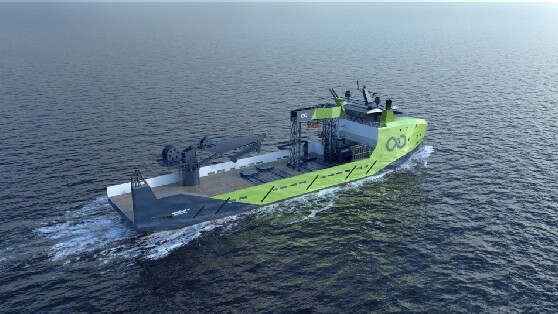

Ocean Infinity is on a mission to play its part in protecting the planet by transforming operations at sea, through the development and deployment of innovative technology.
Here, Sam Taylor, Business Development Manager, discusses the essential technologies being developed to facilitate safe remote operations that could bring wider benefits to the conventional offshore industry by enabling lower emission operations. Some developments could be quick to implement; delivering immediate environmental benefits with a small shift in thinking, whilst other changes will be generational, requiring a wholesale shift in how the offshore industry is designed and operated.
The Power
The shipping industry alone is responsible for around 940 million tonnes of CO2 annually, at least 2.5% of the world’s total CO2 emissions. In response to this, the International Maritime Organisation has set a target to cut emissions by 50% by 20501, a huge target.
Remote vessels, by nature, don’t need to accommodate the same number of people that a conventional vessel might. This means that custom developed remote vessels, are typically smaller in size than conventional vessels designed for the same task and therefore have a lower environmental footprint.
But arguably, changing how we generate power onboard vessels, be they crewed or uncrewed, could deliver the largest achievable emissions reduction. There is an increase of new-build vessels taking on the challenge of power generation with the rise of credible alternative fuel sources such as LNG, Ethanol and Hydrogen, and the now common place battery hybrid. However, the introduction of alternative fuel sources is very much a transition, not an overnight switch.
The development of our remotely operated Armada fleet is stimulating this transition, pushing the development of alternative fuel sources. The larger vessels in the fleet, the 78m and 85m vessels, are being built with the integration of new fuel-cell and battery technology very much in mind.
We have a team of world-leading engineers developing cutting edge green fuel technologies for our robotic ships. Within 5 years, we will be using green fuel technology in our vessels to provide the greenest, cleanest boats the industry has seen.
One of the projects currently underway is the Clean Maritime Demonstration project, which will see us, along with partner organisations, build a Marine Propulsion Test facility, with an integrated Ammonia Marine Power System (AMPS). The test facility will demonstrate one of the clean-fuelled technologies eventually capable of powering our Armada fleet.
The Payload
As with conventional vessels, the primary objective of the robotic vessel is delivery of its ‘payload’ to the project worksite; whether that be subsea, surface or cargo. If there is no longer a crew onboard to maintain or operate the asset whilst offshore, how does that impact the design?
Simply put, remote operations change a lot in payload design. It changes how we deliver the asset to site; it changes how we maintain the asset, increasing the focus on the reliability of its design; it changes the construction of the asset, moving away from hydraulic to a fully electrical design reducing the environmental impact should a breakdown or failure occur; and importantly, it changes how we operate the asset, demanding new solutions for operational control and data transfer.
Working with the reality of low bandwidth and high latency offshore, we need to adjust how we operate our payload, leading to an increased use of Artificial Intelligence (AI) and Machine Learning (ML) with a ‘human in the loop’ design philosophy. We cannot move towards greener robotic solutions without development of command and control enterprise infrastructure.
This demand has spurred new payload designs right across the industry with new vehicle designs2 and new systems of operation control. For Ocean Infinity, this is enhanced with in-house software and new control systems incorporating both the vessel and the payload into a single eco-system.
The entire offshore industry can take advantage of technologies developed to meet demands of remote operations delivering small, but impactful, changes to both the conventional and remote operated global fleet all leading to reduced maintenance and downtime, fewer port calls – ultimately resulting to reduction in emissions.
Spearheading change
We are fast developing new solutions, necessary for remote and uncrewed operations, which will have significant impact upon the conventional market, from logistics and remote handling of goods and equipment, through to AI and ML, drastically reducing the time required for data processing whilst improving the quality of our deliveries.
In short, the robotic and uncrewed vessel industry is not operating outside of the conventional scene but is at the vanguard of technology development, spearheading the transition of operations offshore and thus enabling people and the planet to thrive.



Related News.
Cyprus Maritime Innovation takes Centre Stage at SMM Hamburg 2026
Underscoring its expanding role as a premier international hub for cutting-edge maritime technology and sustainable shipping, the Republic of Cyprus…

Trump seeks to refill US oil reserve with Venezuela deal but faces long delay
U.S. President Donald Trump said on the 30th (local time) that he would refill the U.S. Strategic Petroleum Reserve, which has been depleted with…
US Navy Official visits South Korean Shipyards in private
With U.S. President Donald Trump pushing a plan to allow overseas construction of U.S. warships, attention is focusing on whether the building of…

SES and De Boer Marine expand collaboration with FlexMaritime deployment across Global Markets
SES, a leading space solutions company, and De Boer Marine, a leading provider of top-quality marine equipment and maritime connectivity services,…
New ESG guidance to help maritime industry turn sustainability into commercial advantage
New framework helps shipowners and ports align ESG strategy with access to capital, charterer expectations and long-term asset value. Maritime…
Britannia P&I Club analysis finds four in five crew deaths linked to illness rather than accidents
New report highlights cardiovascular disease as leading cause of fatalities and raises concerns over mental health risks among younger seafarers.…
The Swedish Club launches new Loss Prevention podcast, Knot Another Lesson
The Swedish Club has launched Knot Another Lesson, a new podcast exploring the practical lessons, emerging risks and operational challenges shaping…

Lloyd’s Register appoints Jens Grunenberg as Senior Representative for Germany
Lloyd’s Register has appointed Jens Grunenberg as its Senior Representative for Germany, effective 1 September. Based in Hamburg, Grunenberg will…
Indian Register of Shipping sets sights on Hamburg for European Expansion
Indian Register of Shipping, a leading international classification society and full member of the International Association of Classification…
MOL completes Merger of 6 Ship Management Companies
Unifying Management of Over 200 Vessels and Strengthening Safety Mitsui O.S.K. Lines, announced that it has completed the integration of the MOL…
Subscribe to our newsletter!
if you dont want to swim alone in the ocean of news, sign up for the newsletter, and you will receive daily all the important news of world shipping!
