European carbon price above USD 100 could increase freight rates by 10-30 %

The EU ETS allowances have been traded above USD 100 every day since the start of February. At this level the carbon price could increase freight rates by 10-30%. We use four example voyages from the tanker segment to show how this carbon price could impact freight rates on intra EU voyages and on global EU voyages.
Last week’s average settlement price in the EEX spot market was approx. EUR 93, or USD 105, per tonne emitted CO2. Using four commonly traded tanker routes to exemplify, we see that a carbon cost at this level would lead to a substantial increase of freight rates:
Emissions and carbon cost related to four commonly traded tanker routes
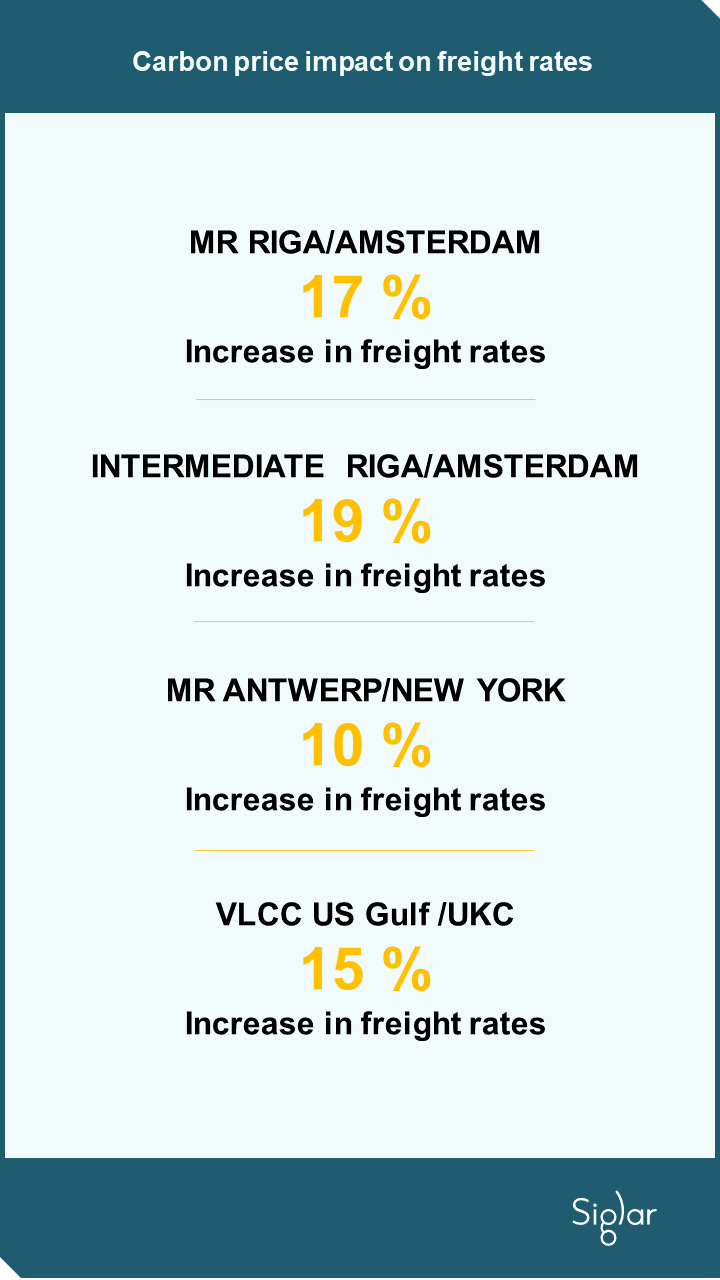
MR vessel from Riga / Amsterdam
Emissions: 700 tonnes of CO2
Added carbon cost: USD 73 500 **
Percentage of freight rate: 17 %
Added carbon cost per tonne cargo: USD 2.0
Intermediate vessel Riga / Amsterdam
Emissions: 450 tonnes of CO2**
Added carbon cost: USD 47 500
Percentage of freight rate: 19 %
Added carbon cost per tonne cargo: USD 3.8
MR vessel Antwerp / New York
Emissions: 1 700 tonnes of CO2
Added carbon cost: USD 89 500*
Percentage of freight rate: 10 %
Added carbon cost per tonne cargo: USD 2.4
VLCC vessel from US Gulf / UKC
Emissions: 4 700 tonnes of CO2
Added carbon cost: USD 247 000***
Percentage of freight rate: 15 %
Added carbon cost per tonne cargo: USD 1.0
According to the current revision of the European Emissions Trading System (EU ETS), only 50 % of emissions from global EU voyages would be included in the scheme, whereas 100 % of emissions from internal EU voyages and 100% of port stays in the EU would be included. This is reflected in the above numbers.
New EU suggestion: ETS could cover 100 % of emissions from global EU voyages
In a new draft, an EU Parliament committee suggests that 100% of emissions from global EU voyages could be included in the scheme. In that case the carbon cost in our extra-EU voyage examples would increase substantially.
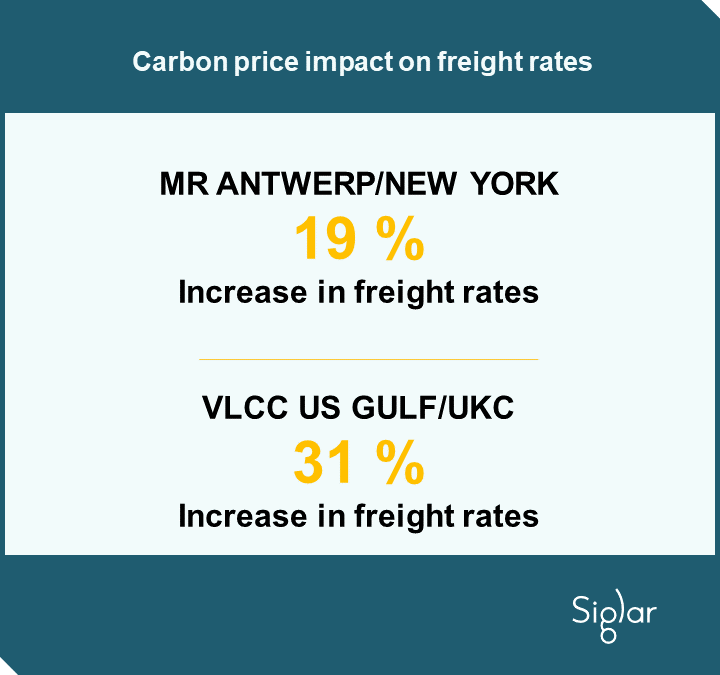
MR vessel from Antwerp / New York
Added carbon cost: USD 179 000
Percentage of freight rate: 19 %
Added carbon cost per tonne cargo: USD 4.8
VLCC US Gulf / UKC
Added carbon cost: USD 494 000
Percentage of freight rate: 31 %
Added carbon cost per tonne cargo: 1.9 USD
The final design of the expansion of the ETS to the maritime sector is not yet decided upon. The phase-in of the sector will however start in 2023 leaving companies with little time to prepare.
Commercial decarbonisation of the maritime industry
Carbon reporting is a good place to start if you want to prepare for the coming EU ETS exposure and to understand the carbon exposure of your chartering decisions. There are great emissions reduction opportunities in commercial decarbonisation of the maritime industry. Therefore, we have developed a Siglar carbon standard reporting system, gathering the data you need to understand and mitigate your carbon cost exposure, and to map the opportunities that lie within your commercial decisions.
* Emissions from a modern MR vessel transporting 37 000 tonnes of gasoline from Antwerp to New York, ballasting from New York. Number includes 50% of emissions from laden leg and ballast from New York and 100% of emissions from port stay in Antwerp.
** Emissions from a VLCC transporting 260 000 tonnes of crude oil from US Gulf to UKC, ballasting from Rotterdam. The number includes 50 % of emissions from laden leg and ballast from UKC and 100% of emissions from port stay in Rotterdam.
*** Emissions from a modern MR vessel transporting 37 000 tonnes of gasoline from Riga to Amsterdam, ballasting from Le Havre. The number includes 100 % of emissions from laden leg and ballast from Le Havre and 100% of emissions from port stay in Riga and Amsterdam.
*** Intermediate vessel transporting 12 500 tonnes of gasoline from Riga to Amsterdam, ballasting from Le Havre. The number includes 100% of emissions from laden leg and ballast from Le Havre and 100% of emissions from port stay in Riga and Amsterdam.
Source: Siglar Carbon



Related News.

Cyprus Maritime Innovation takes Centre Stage at SMM Hamburg 2026
Underscoring its expanding role as a premier international hub for cutting-edge maritime technology and sustainable shipping, the Republic of Cyprus…

Trump seeks to refill US oil reserve with Venezuela deal but faces long delay
U.S. President Donald Trump said on the 30th (local time) that he would refill the U.S. Strategic Petroleum Reserve, which has been depleted with…
US Navy Official visits South Korean Shipyards in private
With U.S. President Donald Trump pushing a plan to allow overseas construction of U.S. warships, attention is focusing on whether the building of…
SES and De Boer Marine expand collaboration with FlexMaritime deployment across Global Markets
SES, a leading space solutions company, and De Boer Marine, a leading provider of top-quality marine equipment and maritime connectivity services,…

New ESG guidance to help maritime industry turn sustainability into commercial advantage
New framework helps shipowners and ports align ESG strategy with access to capital, charterer expectations and long-term asset value. Maritime…

Britannia P&I Club analysis finds four in five crew deaths linked to illness rather than accidents
New report highlights cardiovascular disease as leading cause of fatalities and raises concerns over mental health risks among younger seafarers.…

The Swedish Club launches new Loss Prevention podcast, Knot Another Lesson
The Swedish Club has launched Knot Another Lesson, a new podcast exploring the practical lessons, emerging risks and operational challenges shaping…

Lloyd’s Register appoints Jens Grunenberg as Senior Representative for Germany
Lloyd’s Register has appointed Jens Grunenberg as its Senior Representative for Germany, effective 1 September. Based in Hamburg, Grunenberg will…
Indian Register of Shipping sets sights on Hamburg for European Expansion
Indian Register of Shipping, a leading international classification society and full member of the International Association of Classification…
MOL completes Merger of 6 Ship Management Companies
Unifying Management of Over 200 Vessels and Strengthening Safety Mitsui O.S.K. Lines, announced that it has completed the integration of the MOL…
Subscribe to our newsletter!
if you dont want to swim alone in the ocean of news, sign up for the newsletter, and you will receive daily all the important news of world shipping!
