Nigeria: Guidance on contracting government security forces
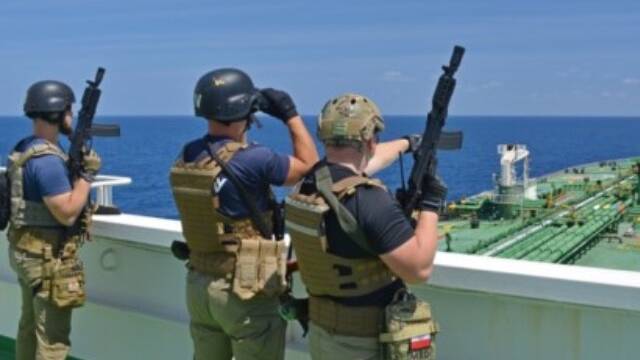

On 18 February 2021, Risk Intelligence published a set of guidelines concerning the use of privately contracted government security forces in Nigeria. The publication was released following the recent developments on the disbanding of the Secure Anchorage Area (SAA) and to provide clarity in the use of armed security (armed escort vessels) in Nigerian waters.
The use of armed guards on merchant ships has been expressly prohibited by the Nigerian Navy’s Chief of Naval Staff since 6 June 2016. This has resulted in the Nigerian Navy entering contractual relationships with private security companies which have been governed by a Memorandum of Understanding (MoU) since 2012 which was comprehensively revised in 2016 and again in 2019. The number of private maritime security companies – now designated as Private Maritime Logistics Support Companies (PMLSCs) – increased to 30 MoU holders (see Annex A of the publication for a complete list).
The publication (see attachment) highlights the following:
- The Nigerian Navy and NIMASA are the only organisations in Nigeria that are empowered to maintain safety and security in territorial waters and the Exclusive Economic Zone (EEZ).
- The Nigerian Marine Police’s jurisdiction is limited to protecting ports and waterways (inland of the fairway buoys).
- The NIMASA Act empowers the agency to contract private companies or make other arrangements with them to provide specific services related to the safety and security in Nigeria’s maritime domain, i.e. territorial waters and the EEZ.
- Unless related to the Nigerian Navy’s own arrangements with private security companies under the MoU, NIMASA considers it an offence for a vessel sailing in Nigeria’s territorial waters to have any person (Nigerian citizen or foreigner) described as a security guard and/or performing functions of a security expert or bridge advisor (armed or unarmed) on board.
- The offending vessel could be subjected to an investigation and may be detained by Nigerian authorities.
- Penalties for non-compliance include forfeiture of any article or property seized by NIMASA and, upon conviction, the offender will be liable to pay a fine of one million Naira (around US$ 2,600) or may be imprisoned for no more than twelve months, or both.
Risk Intelligence goes on to advise that when contracting PMLSCs under the MoU for the provision of maritime security services, emphasis should be placed on:
- PMLSC compliance with the MoU issued in 2019.
- PMLSC compliance with other regulations (as stipulated in the MoU), especially corporate, labour, immigration (for foreign personnel) and cabotage (for contracted escort vessel) laws.
- Suitable and suitably armed escort vessels, capable of deterring Nigerian offshore attackers (notably including mounted weapons on security vessels).
- Nigerian Navy certificates for the security vessel(s).
- If a non-MoU holder is part of the operation: written approval by the Nigerian Navy.
- Fit-for-purpose standard operating procedures (by PMLSCs) to deal with the complex issue of shared tactical and operational command and control with the Nigerian Navy as well as with resolving potential conflicts between the PMLSC’s Rules for the Use of Force (RUF) and the Nigerian Navy’s Rules of Engagement (which always supersede the RUF).
- Contingency planning for escort vessel breakdown or re-assignment of personnel by the Nigerian Navy.
- Appropriate insurance cover.
Risk Intelligence also shared that on 26 February 2021, a meeting was held at the naval base in Lagos to discuss the situation related to the Secure Anchorage Area (SAA), which is no longer supported by the Nigerian Navy.
When the SAA was disbanded there were security vessels contracted to protect individual vessels or clusters of vessels. The Nigerian Navy does not approve of this as it is essentially (re)creating an unofficial SAA. Security or escort vessels are therefore required to disengage upon arrival at the anchorage or the Nigerian Navy should be informed of their engagement at least 5 hours prior to arrival to obtain approval for any extended stay at/around the anchorage (up to a maximum of 24 hours).
The Nigerian Navy also stated that they will continue the embarkation of armed guards on vessels at the Lagos anchorage, but this is regularly re-evaluated. Hence, shipowners contracting naval personnel as armed guards must rely only on verbal confirmation from the Nigerian Navy that the request has been approved – no written confirmation will be provided. This essentially means that such arrangements could be terminated at any point without warning.
Naval personnel that are provided as armed guards will be tested for COVID-19 by the Nigerian Navy. The personnel will only be released after having tested negative. However, it is unlikely that information about tests or other health-related records will be released by the Nigerian Navy, meaning that shipowners and operators may have to rely on verbal confirmation in this context as well.



Related News.
Cyprus Maritime Innovation takes Centre Stage at SMM Hamburg 2026
Underscoring its expanding role as a premier international hub for cutting-edge maritime technology and sustainable shipping, the Republic of Cyprus…

Trump seeks to refill US oil reserve with Venezuela deal but faces long delay
U.S. President Donald Trump said on the 30th (local time) that he would refill the U.S. Strategic Petroleum Reserve, which has been depleted with…
US Navy Official visits South Korean Shipyards in private
With U.S. President Donald Trump pushing a plan to allow overseas construction of U.S. warships, attention is focusing on whether the building of…

SES and De Boer Marine expand collaboration with FlexMaritime deployment across Global Markets
SES, a leading space solutions company, and De Boer Marine, a leading provider of top-quality marine equipment and maritime connectivity services,…

New ESG guidance to help maritime industry turn sustainability into commercial advantage
New framework helps shipowners and ports align ESG strategy with access to capital, charterer expectations and long-term asset value. Maritime…

Britannia P&I Club analysis finds four in five crew deaths linked to illness rather than accidents
New report highlights cardiovascular disease as leading cause of fatalities and raises concerns over mental health risks among younger seafarers.…

The Swedish Club launches new Loss Prevention podcast, Knot Another Lesson
The Swedish Club has launched Knot Another Lesson, a new podcast exploring the practical lessons, emerging risks and operational challenges shaping…

Lloyd’s Register appoints Jens Grunenberg as Senior Representative for Germany
Lloyd’s Register has appointed Jens Grunenberg as its Senior Representative for Germany, effective 1 September. Based in Hamburg, Grunenberg will…
Indian Register of Shipping sets sights on Hamburg for European Expansion
Indian Register of Shipping, a leading international classification society and full member of the International Association of Classification…
MOL completes Merger of 6 Ship Management Companies
Unifying Management of Over 200 Vessels and Strengthening Safety Mitsui O.S.K. Lines, announced that it has completed the integration of the MOL…
Subscribe to our newsletter!
if you dont want to swim alone in the ocean of news, sign up for the newsletter, and you will receive daily all the important news of world shipping!
